
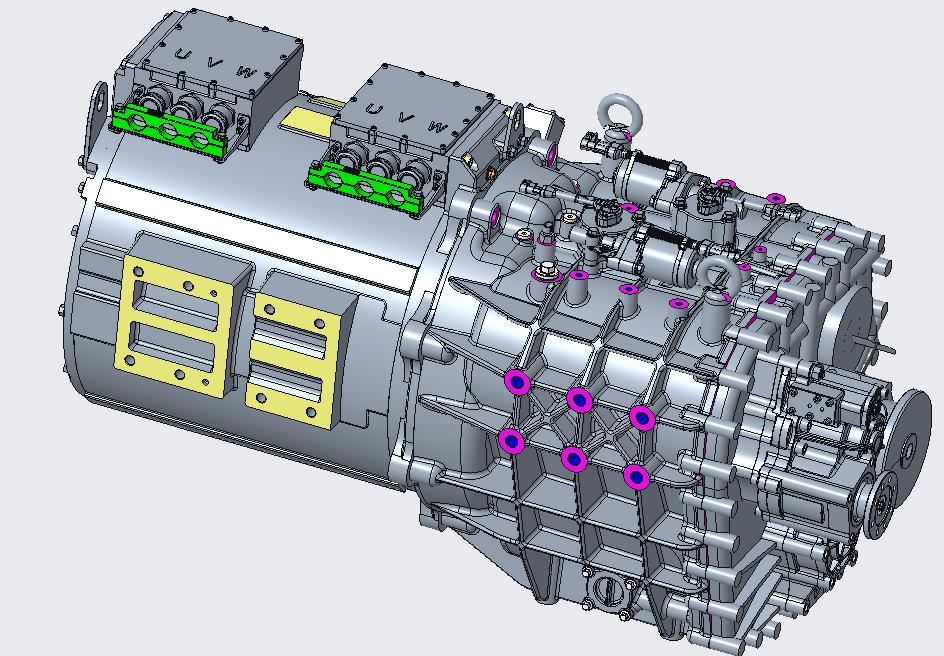
1000 HP Electric Motor for Car: Decoding the Power Behind Extreme Performance
The term “1000 horsepower for a car” has evolved from a dream to a startling reality, primarily due to advancements in electric drivetrain technology. While this staggering power figure captures headlines, the true story lies in the specific motor parameters that make it possible, reliable, and controllable. The leap from a high-performance luxury sedan to a 90-ton mining truck illustrates the scalable, revolutionary nature of electric propulsion. Let’s decode what 1000 HP (approximately 746 kW) truly means in the context of modern electric motor engineering and how it translates from industrial giants to hyper-performance road cars.
Core Motor Parameters: The Blueprint of Power
A 1000 HP-capable system is defined by its core specifications. Using a state-of-the-art Permanent Magnet Synchronous Motor (PMSM) as our benchmark—similar to those used in top-tier EVs and heavy-duty applications—we can break down the key figures:
Motor Type: Permanent Magnet Synchronous Motor (PMSM). This is the gold standard for high-power density and efficiency in performance EVs. It uses powerful rare-earth magnets in the rotor to create a constant magnetic field, resulting in immediate torque response, excellent controllability, and superior power-to-weight ratio compared to other motor types.
Rated/Peak Power (e.g., 500 kW / 800 kW): This is the heart of the 1000 HP discussion. Peak power (~800 kW = ~1073 HP) is the maximum short-burst output the motor can achieve, crucial for launches and overtaking. Rated power (~500 kW = ~670 HP) is the power it can sustain continuously without overheating. This dual-rating system is key to delivering explosive performance while ensuring long-term durability and managing thermal loads.
Rated/Peak Torque (e.g., 2400 Nm / 4800 Nm): This is the “muscle” of the motor. Torque is the immediate rotational force, and electric motors excel here by delivering peak torque from 0 RPM. A figure like 4800 Nm of peak torque (after gear reduction) is what launches a multi-ton vehicle with violence. This instant-on force is what makes even large EVs feel shockingly agile.
Max Speed (e.g., 3500 rpm): Unlike internal combustion engines, electric motors have a wide, flat power band. They can spin to high RPMs (like 3500-20,000+ rpm in some car motors) without needing a complex multi-gear transmission. This allows for both incredible low-end acceleration and sustained high-speed power.
The System Integration: Beyond the Motor Alone
A 1000 HP motor doesn’t operate in a vacuum. It’s part of a meticulously engineered system:
Transmission & Gearing: While many passenger EVs use a single-speed reducer, extreme-performance or heavy-duty applications may employ a multi-speed gearbox (e.g., a 4-speed unit) to optimize torque at low speeds and efficiency/power at high speeds. This ensures the immense motor torque is translated effectively to the wheels across all driving conditions.
Thermal Management: Managing the heat generated by 1000 HP of continuous or peak output is the greatest engineering challenge. This requires a sophisticated liquid cooling system—often direct oil cooling on the stator and rotor—to maintain performance during repeated launches and prevent power fade.
High-Voltage Platform & SiC Inverter: To handle the immense electrical current required, 1000 HP systems are built on 800-volt (or higher) architectures. This is paired with a Silicon Carbide (SiC) power inverter, which switches power with minimal loss, boosting efficiency, reducing heat, and enabling faster charging.
From Mining Trucks to Hypercars: The Versatility of Scale
The listed parameters (800 kW peak power, 4800 Nm torque) are not just theoretical; they are directly applicable to the most demanding sectors. A motor system powering a 90-120 ton mining truck must be rugged, reliable, and immensely powerful to move massive loads up steep grades. The same core PMSM technology, scaled and packaged differently, is what powers the world’s fastest production cars.
In a hypercar like the Tesla Model S Plaid, Lucid Air Sapphire, or Rimac Nevera, multiple motors of this caliber are combined. A tri-motor setup can easily sum to over 1000 HP, delivering sub-2-second 0-60 mph acceleration. The principles remain identical: extreme power density, instantaneous torque, and revolutionary thermal management.
Conclusion: Redefining the Performance Threshold
The 1000 HP electric motor for a car is more than a milestone; it’s a testament to a fundamental shift. The parameters—PMSM design, staggering kW and Nm figures, and high-RPM capability—reveal a machine that is simpler, more responsive, and more potent than the most complex internal combustion engines it replaces. This technology, proven in the brutal environment of a mining site, is now delivering unprecedented, accessible, and repeatable supercar performance on the road. As battery and power electronics technology continue to advance, this 1000 HP benchmark will evolve from the pinnacle to the new normal for high-performance electric vehicles.
Please contact CMVTE if any inquiries!
