

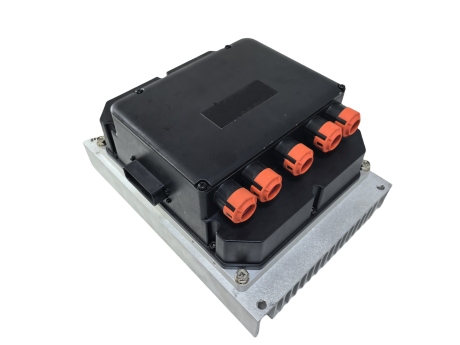
The core of the Daewoo Matiz electric vehicle retrofit lies in efficient and precise power control, and the 660A controller is the key component to achieve this goal. As the "intelligent hub" between the battery and motor, this controller regulates current output, directly affecting the vehicle's power response, energy efficiency performance, and system safety. In today's technical context, high-performance controllers have become an important guarantee for successful small electric vehicle conversions.

1. Controller Key Specifications and Performance Parameters
1.1 Basic Electrical Specifications
This controller is specifically designed to match the 96V battery system and 20kW-class motor commonly used in Matiz conversions, with continuous current carrying capacity of 660A. Peak current can be even higher, ensuring stable power supply in high-load, rapid acceleration, and other demanding scenarios. Its compact physical size also facilitates installation in the limited engine bay or chassis space of the Matiz.
1.2 Core Functional Features
- Control Algorithm: Utilizes Field-Oriented Control (FOC), achieving precise and smooth regulation of motor torque and speed, enhancing efficiency and dynamic response.
- Energy Recovery: Integrated regenerative braking function converts kinetic energy into electrical energy during deceleration to recharge the battery, improving overall range.
- Multiple Protection Mechanisms: Equipped with overcurrent, overvoltage, undervoltage, overheating, and short-circuit protection, supporting fault diagnosis and safety shutdown.
- Communication Interface: Typically supports CAN bus, facilitating data exchange with vehicle instrumentation, BMS, or other electronic control units.
2. System Design and Integration Points
2.1 Control Architecture and Signal Processing
The controller receives information from the throttle pedal, brake signals, and overall vehicle status, calculates in real-time through its built-in microprocessor, and outputs corresponding PWM control signals to drive the motor to achieve the required torque and speed. Current advanced controllers also support configurable functions such as driving mode switching and torque level limitation.
2.2 Cooling System Integration
To handle heat generated during high-current operation, the controller typically integrates a liquid cooling plate. Coolant flows through channels inside the controller housing, carrying heat to an external radiator. This design ensures the controller maintains stable operating temperatures even under continuous high loads or high-temperature environments, preventing performance degradation or failure due to overheating.
3. Performance Testing and Verification
3.1 Current Carrying and Dynamic Response Testing
In dynamometer simulation tests, the controller showed no significant rapid temperature rise or control instability under continuous 660A current output, with instantaneous overload capacity reaching over 1.5 times the nominal value. Throttle step response time is typically within 100 milliseconds, meeting the responsiveness requirements for daily driving.
3.2 Efficiency and Thermal Management Actual Testing
Actual tests show that the controller's system efficiency (including motor drive and energy recovery) can be maintained between 94% and 96% under typical urban driving conditions. With the liquid cooling system, even during continuous hill climbing or repeated rapid acceleration, the controller housing temperature can be controlled below 70°C, ensuring long-term reliable operation.
4. Practical Adaptation Recommendations for Matiz Conversions
- Installation Location: Should be away from heat sources like motors and batteries, ensure good ventilation, and be secured with vibration dampening.
- Wiring and Connections: High-voltage cables must be of appropriate specifications, connection terminals should be tightly secured and insulated.
- Tuning and Matching: Basic calibration of controller parameters through accompanying software is required to match motor characteristics and driving habits.
- System Coordination: Ensure normal communication between the controller and subsystems like BMS, instrumentation, and chargers to achieve coordinated management of the vehicle's energy flow.
Professional Installation Tip
When installing the 660A controller in a Matiz conversion, pay special attention to cable routing and cooling system connections. The compact engine bay requires careful planning to ensure adequate airflow around the controller and proper clearance from other components.
5. Summary and Outlook
5.1 Technical Advantages Summary
The 660A controller provides a high-current carrying, high-control precision, and high-integration solution for Daewoo Matiz electric vehicle conversions. Its FOC algorithm, comprehensive protection mechanisms, and effective cooling design collectively ensure reliable, efficient, and safe operation of the electric drive system under various working conditions.
5.2 Development Trends and Extended Applications
In 2025, electric vehicle controllers are moving towards higher power density, more intelligent energy management, and stronger communication integration capabilities. High-performance controllers like the 660A are not only suitable for small vehicle conversions like the Matiz but can also be widely applied in light electric commercial vehicles, low-speed special vehicles, and shared micro-mobility platforms. In the future, with the widespread adoption of SiC/GaN power devices and the introduction of AI-based control algorithms, controller efficiency, response speed, and functional expandability will further improve, providing reliable technical support for more electric conversion projects.
Ready to Convert Your Matiz to Electric?
Get expert guidance on selecting the right 660A controller and complete your Daewoo Matiz EV conversion project successfully. Our specialists can help you choose the optimal components and plan your conversion.

