

When we sit in a modern car, we may seldom realize that tens of thousands of data signals are flowing in the "blood vessels" of this sophisticated machine.
From ABS anti-lock braking system to airbag control, from powertrain management to body electronic control, all these systems are having a silent and critical conversation through the CAN bus.
But have you ever wondered why engineers carefully install two seemingly ordinary 120 Ω resistors on both ends of the bus?
This is not only to comply with the requirements of international standards, but also to ensure the lifeline of reliable communication of the entire automotive neural network. Signal integrity has become more important than ever as cars become more electronic and the number of controllers has increased from dozens to hundreds.
Although the termination resistor looks simple, it plays an irreplaceable role in preventing signal reflection and ensuring waveform integrity.
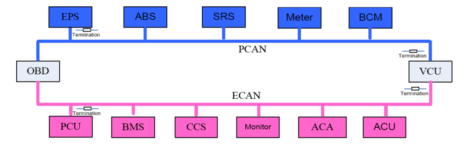
The main communication between controllers adopts CAN communication, for example, as shown in the figure below: vehicle control is divided into body PCAN and power ECAN, and the two ends of CAN bus are connected with resistors respectively;
1. Standard ISO11898
According to the provisions of international standard ISO11898-2 on termination resistors, a 120Ω termination resistor is connected at the beginning and end of the bus.
- International standard ISO11898-2 specifies the use of termination resistors
- 120Ω resistors are required at both ends of the CAN bus
- This standard ensures consistent implementation across automotive manufacturers
- Compliance with ISO11898 is essential for reliable CAN bus communication
2. Effect of Terminal Resistance
The CAN bus is a twisted pair for differential transmission. The signal is conducted on the bus in the form of electricity. The transmission line of the bus is a characteristic impedance. If the end (terminal) impedance of the transmission line does not match the characteristic impedance of the transmission line, the signal energy cannot be completely absorbed, and part of the energy will be reflected back. This reflected signal will be superimposed with the new signal sent later, resulting in serious distortion of the waveform.
Resistance Value
120Ω (characteristic impedance of CAN twisted pair, usually 120Ω, with the highest matching degree)
Power Rating
Usually 1/4 W or 1/2 W (selected according to the bus current)
Resistor Type
High-precision metal film resistor is preferred (± 1%)
Key Functions of Terminal Resistors:
- Prevent signal reflection at the ends of the bus
- Ensure signal integrity and waveform quality
- Match the characteristic impedance of the transmission line
- Absorb signal energy completely to prevent reflections
- Maintain reliable communication across the entire network
3. CAN Bus Two-Terminal Resistance
If each node is connected with a 120Ω termination resistor, the total resistance of multiple nodes in parallel will become smaller (for example, the total resistance of five nodes in parallel is 24Ω), which will increase the load of the CAN transceiver, resulting in insufficient driving capacity, reduced signal amplitude, and also unable to communicate normally.
Therefore, it is strictly forbidden to install termination resistors at each node, and they must be installed only at both ends of the physical location.
Important: Termination resistors must only be installed at the two physical ends of the bus network. Installing resistors at every node will cause excessive load on the CAN transceiver and communication failures.
4. Precautions
Influence of Resistance Deviation
If the resistance of the termination resistor does not match the characteristic impedance of the bus, the above protection effect will be reduced. Resistance deviations may result in increased signal reflection or a change in the discharge rate.
Location is Critical
The termination resistors must be installed at both physical ends of the bus network (typically the two nodes furthest apart). Not every node needs to be installed, or multiple resistors in parallel will significantly reduce the overall impedance and load the transceiver, which may result in insufficient drive capability, reduced signal amplitude, and inability to communicate properly.
Fault Diagnosis
Measuring the CAN bus resistance is a method to determine whether the terminal resistance is normal. Measure the resistance between CAN_H and CAN_L when the vehicle is powered off. The normal value should be about 60Ω (two 120Ω resistors are connected in parallel).
Diagnostic Guide:
- Normal resistance: ~60Ω (two 120Ω resistors in parallel)
- If resistance is 120Ω: may indicate only one termination resistor
- If resistance is infinite: may indicate open circuit or missing resistors
- If resistance is too small or zero: may indicate short circuit
The core function of the CAN bus termination resistor is to prevent the signal from reflecting at both ends of the bus, so as to ensure the reliability and stability of communication.
Terminating resistors may be one of the most obscure components in the grand picture of automotive electronics, but their importance is not to be underestimated.
With the development of intelligent and networked automobiles, the requirements for communication quality and reliability will only be higher and higher. Understanding and focusing on the role of termination resistors will not only help us design more stable systems, but also help us quickly locate problems when we encounter communication failures.The transmission line theory and signal integrity knowledge behind this small component are worth in-depth study and mastery by every automotive electronics engineer.

