

When you enjoy the pleasure of speeding up the electric vehicle or admire the convenience of fast charging, have you ever thought about the huge current flowing silently inside the device and the “hot” challenges caused by them?
Especially in power battery packs and large energy storage systems of electric vehicle, the heat generated by tens or even hundreds of amperes of current passing through conductive components is like an invisible “flame”, which can affect performance and endanger safety if not handled properly.
The temperature rise and current-carrying capacity management of the “main road” bearing this current, usually composed of copper or aluminum bars, has become the core battlefield of thermal safety design.
Copper bars, these seemingly simple metal strips, are actually the bridge of energy transmission, but also the “heat dissipation armor” and “safety bottom line” of the internal thermal management of battery packs.
How to accurately control the temperature rise of copper bar itself and how to scientifically evaluate its current-carrying capacity to ensure that it can conduct electricity efficiently without “fever” under various working conditions has become a key issue for engineers to continuously optimize.
The core purpose of accurately calculating the temperature rise and current carrying capacity of copper bars is to achieve the best balance between safety, cost and performance, and its importance is reflected in the following three aspects:
- Directly related to the safety and life of the system:excessive temperature rise is the most direct security threat to the high-voltage system. First of all, the heat will directly affect the adjacent cells through heat conduction. Some studies have pointed out that in order to protect the battery core, the temperature rise of the copper bar usually needs to be controlled within 40 K (for example, when the ambient temperature is 25 ℃, the surface temperature of the copper bar is ≤ 65 ℃), so as to prevent the temperature of the battery core from breaking through the safety upper limit. Secondly, high temperature will accelerate the oxidation of copper bar itself and connection points, resulting in a vicious cycle of contact resistance increase, resulting in local hot spots, which may lead to overheating and ablation of key devices such as relays and fuses. Long-term high temperature will also lead to annealing of copper bars, decrease of mechanical properties, and affect the acquisition accuracy of temperature and current sensors, which will lead to inaccurate monitoring of state of charge (SOC) and state of health (SOH) of battery management system (BMS).
- Impact on system performance and efficiency:The current carrying capacity of the copper bar is not a fixed value, but is dynamically affected by temperature. The resistivity of copper increases with the increase of temperature (the resistivity increases by about 3.93% when the temperature increases by 10 ℃), which will lead to more serious heating at the same current, reduce the effective current-carrying capacity and form a performance bottleneck. At the same time, the increase of resistance means higher conduction loss (I ² R), which directly reduces the energy output efficiency of the battery pack.
- To guide the optimization of design and avoid cost waste: the traditional “copper five aluminum three” or look-up table estimation method is often no longer accurate in the complex closed environment of the battery pack. An overly conservative design (too large a cross-sectional area) can lead to unnecessary increases in material costs, weight, and space, while an inadequate design (too small a cross-sectional area) can lead to overheating. Therefore, a set of accurate calculation and verification methods is the key to achieve lean design, reduce costs and ensure safety.
Understanding the temperature rise mechanism and current-carrying capacity calculation principle of copper bar is not only to meet the functional requirements of electrical connection, but also to build a strong thermal safety defense line for battery system. This is not only related to the life of the equipment, but also directly determines the safety of life and property of users.
We will discuss in depth the generation and control of the temperature rise of the copper bar, as well as the method of determining its current-carrying capacity, to see how the small copper bar guards the “cold and hot balance” of the huge system.

Generation mechanism of temperature rise
- Joule heating effect dominates heating
When the current passes through the copper bar and the aluminum bar, according to Joule’s law Q = I ² Rt (Q is heat, I is current, R is resistance, and t is time), the conductor generates heat due to its own resistance.
Although copper and aluminum have excellent conductivity and small resistance value, the heat accumulation is significant in the large current charging and discharging scenario of battery pack (such as the instantaneous current of electric vehicle can reach hundreds of amperes). If the heat dissipation is not timely, the temperature of the conductor will rise, which will affect the surrounding battery core through heat conduction.
There are three temperature relationships in the battery pack: the ambient temperature outside the pack, the ambient temperature inside the pack, and the surface temperature of the heating element (copper bar, aluminum bar, battery core, etc.). Wherein, the temperature in the ladle = the ambient temperature outside the ladle + the temperature rise in the ladle caused by the heating element; the surface temperature of the heating element = the temperature in the ladle + the temperature rise of the heating element itself. When heat generation and heat dissipation are balanced, the temperature and temperature rise tend to be stable.
- Additional temperature rise due to contact resistance
There is contact resistance between copper bar, aluminum bar and battery pole, terminal and other parts. If the connection is loose, the surface is oxidized or contaminated with impurities, the contact resistance will increase sharply.
According to the power formula P = I ² R, the increase of contact resistance will lead to the surge of local heat generation and the formation of hot spots. The temperature of these hot spots is usually much higher than that of the conductor body, and it is very easy to transfer to the nearby battery core through heat radiation and heat conduction, so that its temperature approaches or even exceeds the safety limit of 60 C, which directly threatens the life and safety of the battery core.
Temperature rise limit requirements of copper bar
Copper bar: The temperature rise is controlled at 40 K. Taking the ambient temperature of 25 ℃ as an example, the surface temperature of the copper bar is ≤ 65 ℃ (temperature rise < 40 K). This is because there will be a certain attenuation in the process of heat transfer from the copper bar to the battery core. If the temperature of the copper bar exceeds 70 ℃, even after air attenuation, the temperature of the battery core may still exceed 60 ℃.
At the same time, the temperature rise within 40 K can avoid the annealing of the copper bar due to overheating, and ensure the stability of its mechanical and conductive properties. (Of course, the specific items are subject to the requirements of the battery core and thermal management, and a certain redundant temperature is reserved).
How to determine the current carrying capacity of the copper bar?
The authoritative standard for the current-carrying capacity of copper bars is DIN43671-1975, which defines the current-carrying capacity of rectangular copper bars when the ambient temperature is 35 ℃ and the operating temperature of copper bars is 65 ℃, as shown in the following table.
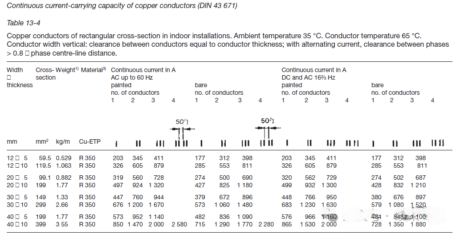
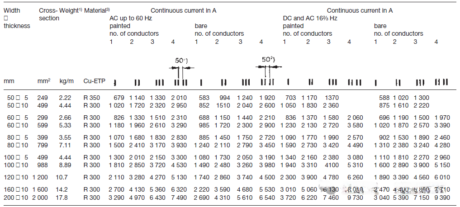
For example, when placed vertically, the current carrying capacity of a single painted copper bar 100 * 10 is 1810 A, while the current carrying capacity of a single bare copper bar 100 * 10 is 1490 A.
The current carrying capacity of the painted copper bar is different from that of the bare copper bar, mainly because the emissivity of the two is different during heat radiation and heat dissipation, and the emissivity is related to the surface condition and color of the heating element.
The emissivity of the painted copper bar is 0.9, while the emissivity of the bare copper bar is 0.4. DIN43671-1975 also gives the current-carrying capacity conversion method under different ambient temperatures and different copper bar operating temperatures.
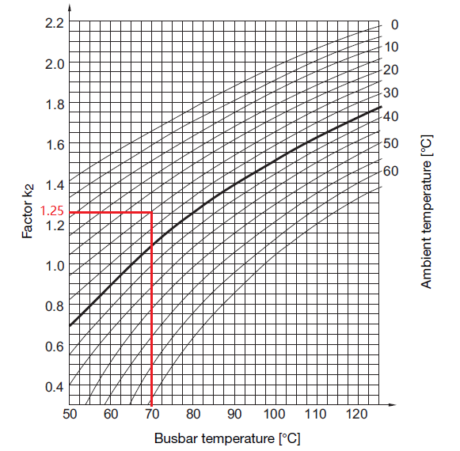
In the table, the horizontal axis is the allowable temperature of the copper bar, the curve cluster is the ambient temperature, and the vertical axis is the conversion coefficient K2. If the ambient temperature is 35 ℃ and the allowable temperature of the copper bar is 65 ℃, the coefficient K2= 1.
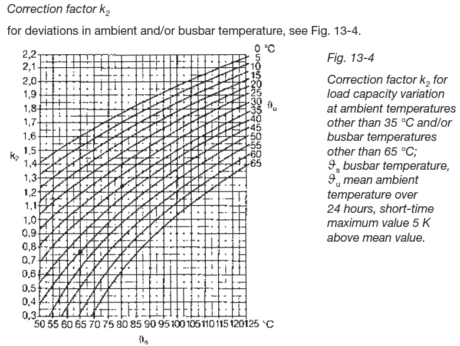
In DIN43671, when the ambient temperature is 35 ℃, the allowable temperature of copper bar is 65 ℃, and the copper bar is placed vertically, the current-carrying capacity of a single painted copper bar 100 * 10 is 1810 A.
If the ampacity is to be converted into the ampacity when the ambient temperature is 25 ℃ and the allowable temperature of the copper bar is 70 ℃, it is necessary to look up the table to obtain K2= 1.25.
Through calculation, the current carrying capacity of the copper bar is 1810 * 1.25 = 2262 A, which is almost the same as the current carrying capacity of 2265 A given by Pi-4.
Similarly, if it is converted into the current-carrying capacity when the ambient temperature in the low-voltage cabinet is 55 ℃ and the allowable temperature of the copper bar is 105 ℃ in GB/T7251.1, it is necessary to look up the table to obtain K2= 1.3.
Through calculation, the current carrying capacity of copper bar is 1810 * 1.3 = 2353A.
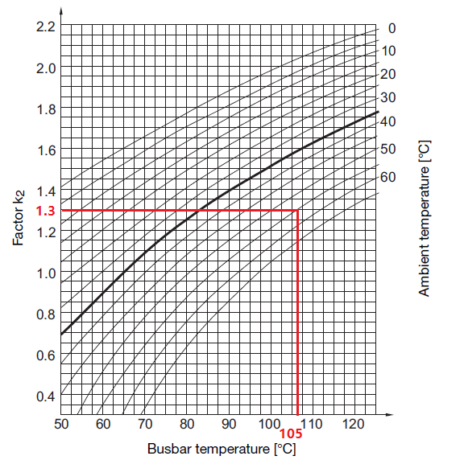
The copper bar in the low voltage cabinet is generally bare copper bar, so if the temperature in the cabinet is 55 ℃ and the operating temperature of the copper bar is 105 ℃, the current carrying capacity of the 100 * 10 copper bar is 1490 * 1.3 = 1937A in the case of vertical placement.
Security Instances and Validation Proc
From design to mass production, safety needs to be guaranteed through layers of verification.
- Front design example:In a published battery pack BDU (battery pack break unit) temperature rise determination method, through the above CFD simulation process, a system containing a plurality of copper bars, relays, and fuses is simulated under a composite working condition for 210 minutes. The results show that the maximum temperature of the fuse is 84. 1 ℃ under the condition of 55 ℃ ambient temperature and water cooling, which is lower than preset target value, so the design does not need to be optimized. This demonstrates the effectiveness of the simulation to avoid risk in the early stage.
- Negative safety warning:Improper management of contact resistance is a common cause of failure. It has been pointed out that the looseness, oxidation or pollution of the connection part will lead to a sharp increase in contact resistance, resulting in local hot spots, whose temperature is much higher than that of the conductor body, which is very easy to cause accidents. For example, a high-voltage DC contactor of an electric vehicle has been ablated due to overheating. Therefore, the temperature of key positions such as contacts and connection points must be detected during physical verification.
- Complete “simulation-test” closed-loop verification process:
- Simulation-driven design:First, use simulation to carry out multiple rounds of iterative design.
- Sample test and correction:make engineering samples (sample A and sample B), reproduce the simulation conditions on the test bench, and measure the temperature rise of each key point with thermocouples. The measured data are compared with the simulation results to correct the parameters of the simulation model and improve the confidence of the model.
- System level and vehicle level verification:complete the battery pack level test after BDU packaging, and the vehicle durability test after final boarding, and continue to optimize according to the actual temperature rise. This constitutes a complete reliability assurance system from components to systems, from virtual to physical.
In engineering practice, the data given by the standard provides a solid foundation, and the engineer’s understanding, application and necessary margin design are the key. As we can see from the temperature conversion, a 5 degree increase in ambient temperature or a few degrees increase in allowable temperature can cause a significant fluctuation in ampacity.
Therefore, in the actual selection and application, only by strictly following the standards, deeply understanding the physical mechanism behind them, comprehensively evaluating the specific environmental conditions and thermal management capabilities, and reserving reasonable safety redundancy (perhaps the key space of 0.1 mm or several degrees Celsius), can system operate efficiently and safely.
Behind every reliable copper bar, there are countless verifications, fine calculations and zero tolerance for “temperature out of control”. This is not only responsible for the equipment, but also a heavy commitment to the users who trust these equipment.

