

Choosing the right 96V motor system for a 20/40 kW electric tractor is the most important decision in your build — and the most expensive one. Specialist EV motor brands routinely price a comparable system at $8,000-$15,000, and that is before you add the controller, battery, and integration work. CMVTE manufactures the motor and controller in-house at our Foshan factory and ships matched systems for $3,200-$5,800. Here is exactly how to spec one for agricultural duty.

AC Induction vs PMSM: The Tractor Trade-Off
| Characteristic | AC Induction | PMSM |
|---|---|---|
| Low-speed torque | Good | Excellent |
| Efficiency at partial load | Moderate | Higher |
| Heat / overload tolerance | Excellent | Sensitive to overheating |
| Price per kW | Lower | Higher |
| Best for tractors | Plowing, tilling, heavy loads | Maximizing battery range |
For a 96V 20/40 kW tractor, a PMSM maximizes the run time you get from every kWh, while an AC induction motor shrugs off the abuse of hard field work. CMVTE supplies both, plus a matched controller programmed for whichever you choose.
CMVTE Tractor Motor System Pricing
| System | Continuous / Peak | CMVTE Price | Typical Brand Price |
|---|---|---|---|
| 96V drive system (motor + controller) | 20 kW / 40 kW | $3,200 – $4,200 | $8,000 – $12,000 |
| 96V heavy-duty system (liquid cooled) | 40 kW / 80 kW | $4,800 – $5,800 | $12,000 – $18,000 |
| Matched battery + BMS (optional) | 96V LiFePO4 | From $3,500 | Quoted separately |
The CMVTE price includes the motor, controller, CAN interface, wiring, and factory-matched testing — a complete drive package, not a bare motor that leaves you to source everything else.
Six Specs That Matter for a 96V Tractor
- Starting torque: You need 200-400 Nm from 0-500 RPM to pull implements out of a standstill. Check the torque-speed curve, not just the kW rating — a tractor lives in the low-speed region.
- Voltage window: The motor must run efficiently across the battery's full swing (roughly 70-110V for a nominal 96V pack). Mismatched voltage causes overheating and controller damage.
- Controller rating: The inverter must handle the 40 kW peak and support field-oriented control (FOC) plus thermal protection. Regenerative braking is a bonus for sloped terrain.
- Cooling: Plowing runs the motor under load for hours. Choose liquid cooling for hot climates and sustained work; air-cooled suits lighter chores.
- Sealing: Field work means dust, mud, and water. Demand IP65 or better on both motor and controller, with sealed bearings and corrosion-resistant housings.
- Duty cycle: Confirm the system handles intermittent 40 kW surges — climbing slopes or breaking hard soil — without thermal shutdown.
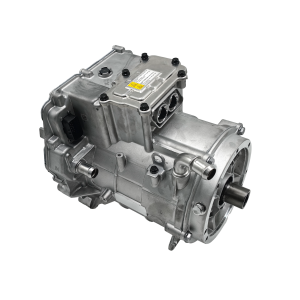
Transmission and Integration
Most tractors keep their mechanical transmission and mate the electric motor to it through an adapter plate — this multiplies torque for pulling work and preserves familiar gear selection. CMVTE supplies adapter plates and couplers for common tractor bellhousing patterns. For 4WD builds, consider a dual-motor setup or a differential integration; our engineers can spec the drivetrain layout with you.
CAN bus communication (CAN 2.0B) is standard on CMVTE systems, so the tractor's display, telematics, and diagnostics show real-time motor temperature, current, and voltage — the monitoring a working machine needs.
Example: Specifying a 96V 20/40 kW Build
Here is a realistic CMVTE package for a mid-size tractor doing tillage, mowing, and loader work:
- Motor: 96V PMSM, 20 kW continuous / 40 kW peak, liquid-cooled
- Controller: matching inverter with FOC, 40 kW peak capability, regenerative braking
- Battery: 96V 210Ah LiFePO4 pack (20 kWh) with BMS and CAN — roughly 3-4 hours of field work
- Adapter kit: bellhousing plate, coupler, and rubber mounts for vibration isolation
- Total drive + battery: around $8,700 factory-direct, versus $20,000+ for the same capability from specialist brands
This is the configuration most 20/40 kW tractor builders end up choosing, and it is the one CMVTE recommends as the starting point for a single-pack build.
Why Factory-Direct Beats Brand Premium
- Matched system, not parts: Motor, controller, and battery are engineered and tested together at our factory — no cross-brand compatibility guessing.
- No importer markup: Specialist EV brands source from manufacturers and add 100-200%. CMVTE is the manufacturer.
- Warranty and support: New hardware with warranty, wiring diagrams, and engineers who answer within 24 hours.
- Built for agricultural duty: Our motors are used in tractors, UTVs, and harvesters across 130+ countries — this is our core market, not a sideline.
Get Your Tractor Motor System Quoted
Tell CMVTE your tractor model, weight, PTO requirements, and whether you do heavy or light field work. Our engineers will match the right 96V motor, controller, and cooling configuration, and send a fixed quote within 24 hours.
Contact CMVTE now — get your 96V tractor motor kit quote within 24 hours.

