

The “fastest” motor on the market is not defined by a single metric, but by a combination of high power and high RPM. In real-world EV conversions, high-performance setups typically use PMSM (Permanent Magnet Synchronous Motors)—such as the Tesla Large Drive Unit—delivering around 220kW to 450kW+ with maximum speeds exceeding 16,000 RPM.
However, there’s a critical point most people overlook:
👉 “Fastest” does not mean “best for your build.”
From CMVTE’s real-world conversion experience, we’ve seen many projects fail because users focused only on peak power, leading to issues like:
- Controller mismatch
- Insufficient battery discharge
- Unstable system performance
So the real question is not:
❌ What is the fastest motor?
✅ But rather: What is the fastest complete solution for your specific vehicle, battery, and budget?
In the following sections, we’ll break down motor types, compare real performance data, and share proven high-performance motor solutions based on actual EV conversion projects.
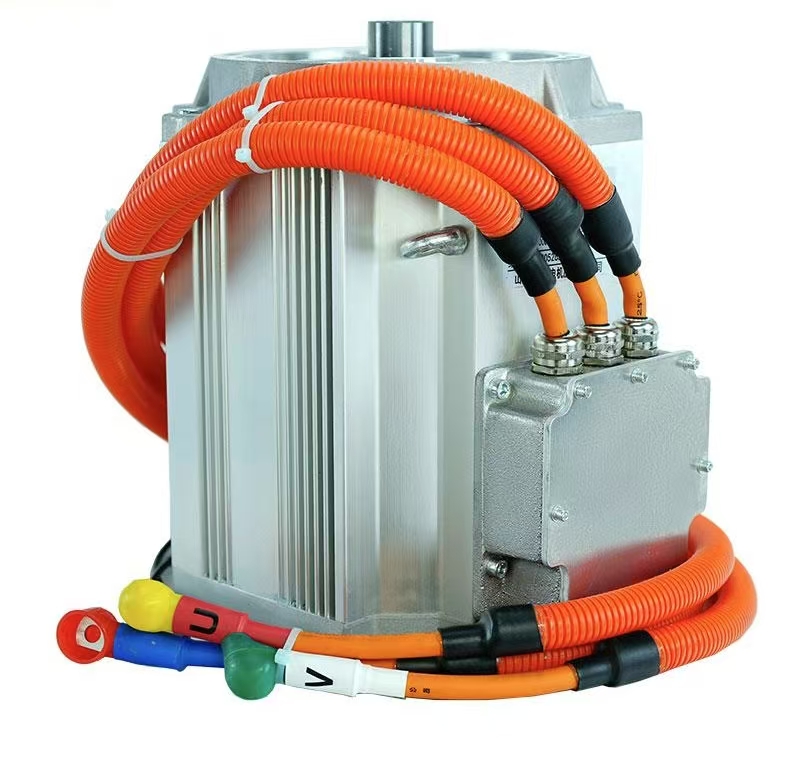
High-Performance EV Motors on the Market (Types, Models & Specs)
After understanding that the “fastest motor” is essentially a combination of power and RPM, the next step is to recognize a key reality: there is no single “fastest” motor in the EV conversion market. Instead, multiple high-performance solutions compete across different technologies. Based on CMVTE’s real-world projects, three main motor types dominate high-performance EV conversions, with PMSM clearly leading the field.
Among these, PMSM (Permanent Magnet Synchronous Motors) are the top choice for high-performance builds. Systems from Tesla—such as the Large Drive Unit (LDU) and Small Drive Unit (SDU)—have been widely proven in real-world conversions. These motors typically offer:
- Power range: 150kW – 450kW+
- Max RPM: 12,000 – 18,000
- Key advantages: high power density, high efficiency, fast response
👉 This is why they dominate high-performance EV builds focused on speed and acceleration.
In comparison, AC induction motors offer a more mature and durable solution. Early versions of the Tesla Model S used this technology. While slightly behind PMSM in peak performance, they remain highly reliable and cost-effective:
- Power range: 100kW – 300kW
- Max RPM: ~10,000 – 14,000
- Key advantages: simple structure, durability, proven systems
👉 Ideal for projects balancing performance and budget.
For lighter or medium-power applications, BLDC (Brushless DC Motors) provide a cost-effective solution, commonly used in golf carts, small EVs, or electric motorcycles. While they don’t compete in the “fastest motor” category, they remain practical in many scenarios:
- Power range: 5kW – 100kW
- Max RPM: 3,000 – 10,000
- Key advantages: low cost, simple design, easy integration
👉 Best suited for lightweight or entry-level conversions.
What Actually Determines the “Fastest” Motor?
When searching for the fastest electric motor for EV conversion, most people focus on peak numbers like power (kW) and maximum RPM. However, in real-world EV conversions, these figures alone do not define true performance. The actual speed and driving experience depend on how the entire system works together.
In practice, four key factors determine whether a motor setup can truly deliver high performance:
1. Motor Power — Defines Acceleration
- Higher power generally means stronger acceleration
- Power is calculated as torque × RPM
- High power does not necessarily translate into high top speed
👉 Many builds feel powerful at launch but struggle at higher speeds due to limited RPM range.
2. RPM — Defines Theoretical Top Speed
- Higher RPM directly increases theoretical vehicle speed (with the same gear ratio)
- Example: 16,000 RPM vs 10,000 RPM creates a significant speed gap
👉 The challenge is that many motors cannot maintain stable power output at high RPM levels, limiting real-world performance.
3. Battery Discharge — Limits Real Output
- The battery determines how much power can actually be delivered
- A 300kW motor paired with a 150kW battery will only output 150kW
Common limitations include:
- Insufficient discharge current
- Voltage sag under load
- Performance drop during sustained high output
👉 In many cases, the battery—not the motor—is the true bottleneck.
4. Controller & System Matching — Unlocks or Limits Performance
- The controller (inverter) manages power delivery from battery to motor
- It affects efficiency, responsiveness, and usable RPM range
Poor matching can lead to:
- Reduced power output
- Unstable performance
- System inefficiency or failure
👉 A high-performance motor without a proper controller setup cannot reach its full potential.
🔑 Key Insight
- There is no single “fastest motor” in isolation
- Real performance comes from system-level optimization

Best Motor Solutions for Different EV Conversion Scenarios
-
After understanding that performance depends on the entire system rather than a single motor, the next step is much more practical:
👉 What is the best motor solution for your specific EV conversion scenario?
Based on CMVTE’s real-world project experience, high-performance setups should always be selected according to vehicle type, usage goals, and system constraints.
-
1. High-Performance Builds (Sports Cars / Maximum Speed)
- Recommended motor type: PMSM (Tesla Drive Units)
- Power range: 250kW – 450kW+
- Typical RPM: up to 16,000+
👉 Key focus:
- Maximum acceleration and top speed
- High voltage battery system (usually 300V–800V)
- Advanced controller matching
👉 CMVTE solution:
CMVTE typically recommends Tesla Large Drive Unit (LDU)-based systems, combined with high-discharge lithium battery packs and optimized inverter control strategies. This setup is proven in multiple high-performance builds to deliver extreme acceleration and stable high-speed output.
2. Balanced Performance Builds (Daily Driving + Power)
- Recommended motor type: PMSM or AC Induction
- Power range: 120kW – 250kW
- Typical RPM: 10,000 – 14,000
👉 Key focus:
- Reliable daily driving
- Good acceleration without excessive system cost
- Easier integration
👉 CMVTE solution:
For this category, CMVTE often designs mid-power PMSM systems or optimized AC induction setups, ensuring a balance between performance, cost, and system stability. These solutions are widely used in sedan and SUV conversions where usability matters as much as performance.
3. Heavy-Duty Builds (Trucks / Commercial Vehicles)
- Recommended motor type: High-torque PMSM or dual-motor systems
- Power range: 200kW – 400kW
- Key feature: High torque output rather than extreme RPM
👉 Key focus:
- Load capacity
- Low-speed torque
- Thermal stability under heavy load
👉 CMVTE solution:
CMVTE typically recommends high-torque motor configurations or dual-motor setups, combined with reinforced battery systems. In heavy-duty projects, torque delivery and system durability are prioritized over peak speed.
4. Lightweight Builds (Golf Carts / Compact EVs)
- Recommended motor type: BLDC
- Power range: 5kW – 50kW
- Typical RPM: lower but sufficient for light vehicles
👉 Key focus:
- Cost efficiency
- Simplicity
- Easy installation
👉 CMVTE solution:
For lightweight applications, CMVTE provides compact BLDC-based solutions, focusing on affordability and ease of integration while still delivering reliable performance for small vehicles.
🔑 Key Takeaway
- There is no universal “best motor”
- The best solution depends on your vehicle + battery + usage scenario
👉 CMVTE’s approach is not to sell a single motor, but to deliver:
✔ Complete EV conversion solutions
✔ System-matched motor + controller + battery
✔ Proven configurations based on real projects

How to Choose the Fastest Motor for Your EV Conversion
Final Decision Guide
Choosing the fastest electric motor for your EV conversion is not about picking the highest number on a spec sheet—it’s about building a system that works together efficiently and reliably. Based on real-world experience, the best approach is to start with your vehicle and define your performance goal clearly. If your priority is maximum speed and acceleration, you should focus on high-power PMSM systems with high RPM capability. If you need a balance between daily usability and performance, a mid-power PMSM or AC induction motor may be a better fit. For heavy-duty applications, torque and system durability should take priority over peak speed, while lightweight builds benefit more from simplicity and cost efficiency.
Beyond the motor itself, always evaluate whether your battery can supply sufficient power and whether your controller can fully utilize the motor’s capability. Many projects fail not because the motor is insufficient, but because the system is poorly matched. This is why CMVTE focuses on complete EV conversion solutions rather than standalone components. By integrating motor, controller, and battery into a unified system, we ensure that performance is not only high on paper but also reliable in real-world driving conditions.
Final Thoughts
There is no single “fastest motor” that fits every EV conversion. The fastest setup is always the one that is properly matched to your vehicle, your battery system, and your performance goals.
👉 If you are planning an EV conversion project and want to achieve maximum performance, the best step is to start with a system-level design, not just a motor choice.
FAQ (Frequently Asked Questions)
1. What is the fastest electric motor for EV conversion?
The fastest motors are typically high-power PMSM systems, such as Tesla drive units, which can deliver over 400kW and exceed 16,000 RPM. However, real performance depends on the complete system, not just the motor itself.
2. Does higher power always mean higher speed?
No. Higher power improves acceleration, but top speed is more closely related to RPM and gear ratio. A high-power motor with low RPM may not achieve high speeds.
3. Can I use any motor for EV conversion?
Technically yes, but not all motors are suitable for high-performance builds. Proper matching with battery, controller, and vehicle is essential.
4. What is better: PMSM or AC induction motor?
PMSM motors offer higher efficiency and power density, making them ideal for performance builds. AC induction motors are more durable and cost-effective, suitable for balanced applications.
5. Why is my EV conversion not as fast as expected?
In most cases, the limitation comes from battery discharge capability, controller mismatch, or system inefficiencies—not the motor itself.

