

In the high-voltage system of electric vehicles, the high-voltage distribution box is the core node between the power battery and the high-voltage loads, which undertakes the functions of high-voltage distribution, circuit protection, pre-charging control and fault quarantine.
For wiring harness design, development and verification personnel, it is not a simple integrated box, but a key link in the vehicle high-voltage architecture. If this assembly is not clearly defined in the early stage, it will often expose problems in the layout, temperature rise, power-on strategy, maintenance and verification.
- Function definition
The most feared thing in the design of high-voltage distribution box is not that the device will not be selected, but that the functional boundary is not clear at the beginning.
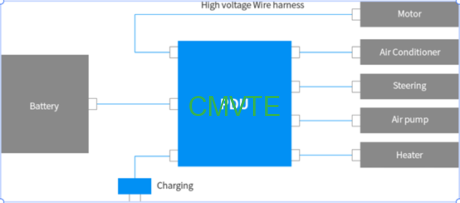
In the initial stage of the project, it is usually necessary to define several core inputs: what is the system voltage platform, what are the maximum continuous current and peak current, what are the high-voltage loads of the whole vehicle, whether each branch needs independent protection, which equipment needs to be pre-charged, who controls the power on and off, and which circuits must be disconnected under collision or fault conditions.
Only when these conditions are clear, can following loop topology, number of components, connector definition and layout in the box have a basis. In the actual development, the high-voltage distribution box is often treated as a post-integrated component, first fixing the battery, electric drive, air conditioning, OBC, DCDC, and finally trying to put the device into the box.
This practice advances fast in the early stage and reworks the most in the later stage. Because the high-voltage distribution box is not an assembly problem in essence, but a function landing problem of the high-voltage system. How to divide the branch, how to do the protection, how to control the pre-charging, and how to cut off the power for maintenance are all things that should be thought clearly in the scheme stage.
- Main circuit design
The main circuit is the design basis of the high-voltage distribution box, which usually includes the main positive, main negative, pre-charging branch and each high-voltage load branch. The large current connection in the box is generally completed by the copper bar.
The working principle of precharging is that many designs seem to have no problems at the schematic level, but when they really fall to the ground, the problems often lie in the unclear current path, unclear protection boundary and unclear state definition.
When designing the main circuit, at least several States should be sorted out and understood: how the current goes when it is normally powered on, how the circuit is closed in the pre-charging stage, which branches are in working state after the main contactor is closed, who will cut off in case of failure, and how to ensure safe and quarantine in the maintenance state.
If the drawings only express the “connection relationship” and do not straighten out these States, the probability of subsequent system joint commissioning will be modified repeatedly. In addition, the branch division can not be handled simply. Loads such as drive, electric air conditioner, OBC, DCDC and PTC vary greatly in power level and operating characteristics.
The branch division is too thick and the protection is not fine enough; If the division is too fine, it will increase the pressure of devices and space. There is no standard answer here, but there is a basic principle: branch division should serve real load characteristics, not just schematic neatness.
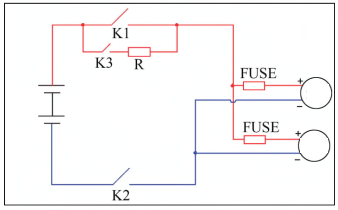
Branch Load Fuse Design Reference
- Selection of protection device
The core devices in the high-voltage distribution box are mainly fuses and high-voltage DC contactors. The two have different responsibilities, the fuse is responsible for fault protection, and the contactor is responsible for controllable on-off, which should be clearly distinguished in the scheme stage. The most common problem in the selection of fuses is to look only at the rated current, not at the breaking capacity and action characteristics. The high-voltage system of new energy vehicles belongs to the DC system, the short-circuit current is established quickly, and the breaking conditions are more stringent than traditional low-voltage scenarios. Especially in the near end of the battery and the large capacitance load branch, if the fuse is not selected correctly, it may not be broken cleanly when it should be broken, and it may act in advance when it should not be broken.
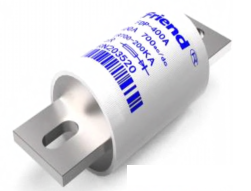
High-voltage fuse
The same is true of contactor selection, which can not only look at the continuous current carrying capacity. The more common problems encountered in the project are on-load breaking capacity, contact life, pick-up and release stability, and action reliability under extreme temperatures.
If the contactor only has “enough parameters”, but it is not verified by combining the power frequency and working condition boundary of the whole vehicle, it is prone to adhesion, ablation or misoperation in the later period.
The selection of protection devices with real engineering significance is not that a single device meets the parameters, but that the whole set of protection logic matches the working conditions of the whole vehicle.
- Pre-filling circuit design
In the design of high-voltage distribution box, the pre-filling circuit is usually not the most complex part, but it is easy to become the focus of problems in the joint commissioning stage.
The reason is not complicated. Motor controller, OBC, DCDC and other high-voltage equipment generally have a large capacitor at the input end. If the main circuit is directly powered on, it will produce a large surge current. This current will not only impact the contactor and fuse, but also affect the power stability of the high-voltage system.
The function of the precharge circuit is to slowly charge the capacitor on the load side through the precharge resistor before the main contactor is closed, to reduce the voltage difference, and then to complete the closing of the main circuit. The difficulty is that precharging is not as simple as “adding a resistor”.
The value of resistance shall be determined in combination with the load equivalent capacitance, allowable surge current, target precharge time and the thermal capacity of the resistance itself. If the resistance is too large and the precharge time is too long, the system may report an error overtime; If the selection is small, the current limiting effect is insufficient, and the impact still exists. More critical is the control logic.
When to start precharging, where to place the differential pressure detection point, what conditions are met to allow the main contactor to close, and how to exit after timeout, these problems can not be solved by the distribution box alone, but the hardware design and control strategy should be closed together. Precharge anomalies in many projects appear to be hardware problems, but in fact, hardware parameters, sampling logic and control strategies are not aligned.
- Insulation and safety
The high voltage distribution box is first and foremost a high voltage insulator. As long as there are adjacent arrangement of positive and negative poles, hard connection of copper bars, adjacent metal shells and exposed interfaces in the box, insulation safety can not be judged only by experience. Basic insulation: primary protection against contact with live parts, achieved by insulating material:
Double insulation: double protection system consisting of basic insulation and supplementary insulation.
Reinforced insulation: single insulation system, protection against electric shock equivalent to double insulation, thickness at least 0.4mm.
The design focuses on clearances, creepage distances, insulation materials, degrees of protection, sealing strategies, and boundary changes in vibration, damp heat, condensation, and contaminated environments.
Many problems can not be seen in the sample stage, but will be exposed after durability, salt spray or wading, which is not the failure of the device in essence, but the lack of insulation margin. The interface area is also important.
The high voltage connector is not only a conducting part, but also a part of the insulation system. Whether the connector locking is reliable, whether the outgoing direction is reasonable, and whether the cable will exert stress on the interface for a long time after bending, all of these directly affect the long-term reliability.
- Thermal design and structural design
The structural design of high-voltage distribution box is not only to meet the installation of devices, but also to take into account the assembly, maintenance and thermal management. Although the box is not a typical large heat source assembly, the copper bar, contactor, fuse and connection point will heat up, and what really needs to be vigilant is the local hot spot.
Many temperature rise problems are not caused by excessive total power consumption, but by high contact resistance of connection points, obvious change of copper bar section or excessive concentration of device layout. In terms of structural design, it is necessary to consider the installation sequence, fastening operation space, connector insertion and extraction path, box cover disassembly and assembly, and wiring harness outgoing direction as soon as possible.
The high-voltage distribution box looks like a box, but the actual development is often stuck in these very “engineering” details. No matter how compact the drawings are, if the assembly is difficult and the maintenance is not accessible, the scheme will not be mature.
- Design verification
The verification of high-voltage distribution box usually covers items such as conductivity, insulation withstand voltage, temperature rise, pre-charging function, vibration, mechanical shock, high and low temperature cycle, damp heat, salt fog and wading. But the real value is not just to pass a single piece, but to put it in the whole vehicle system to see if it is stable.
Many problems can only occur under system linkage, such as pre-charging stability under different temperatures and SOC, branch protection action boundary, loosening risk of interface under vehicle vibration, and actual assembly interference between harness and box.
For the wiring harness engineer, the high voltage distribution box cannot be completely treated as a supplier’s part, because many of the problems eventually exposed essentially occur in the interface between the distribution box and the wiring harness, load and layout.
On the surface, the design of high-voltage distribution box is an assembly development problem, but the actual test is the ability of vehicle high-voltage system engineering. The real difficulty of this component is not to put the device into the box, but to unify the power distribution, protection, pre-charging, insulation and engineering.
For wiring harness design, development and verification personnel, the focus of high-voltage distribution box related work is not only to understand the components in the box, but also to pay attention to functional boundaries, branch definition, pre-charging strategy and interface reliability. If these problems are clear, many later problems can be avoided in advance in the program stage.

