

The rapid development of electric vehicles is reconstructing the traditional knowledge system of automobile maintenance. When the roar of fuel vehicles can no longer be heard under the hood, instead replaced by the silent operation of high-voltage current, the toolbox of maintenance technicians also needs to be loaded with new cognitive weapons. Today, let's focus on the pulse of the electric compressor - the "silent heart" hidden in the depths of the electric vehicle air conditioning system.
Traditional vs Electric Compressor Systems
| Aspect | Traditional Fuel Vehicle Compressor | Electric Vehicle Compressor |
|---|---|---|
| Power Source | Engine belt drive | High-voltage electric energy |
| Control Method | Mechanical clutch engagement | Electronic control via motor controller |
| Operation | Linked to engine RPM | Independent variable speed control |
| Energy Efficiency | Lower (parasitic load on engine) | Higher (precise control, no idle loss) |
| Refrigeration Capacity | Fixed relative to engine speed | Variable and precise based on demand |
Working Principle of Electric Compressor
Unlike traditional fuel vehicles, which rely on engine belt drive, the electric compressor operates through high-voltage electric energy. The compressor of the traditional vehicle is driven by the engine, and the refrigeration function is realized by belt transmission. In pure electric cars, there is no engine, so high voltage is used to drive the compressor. The high-voltage electricity output by the battery pack is converted into three-phase alternating current through the control of the electric compressor to drive the motor of the compressor.

Electrical Work Flow of Compressor
The electrical operation of the compressor is divided into two core parts, the low voltage control link and the high voltage drive link, to achieve the stable operation of the compressor:
Low Voltage Control Link
The external signal harness has bidirectional communication function: on one hand, it exchanges data with the control terminal, transmits the operation status and fault information of the compressor, and receives the operation instructions of the control terminal; on the other hand, it provides low-voltage power supply for the control board, and provides working power for the signal acquisition, logic operation, instruction output and other modules of the control board.
High Voltage Drive Link
The external high-voltage power supply line provides a working power supply for the driving board; after receiving the drive control signal output by the control board, the drive board converts the high-voltage power supply into UVW three-phase drive power, so as to control the operation of the motor of the compressor and realize the refrigeration/heating function of the compressor.
Core Components
Compressing and pressurizing the refrigerant is the power source of the air conditioning refrigeration cycle (similar to the traditional vehicle compressor, but the driving mode is different).
Replaces the traditional mechanical drive, with lower energy consumption and higher speed control accuracy.
Implements "DC → AC" conversion and is the control core to adjust the motor speed.
Real-time collection of refrigerant state data to provide control basis for VCU (Vehicle Control Unit).
Common Fault Diagnosis
Common Mechanical Faults
A compressor can be started normally using a test platform, but the pressure cannot reach normal levels. Disassemble the compressor and you may find that the scroll has been seriously worn. Clean inside of the compressor, replace the scroll and fill with POE special oil. After testing again, the pressure reaches the standard, the pressure is normal, and the fault is eliminated.
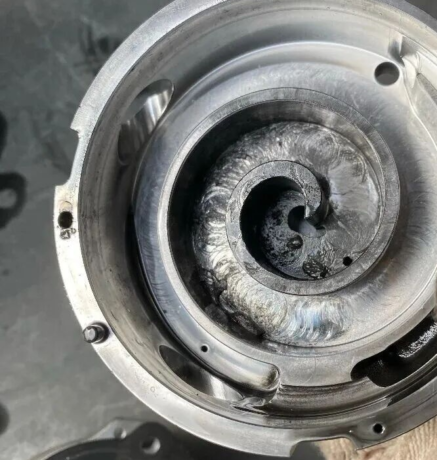
Common Wear Parts and Fault Effects
Installation position: combination position of front end cover and housing. Function: sealing. Fault effect: after damage or deformation, air leakage occurs due to poor sealing.
Component properties: scroll component parts. Common fault: wear. Fault effect: poor cooling effect and abnormal noise.
Component properties: scroll component parts. Common fault: wear. Fault impact: air leakage occurs, and the refrigeration effect becomes poor.
Common faults: loose bearing and excessive clearance. Fault effect: the compressor produces abnormal sound during operation.
Circuit Logic and System Integration
The electric compressor system is integrated into the vehicle's electrical architecture through a sophisticated circuit logic:
Power Distribution
Power is distributed to each module (battery, ON power, ACC power) through fuses such as EP23 and RP12.
Signal Processing
VCU receives sensor signals (such as temperature and pressure) and sends control commands to compressor, PTC and other components.
Communication
Signal transmission and communication between components are realized through hard wires (such as HV03 and HV04) and CAN bus (P_CAN).
Summary
Today, when the electric vehicle quietly replaces the traditional roar, the "silent heart" of the electric compressor has become the core lifeline of the air conditioning system. We have analyzed its secret in a simple way: the high-voltage electric drive replaces the belt drive of traditional vehicles to realize the precise control of "DC → AC" conversion; the electrical process is divided into a low-voltage signal link and a high-voltage drive chain, which cooperates with VCU, sensors and other components to ensure smooth operation. Common faults, such as pressure leakage or abnormal noise caused by wear, are often due to gasket or bearing damage, which requires professional replacement and testing tools to solve. As a car owner or maintenance enthusiast, understanding these diagnostic points can not only quickly detect problems, but also enhance the skills and self-confidence to deal with the new energy vehicle era.
Need Professional EV Compressor Diagnostics?
Get expert guidance on diagnosing and repairing electric vehicle compressor issues. Our certified technicians can help you identify problems and find the right solutions.
