Across urban logistics, regional distribution, municipal services, and commercial transport, 6–8 ton light-duty trucks are among the most widely used workhorses in many markets. Familiar platforms such as the Isuzu N-Series/NPR, FUSO Canter, Hino 300/Dutro, and Tata LPT series have built strong market positions thanks to their simple chassis, practical payload capacity, and suitability for daily fleet operations. FUSO alone has produced more than 4.5 million Canter trucks worldwide, while Isuzu reports approximately 310,000 commercial vehicles sold globally in fiscal 2025, demonstrating the enormous installed base of commercial vehicles that could potentially become candidates for electrification.
For fleet operators, this large installed base represents more than transportation capacity—it represents an opportunity. Many trucks already have reliable chassis, bodies, and established maintenance networks, making powertrain conversion a potential alternative to purchasing entirely new electric trucks. For vehicles that operate predictable routes, return to a central depot, and accumulate high daily mileage, replacing the diesel powertrain with an electric system can reduce energy and maintenance costs while extending the service life of the existing vehicle.
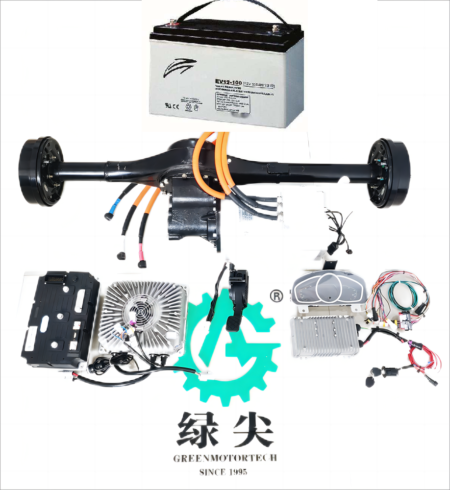
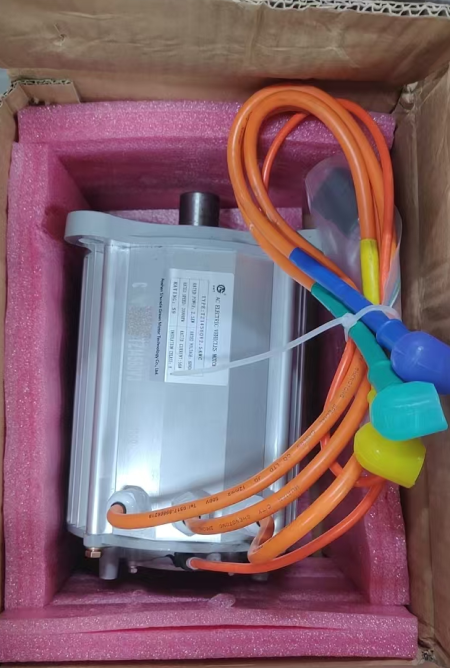
In this case study, we use an 8-ton-class light-duty truck as a practical example to demonstrate how a conventional diesel truck can be converted into a fully electric vehicle. We will examine the motor, battery, drivetrain configuration, performance, range, charging requirements, and operating economics—and show why electrifying an existing truck fleet can be both a technical upgrade and a long-term business opportunity.

| Item | Specification | Item | Specification |
|---|---|---|---|
| Rated Power | 80 kW | Peak Power | 170 kW |
| Rated Torque | 170 Nm | Peak Torque | 410 Nm |
| Rated Speed | 4,500 rpm | Peak Speed | 13,000 rpm |
| Item | Specification | Item | Specification |
|---|---|---|---|
| Vehicle Gear Ratio | 15.71 or 17.91 | Max. Output Torque | 7,150 Nm |
| Rear Axle Type | Pressed Steel | Rear Axle Load Capacity | 3.5T / 4.5T / 5.5T |
| Rear Axle Options | Optional air brakes, disc brakes, or center-mounted drum brakes |
| Item | Specification | Item | Specification |
|---|---|---|---|
| Voltage Range | 450–750 VDC | Protection Rating | IP68 |
| Rated / Peak Current | 160 A / 350 A | Cooling Method | Liquid Cooling |

DC-DC converter typically falls into three voltage levels: low voltage platforms such as 60V and 72V, which are suitable for light-duty equipment and offer advantages in cost and safety but are limited in power output; medium voltage platforms including 96V, 144V, and 300V, which represent the mainstream solution and are widely used in applications such as baggage tractors, belt loaders, and small service vehicles; and high voltage platforms ranging from 300V to 600V or higher, typically used in aircraft tow tractors, large loading equipment, and high-demand systems such as GPU and air conditioning units, offering higher power capability and efficiency but with increased system complexity and cost.
For truck, normally we use 540V->24V DC-DC converter, 1200W

A compact on-board charger is an important component in electric tricycle and cargo trike conversion kits. Compared with external chargers, on-board chargers provide greater convenience for daily charging operations, especially for commercial delivery and utility vehicles.
For truck, based on AC charging requirement, we can offer 7kw, 10kw, 20kw OBC charger
A properly selected on-board charger improves charging safety, battery life, and overall system reliability

Battery installation space is one of the biggest challenges in electric conversions. Unlike factory-built EVs, conversion projects must fit the battery system within limited chassis space while maintaining proper weight distribution and cargo capacity.
To meet different power and range requirements, we provide multiple compact lithium battery pack options, including:
All battery packs use integrated BMS protection with functions including over-voltage, under-voltage, over-current, and temperature protection.

You have successfully sent your inquiry, thank you, we will reply you as soon as possible.