

In the electric vehicle system, the high-voltage system is like the energy core of an electric vehicle, its voltage is as high as hundreds of volts, once there is a problem, the consequences are unimaginable. In order to ensure the safe operation of this energy core, the high-voltage interlock circuit emerges as the times require and becomes the key to the safety of electric vehicles.
1.Why do we need a high-voltage interlock system?
In electric vehicle, the voltage of high-voltage systems is usually more than 300 V, which is more than 10 times the household voltage. Once such a high voltage is exposed, it will pose a great threat to the safety of personnel.
High Voltage Interlock System (HVIL, High Voltage Interlock) is the core technology designed to solve this security risk.
Its core objectives are:
Protect against high voltage exposure: Ensure that all physical protection of high voltage components (e.g., covers, connectors) is closed.
Monitor the connection status: verify the connection integrity of the high-voltage harness in real time.
Fail-safe response: immediately cut off the high voltage output when an abnormality is detected.
2.Technical principle of high voltage interlock
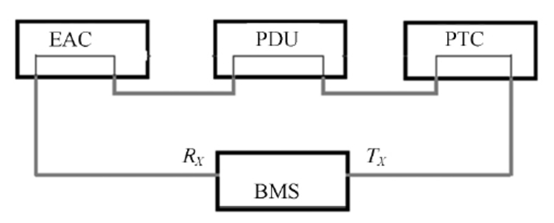
The working process of the high-voltage interlock circuit can be simply summarized as follows: when the vehicle is started, the BMS (battery management system) will send a specific PWM waveform signal. This signal is like a “safety inspector”, which passes through PTC (positive temperature coefficient thermistor), PDU (power distribution unit), EAC (electric compressor) and other high-voltage components along the low-voltage wiring harness.
If all components are properly connected, the signal returns to the BMS intact. At this time, the BMS will allow the high-voltage system to output energy, and the vehicle can start and run normally.
On the contrary, if the signal is interrupted during transmission, such as the high-voltage cable is not installed, the high-voltage components are damaged, or the protective structure fails, the BMS will immediately cut off the high-voltage output to prevent danger.
2.1 PWM waveform detection mechanism
High-voltage interlock system adopts unique “PWM waveform closed-loop detection” technology:
Signal emission: The BMS (Battery Management System) emits a PWM signal of a specific frequency and duty cycle.
Path verification: The signal passes through the PDU, motor controller, air conditioning compressor and other high-voltage components in turn.
Signal return: the signal finally returned to BMS shall be matched with the original waveform.
Abnormal response: If the waveform is distorted or interrupted, the BMS immediately triggers a high voltage cutoff.
Technical advantages:
Compared to traditional voltage detection, the PWM waveform effectively identifies short circuits to ground/power.
Support multi-loop parallel detection to improve fault location accuracy.
2.2 Typical System Architecture
BMS → PTC heater → PDU → Motor controller → A/C compressor → BMS
The high-voltage interlock circuit is usually controlled by the BMS as the core controller, and the high-voltage components are connected in series through the low-voltage wiring harness to form a closed circuit. Depending on the vehicle type, the high-voltage interlock circuit can be designed as a single-circuit or multi-circuit structure.
Single-circuit design: All high-voltage components are connected in series in one circuit. This structure is simple and the cost is low, but once a component in the circuit fails, the whole circuit will be affected, and the difficulty of troubleshooting is relatively large.
Multi-loop design: HV components are divided into multiple relatively independent loops.
For example, the power system, the air conditioning system, the charging system, etc. May be combined into different circuits. The advantage of this structure is that if a circuit fails, other circuits can still work normally without affecting the basic operation of the vehicle, and it is also convenient to quickly lock the fault point.
3 Detailed explanation of key structure design
3.1 Physical protection
Cover interlock switch
A lever-type or button-type structure is adopted, and the circuit can be conducted only when the cover plate is closed. The switch contact force shall be controlled within 8-12 N to ensure reliable closing.
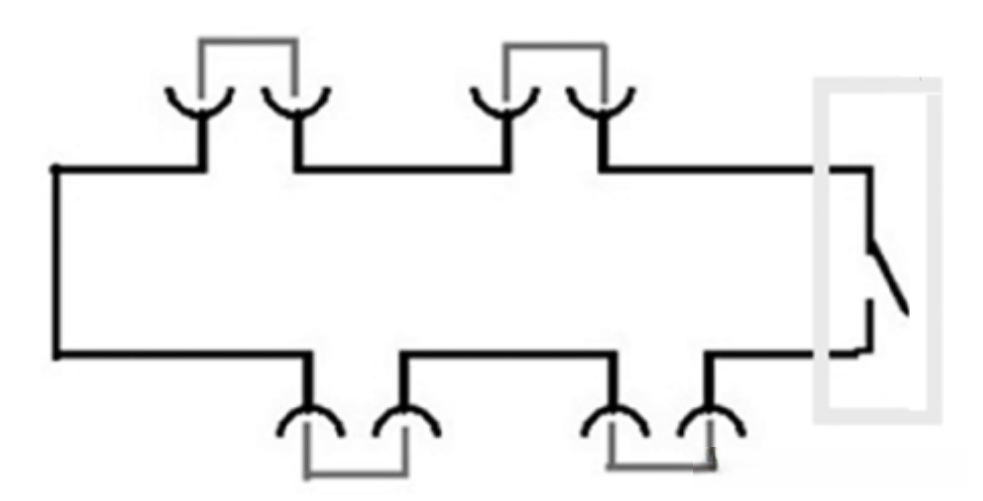
On the cover plate of high-voltage components such as PDU and battery pack, a lever-type or button-type interlock switch is designed. When the cover plate is closed, the switch will be triggered to connect the interlock circuit. If the cover plate is not covered properly, the switch is in the open state, the interlock circuit can not be formed, and the high-voltage system can not be started. For example, the PDU cover plate of a certain model uses a lever-type interlock switch. Only when the cover plate is completely closed, the lever can press the switch to make the circuit conductive.
The following figure shows a schematic of a PDU cover interlock. After the high voltage harness is connected, the interlock circuit will be connected. The cover plate is assembled, the switch is closed, and finally the interlocking circuit is closed.
High-voltage connector interlock
A special interlocking structure is designed inside the male and female connectors of the high-voltage wiring harness.
When the male end and the female end are completely plugged in place, the internal short connector will connect the interlocking circuit. If the connector is not inserted properly, the short connector cannot be contacted, the circuit is disconnected, and the high-voltage system cannot be started.

3.2 Electrical monitoring module
The BMS not only sends the PWM waveform signal, but also analyzes the received signal. The BMS can judge the integrity of the interlock circuit by detecting parameters such as the duty cycle of the signal. Even if the circuit is short-circuited to ground or short-circuited to power, the PWM waveform will change, and the BMS can detect these abnormalities in time and take corresponding protective measures.
- Typical fault analysis and troubleshooting strategy
4.1 Key points of open circuit fault diagnosis
Open circuit fault is one of the most common faults in the high voltage interlock circuit, which is mainly manifested by the failure of the interlock circuit to conduct.
The following are the causes and troubleshooting methods of several common open circuit faults:
Harness error
During the manufacturing or engineering development stage, due to the assembly or temporary modification of the harness, the harness may be connected to the wrong pin, resulting in an open circuit.
When troubleshooting, you can use a multimeter to start from the two PIN pins of the BMS, gradually measure the continuity between the various components, and use the “dichotomy” to quickly narrow the scope of the fault. For example, measure from one PIN of the BMS to the corresponding PIN of the PDU. If it is connected, continue to measure the next component. If it is not connected, the fault may be in the harness or PDU between the two components.
Interlock switch failure
The interlock switch may fail to close due to design size deviation, improper assembly, or its own fault.
When checking, first check the installation of the cover plate or end cover to ensure that the boss or rib can press the switch correctly. If the switch still fails to close, it may be necessary to replace the switch or adjust its mounting position. For example, in the trial production process of a certain model, due to the low height of the protruding rib structure of the cover plate, the interlock switch could not be closed in place, and finally the problem was solved by increasing the height of the rib.
Terminal retracts
The terminals on the low voltage harness or high voltage components may cause pin withdrawal due to quality problems or improper assembly, resulting in poor contact.
When troubleshooting, use a fine probe to check the contact of the terminals to ensure that the terminals are conducting well. If you find that the terminal is pinched out, you need to re-crimp or replace the terminal.
Maintenance precautions
Wait 5 minutes for the capacitor to discharge before disconnecting the high voltage
Wrap the exposed wire harness with insulating tape (voltage class ≥ 1000 V)
4.2 Key points of short circuit fault diagnosis
The short circuit fault mainly includes short circuit to ground and short circuit to power supply, which will cause the PWM waveform to fail to return to BMS normally, thus triggering the high-voltage interlock fault.
Here’s how to troubleshoot a short circuit:
Short circuit to ground:
Measure the insulation resistance of the loop with a megohmmeter (should be > 10 MΩ).
Use a multimeter to measure the continuity between each point in the interlock circuit and body ground. If a certain point is found to be connected to the body ground, it indicates that there is a short circuit to ground at this point. For example, when troubleshooting a vehicle, it was found that the interlock circuit inside the PDU was damaged, resulting in a short circuit with the metal shell, resulting in a short circuit to ground.
Short circuit to power:
Check the diode status between the 12 V supply and the interlock.
Measure the continuity between each point in the interlock circuit and the 12 V supply. If a point has continuity to the 12 V supply, there is a short circuit to power at that point.
4.3 Other faults
In addition to open and short circuit faults, there are a number of other causes that can cause a high voltage interlock fault:
Internal fault of power battery
If the BMS inside the power battery fails, the status of the interlock circuit may be misjudged. During troubleshooting, it is possible to measure whether the interlock circuit forms a path and check whether the PWM waveform sent by the BMS is normal.
High voltage component failure
For example, the failure of the interlock circuit inside the high-voltage components such as PDU and motor inverter will also lead to the abnormal interlock circuit. At this time, it is necessary to use special diagnostic equipment to read the fault code and repair or replace the faulty parts.
As the core technology of electric vehicle safety, the design and maintenance of high voltage interlock circuit are very important. Through in-depth understanding of its working principle, structural design and common troubleshooting methods, we can better ensure the safe operation of the vehicle.
High Voltage Interlock System as a electric vehicle. The design of nerve endings combines multiple intelligences of mechanical protection, electrical detection and intelligent control.
With the popularization of solid-state battery and 800 V high voltage platform, the system will develop towards higher integration and lower power consumption. As practitioners, we should not only master the existing technology, but also pay attention to the application of ISO 26262 functional safety standards in the interlock system, so as to continuously empower the safety development of new energy vehicles.


