

Introduction: Why is Stator Resistance Core to High-Performance Control?
In the field of Permanent Magnet Synchronous Motors (PMSM), what we commonly refer to as "inner resistance" precisely means stator resistance. Please do not regard it as just an ordinary specification parameter—it is the cornerstone that affects the accuracy, efficiency, and stability of your motor control system. Whether you are debugging a servo drive, optimizing an electric vehicle's traction system, or performing motor fault diagnosis, accurately obtaining the stator resistance value is an indispensable first step.
Why is it so critical?
- For Field-Oriented Control: FOC algorithms rely on accurate motor models to achieve decoupled control of torque and flux. If the stator resistance parameter is set incorrectly, it will lead to inaccurate torque current calculations, directly causing torque fluctuations, reduced efficiency, and increased heating.
- For System Efficiency: Stator resistance is at the core of copper loss calculations. Inaccurate resistance values render your loss analysis and temperature rise predictions meaningless.
- For Model Accuracy: In advanced algorithms like Model Predictive Control, mismatched resistance parameters lead to degradation of the entire system performance.
In short, mastering the precise measurement method of stator resistance is the key to unlocking your motor's optimal performance.
Understanding Core Concepts: What is Stator Resistance?
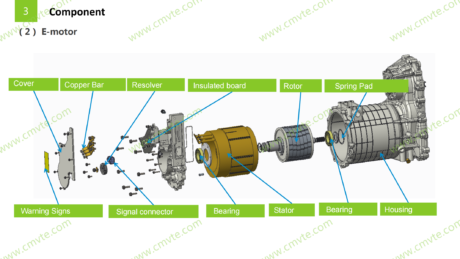
Stator resistance typically refers to the resistance value presented by each phase winding of the motor under DC conditions. It primarily represents the conductive properties of the winding copper wire.
Preparation: Required Tools and Safety Precautions
Before starting operations, please prepare the following tools and strictly adhere to safety regulations.
Required Tools List:
- High-precision digital multimeter or micro-ohmmeter (recommended for higher accuracy)
- Adjustable DC power supply
- High-power load resistor (optional, for current limiting, details later)
- Temperature sensor, such as a thermocouple or PT100 (crucial)
- Connection wires, clips, and insulation tools
- Ensure the motor is completely disconnected from all drives and power sources.
- During operation, ensure high-voltage capacitors are discharged and be cautious of exposed terminals.
- It is recommended to wear appropriate personal protective equipment.
Method 1: DC Injection Method - The Most Common and Practical Approach
This is the most widely adopted method in laboratories and engineering sites due to its simple principle and reliable results.
1. Principle Overview
Apply a known, small DC voltage between two phases of the motor's windings, measure the flowing DC current, and then calculate the winding resistance according to Ohm's Law: R = V / I.
2. Step-by-Step Instructions
-
Step 1: Connect the Circuit
- Connect the positive terminal of the DC power supply to the motor's A-phase terminal.
- Connect the negative terminal of the DC power supply to the motor's B-phase terminal.
- Leave the C-phase terminal floating.
- Set the multimeter to DC voltage range and connect it in parallel across the power supply output terminals.
- (Optional) Connect a shunt resistor in series in the circuit or use the multimeter's DC current range to measure the current.
-
Step 2: Measure and Record Initial Temperature
Use a temperature sensor attached to the motor housing (preferably close to the windings) to measure and record the current winding temperature (T_initial). This serves as the baseline for subsequent calculations and corrections.
-
Step 3: Apply DC Power and Measure
- Set the DC power supply to start from a very low voltage (e.g., 1V).
- Slowly increase the voltage until the circuit current reaches 5% to 10% of the motor's rated current. Never use excessive current to avoid overheating or damaging the windings.
- Tip: If the power supply cannot precisely limit current, you can connect a high-power resistor in series to limit the maximum current.
- Wait for the voltage and current readings to stabilize, then quickly and simultaneously record the voltage value (V_dc) and current value (I_dc).
-
Step 4: Calculate Resistance
- Calculate the line-to-line resistance: R_line = V_dc / I_dc
- Convert to phase resistance: For the vast majority of star-connected PMSMs, the phase resistance is R_phase = R_line / 2

Key Consideration: Temperature Impact and Compensation - From "Accurate" to "Precise"
Resistance measurements that ignore temperature effects have no engineering significance. This is the key distinction between amateur and professional measurements.
- The Problem: Copper's resistance temperature coefficient is approximately 0.00393 / °C. This means that for every 1°C increase in temperature, the resistance value increases by about 0.4%. A winding measured at 100mΩ at 25°C could become 130mΩ at 100°C!
- The Solution: Temperature Correction Formula
To compare measurement results under different conditions, we need to correct the measured value to a standard reference temperature (usually 25°C).
R_corrected = R_measured * [1 + α * (T_ref - T_measured)]
- R_corrected: Resistance value corrected to the reference temperature
- R_measured: The resistance value you actually measured and calculated
- α: Resistance temperature coefficient of the conductor material (0.00393/°C for copper)
- T_ref: Reference temperature (e.g., 25°C)
- T_measured: Actual winding temperature recorded during measurement
Other Measurement Methods Overview
Method 2: Using an LCR Meter
- Operation: Directly connect the LCR meter test leads to any two motor phase terminals, select the resistance measurement mode, and ensure testing with DC or very low frequency.
- Pros and Cons: Advantage is speed and convenience. Disadvantage is that LCR meters typically provide very small test currents, which may not fully reflect the contact conditions of the windings under real operating currents, and accuracy may not match the DC injection method.
Method 3: Dynamic Identification Algorithms (Advanced Solution)
- Description: For motors already integrated into a system, specific test signals (such as DC pulses or high-frequency signals) can be injected through the drive, and algorithms like the Recursive Least Squares method can be used to identify the stator resistance online in real-time.
Common Errors and Troubleshooting
- Error 1: Ignoring Contact Resistance
- Phenomenon: Measured value is too high.
- Solution: Ensure all connection terminals have good, clean, and tight contact.
- Error 2: Using AC for Measurement
- Phenomenon: Inaccurate measurement.
- Reason: AC introduces the inductive reactance of the windings, measuring impedance (Z) rather than pure resistance (R).
- Solution: Always use DC.
- Error 3: Not Considering Temperature or Excessive Measurement Time
- Phenomenon: Non-repeatable data, significant differences in each measurement result.
- Solution: Complete measurements quickly and strictly record temperature. Measure in a cold state.
- Problem: Measured value far exceeds datasheet range?
- Possible Causes: Connection issues, localized overheating or damage to motor windings.
Conclusion: From Precise Measurement to Excellent Control
Through this guide, you have mastered the scientific method for accurately measuring PMSM stator resistance, particularly understanding the core importance of the DC injection method and temperature compensation. This lays a solid foundation for you to achieve precise motor modeling and control tuning.
Remember, stator resistance is just one piece of the motor parameter landscape. To fully characterize your motor, further identification of key parameters such as d/q axis inductance and back EMF constant is necessary.
Successfully measuring resistance is the first step toward precise control. But to fully unleash the potential of your PMSM motor, you need an advanced drive system that can fully utilize these precise parameters.
Explore our motor drive platform with integrated advanced online parameter identification, allowing your system to automatically adapt to motor parameter changes and always maintain optimal performance.

