

Understanding the internal resistance of Permanent Magnet Synchronous Motors (PMSM) is crucial for engineers and technicians working with electric vehicles, industrial automation, and renewable energy systems. This comprehensive guide explains the concepts, measurement techniques, and practical considerations for accurately determining PMSM motor internal resistance.
I. Basic Concept of Motor Internal Resistance
The internal resistance of a motor is one of the most important operational indicators, representing the opposition to current flow within the motor during operation. In DC power applications, internal resistance is typically a pure resistive component. However, in AC systems like those powering PMSMs, internal resistance becomes a more complex parameter that includes both resistive and reactive components.
For PMSM motors, the internal resistance isn't a single value but rather a combination of the stator winding resistance (Rs) and the equivalent resistance representing core losses. The complete impedance model includes the synchronous reactance (Xs) which comprises both inductive reactance and resistance components. Understanding this distinction is vital for accurate motor modeling and performance prediction.
II. Influencing Factors
Several factors impact the internal resistance of PMSM motors, and understanding these is essential for accurate measurement and interpretation of results.
- Material Selection: The conductive materials used in motor windings (typically copper or aluminum), the core material (usually laminated electrical steel), and the permanent magnet material (often neodymium or samarium-cobalt) all significantly affect the internal resistance. Copper's higher conductivity compared to aluminum results in lower resistance for the same winding dimensions.
- Design Structure: The winding configuration (star or delta connection), core geometry, slot design, and permanent magnet arrangement influence the magnetic circuit and thus the motor's effective resistance. Motors with distributed windings typically exhibit different resistance characteristics compared to those with concentrated windings.
- Manufacturing Process: The precision of winding placement, core stacking quality, permanent magnet installation, and impregnation process all affect the final internal resistance. Variations in these processes can lead to significant differences in resistance even between motors of identical design.
- Temperature Effects: Resistance values change with temperature—copper windings increase resistance by approximately 0.4% per degree Celsius rise. Accurate measurements must account for or specify the temperature at which they were taken.
- Operating Frequency: For AC measurements, skin effect and proximity effect can cause the effective resistance to increase at higher frequencies, which is particularly relevant for motors driven by PWM inverters.
III. Measurement Methods
Accurately measuring PMSM internal resistance requires careful technique selection based on available equipment and required precision.
1. Direct Measurement Method
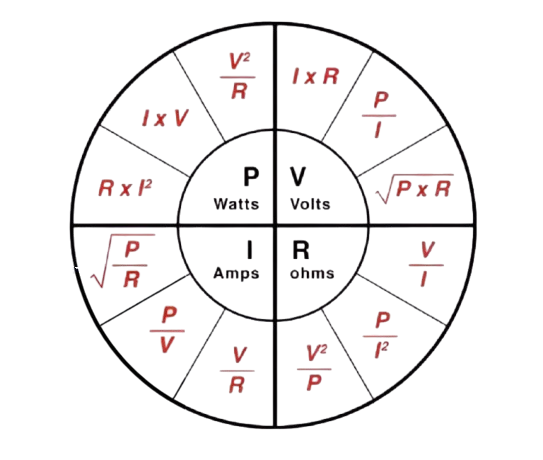
Stator Resistance Measurement: With the motor at complete rest, apply a low DC voltage to the phase terminals and measure the resulting current. Using Ohm's Law (R = V/I), calculate the phase resistance. For star-connected windings, the phase resistance is half of the line-to-line measurement. Ensure the motor remains stationary during measurement to avoid generating back EMF.
Rotor Resistance Estimation: While the permanent magnet rotor itself doesn't have measurable resistance in the conventional sense, the equivalent circuit resistance representing rotor losses can be determined by measuring terminal voltage and current under different load conditions and using the motor's equivalent circuit model to extract parameters.

2. Theoretical Calculation Method
Design Parameter Calculation: Using the known winding material resistivity (ρ), conductor cross-sectional area (A), and total length (L), the DC resistance can be calculated using the formula:
For AC resistance, additional factors like skin depth and proximity effect must be considered, especially at high frequencies.
Electromagnetic Field Analysis: Advanced software tools like ANSYS Maxwell, JMAG, or COMSOL can create detailed motor models that calculate not just the DC resistance but also the frequency-dependent impedance characteristics. These tools solve Maxwell's equations numerically to provide highly accurate predictions of motor parameters.
Locked Rotor Test: By locking the rotor in place and applying AC voltage at rated frequency while measuring voltage, current, and power, you can calculate the combined resistance and reactance using equivalent circuit analysis.
IV. Practical Considerations and Precautions
For most applications, measuring the resistance at ambient temperature and then applying temperature correction provides sufficiently accurate results. However, for precision applications or motor design validation, more sophisticated methods involving temperature-controlled testing may be necessary.
Frequently Asked Questions
Accurate resistance measurement is critical for several reasons: it affects efficiency calculations, temperature rise predictions, voltage drop calculations, and proper tuning of motor control algorithms. Inaccurate resistance values can lead to suboptimal performance, reduced efficiency, and even motor damage in extreme cases.
Copper windings increase resistance by approximately 0.4% per degree Celsius temperature rise. Aluminum windings increase by about 0.6% per degree Celsius. Always note the temperature during measurement and convert to a standard reference temperature (typically 20°C or 25°C) using the formula: Rref = Rmeasured / [1 + α(Tmeasured - Tref)], where α is the temperature coefficient of resistance.
DC resistance is the pure ohmic resistance measured with direct current. AC resistance includes additional effects like skin effect and proximity effect that cause current to distribute non-uniformly in conductors at higher frequencies, effectively increasing the resistance. For PWM-driven motors, the AC resistance at the switching frequency may be significantly higher than the DC resistance.
While a standard multimeter can give a rough estimate, it's not recommended for accurate measurements. Motor winding resistances are typically very low (milliohms), which is below the accurate measurement range of most standard multimeters. A specialized low-resistance ohmmeter or micro-ohmmeter using 4-wire Kelvin measurement is necessary for accurate results.
For critical applications, baseline measurements should be taken when the motor is new and in good condition. Periodic measurements (annually or biannually) can help track motor health. Significant increases in resistance may indicate deteriorating connections, while differences between phases may suggest turn-to-turn shorts or other winding issues.


