

In electric vehicle drive systems, the motor is the "heart" and the motor controller (MCU) is the "brain." For the brain to precisely control the heart's rhythm, it must rely on "eyes" to sense the motor's speed and rotor position in real time. These eyes are the Resolver Sensor.

1. What is a Resolver Sensor?
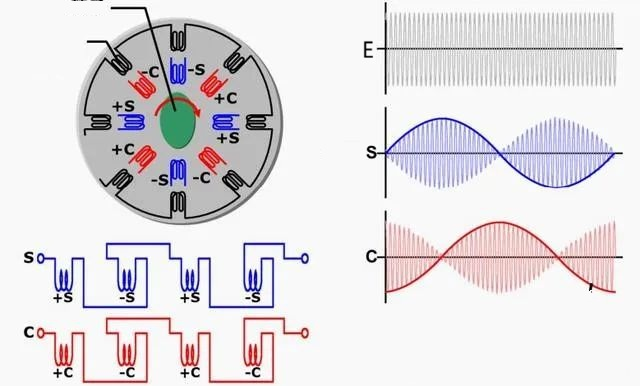
A Resolver is an angle/speed sensor based on electromagnetic induction principles. Essentially a special type of rotary transformer, it converts rotor angle information into electrical signals through electromagnetic coupling between stator and rotor windings, which are then processed by the motor controller.
Core Function:
The resolver doesn't directly output angle values but instead outputs two sets of sinusoidal (Sin) and cosine (Cos) voltage signals that vary with angle. These signals are processed by a Resolver-to-Digital Converter (RDC) chip to obtain precise angle and speed information.
2. The Core Role of Resolvers in Drive Motors
In Permanent Magnet Synchronous Motor (PMSM) or AC induction motor control, the core technology is Field-Oriented Control (FOC). FOC requires knowing the precise position of the rotor magnetic poles to achieve accurate decoupling of stator current and magnetic field, thereby achieving maximum efficiency and torque output.
Resolver Signal Output:
Outputs sinusoidal and cosine signals corresponding to rotor position
Resolver's Specific Responsibilities:
- Speed Detection: Provides real-time speed to ensure dynamic response of the control system.
- Position Detection: Provides rotor angle information to support FOC vector control, enabling precise motor commutation and torque control.
- Safety Redundancy: As a critical sensor, its functional safety must be ensured, typically achieved through dual-channel redundant design.
Without a resolver, there would be no precise control in high-performance electric drive systems.

3. Technical Characteristics and Advantages of Resolvers
Compared to other common position sensors (such as Hall sensors, encoders), resolvers offer the following outstanding advantages:
1. Extremely High Reliability
- Robust Structure: Pure electromagnetic structure with no optical or fragile components, resistant to oil, dust, and moisture.
- Strong Environmental Tolerance: High temperature resistance (typically operating temperature limit exceeds 150°C), vibration resistant, ideal for harsh motor compartment environments.
- Long Lifespan: No contact wear, theoretical lifespan matches the motor.
2. High Precision and High Resolution
- High Resolution: Through high-performance RDC chips, resolution up to 16-bit to 18-bit or higher can be achieved.
- Absolute Position Measurement: Obtains absolute angle immediately upon power-up, no need for homing.
- High Accuracy: Angle error can be controlled within ±0.05°, meeting high-performance servo control requirements.
3. Excellent Anti-Interference Capability
- Principle Advantage: Based on electromagnetic induction, insensitive to electromagnetic interference (EMI).
- Robust Signal: Output analog sine/cosine signals have large amplitudes, remaining stable in complex automotive electromagnetic environments.
Disadvantages:
- Higher Cost: The sensor itself and dedicated RDC chips increase system costs.
- Complex Signal Chain: Requires excitation signal generators and complex decoding circuits, with high requirements for calibration and installation alignment.
- Size and Weight: Typically larger than some newer sensors (such as magnetic encoders).
4. Comparison with Alternative Technology Solutions
| Sensor Type | Core Advantages | Main Limitations | Typical Applications |
|---|---|---|---|
| Resolver | Highest reliability, excellent anti-interference, high temperature resistance, long lifespan, high precision | Higher cost, complex system, relatively large size | High-performance EV drive motors, aerospace, industrial servos |
| Hall Sensor | Extremely low cost, simple circuitry, small size | Low precision, significant temperature drift, provides only rough position information | Low-cost fans, BLDC motor commutation |
| Optical Encoder | Highest resolution and precision, extremely fast response | Sensitive to contamination, vibration, not resistant to high temperature/humidity | Industrial robots in clean environments, CNC machines |
| Magnetic Encoder | Moderate cost, good precision, compact size, digital interface | Sensitive to strong magnetic interference, magnet performance may degrade at high temperatures | Mid-range EV motors, industrial frequency conversion drives, robotics |
In Summary:
- Hall Sensors have the lowest cost but limited precision, used in applications with lower performance requirements.
- Optical Encoders offer top-tier precision but are "delicate" and cannot withstand automotive-grade harsh environments.
- Magnetic Encoders have rapidly developed as alternatives in recent years, achieving a good balance between precision, cost, and size, and are beginning to replace resolvers in some cost-sensitive applications. However, in applications requiring the highest safety, reliability, and extreme environmental adaptability, resolvers remain the undisputed first choice.
Thus, resolvers are currently the mainstream high-reliability solution for drive motors while facing strong challenges from magnetic encoders in the mid-to-high-end market.
5. Conclusion: The Indispensable Precision Eye
In electric drive systems, the resolver, though seemingly small, is a critical component ensuring power performance and system safety. As the "eyes" of the motor, it allows the controller to "see clearly" and "see accurately," enabling powerful torque output and smooth driving control.
With technological evolution, resolvers, with their unparalleled reliability, will maintain their core position in high-end applications in the short term. Simultaneously, new technologies like magnetic encoders continue to advance with improving cost-effectiveness. In the future, the "eyes" of drive systems may present a coexistence of resolvers and magnetic encoders: resolvers remain foundational in areas demanding extreme reliability and safety-first considerations, while high-performance magnetic encoders will occupy more share in mass markets with higher cost and integration requirements.
For engineers and decision-makers, understanding the characteristics of these "eyes" is the first step in selecting the optimal sensing solution for electric drive systems.
Need Expert Advice on EV Motor Sensors?
Get professional consultation on resolver selection, integration, and troubleshooting for your electric vehicle motor applications.
Request Sensor Technology Consultation