

When driving an advanced electric vehicle, the silky, quiet and responsive power experience is often impressive. Unlike the mechanical roar of traditional fuel vehicles, one of the core mysteries of the excellent performance of the electric drive system is hidden in the precise algorithm of the motor controller.
Whether it is an engineer who pursues extreme efficiency or a car owner who is curious about technology, understanding how FOC is like a wise "horse driver" who accurately tames the electromagnetic force of the motor will help us better appreciate the depth and elegance of modern electric drive technology. It is not only the key to achieve efficient, stable and low-noise operation, but also the silent hero behind the improvement of electric vehicle endurance and optimization of driving texture.
1. What is Motor FOC Control?
FOC (Field-Oriented Control) is a field-oriented control, also known as vector control, which is a technology that uses a frequency converter (VFD) to control a three-phase motor. The output of the motor is controlled by adjusting the output frequency, output voltage and angle of the frequency converter. Because the three-phase output current and voltage are represented by vectors during processing, it is called vector control.

FOC control is a kind of control method by abstracting and simplifying the motor motion model. Based on the mathematical model of the motor, it calculates the optimal switching and on-off states of the MOS transistor by measuring the parameters of current, speed and position, so as to realize the precise control of the motor. FOC is an efficient motor control method, which is mainly used in brushless DC motors and permanent magnet synchronous motors.
2. FOC Control Principle
2.1 Rationale
Field-oriented control (FOC) is also called vector control. Its basic idea is to select a certain rotating magnetic field axis of the motor as the set synchronous rotating coordinate axis. In the brushless DC motor, there are three kinds of rotating magnetic field axes: rotor magnetic field, air-gap magnetic field and stator magnetic field. In general, the rotor field is chosen as the synchronous axis of rotation for FOC control.

The basic method of FOC is to decompose the sinusoidal stator current into the magnetic field component current parallel to the magnetic field and the torque component current perpendicular to the magnetic field through coordinate transformation, which are called direct axis current and quadrature axis current respectively, and to control these two currents. This decomposition makes the flux current component and the torque current component completely decoupled, similar to the square wave drive control, thus achieving stable and high-performance control.

In fact, FOC controls the direction of the electromagnetic field of the motor, and the size and direction of the magnetic field have a direct relationship with the size and direction of the current, so the core of using FOC control algorithm to control the brushless DC motor BLDC is to control the size and direction of the three-phase input current.
Key Principle: Torque Maximization
The rotor moment of the rotor is proportional to the vector product of the stator magnetic field vector and the rotor magnetic field vector. According to the vector relationship, if the torque of the motor is maximized, the stator magnetic field vector should be perpendicular to the rotor magnetic field vector.
For the direction control of input current, FOC gives the concept of space current vector. Its essence is to combine the three-phase current vectors and then decompose them into two components perpendicular and parallel to the direction of the rotor magnet axis, that is, the d-q structure. Clark transformation and Park transformation can convert three-phase current into two-phase DC current.
The magnetic field produced by the current component in the vertical direction is orthogonal to the magnetic field of the rotor, which produces a rotating torque, and the resulting motor torque is proportional to the magnitude of this current component; The current component parallel to the magnetic axis of the rotor produces a magnetic field that is consistent with the magnetic field of the rotor and does not produce any torque.
2.2 Key Points
A good control algorithm needs to minimize the current component parallel to the magnetic axis of the rotor, because this current component will only generate excess heat in the motor and aggravate the wear of the bearings. Maximize the current component perpendicular to the magnetic axis of the rotor.
In order to minimize the stator current vector in the same direction as the rotor magnetic field and maximize the vertical magnetic field, the sinusoidal current in the stator coil needs to be adjusted in phase with the rotation angle of the rotor in real time.
2.3 Realization
A P-I controller can be established by controlling the stable three-phase current input, and the P-I controls the modulation input. Once the motor current is converted into a d-q structure, the control becomes simple. We need two P-I controllers: one to control the current parallel to the rotor field and one to control the current perpendicular to the rotor field.

The control signal of the parallel current is zero, so the parallel current component of the motor becomes zero, which drives the current vector of the motor to be converted into the vertical current. The efficiency of the motor is maximized because only the perpendicular current can produce the effective torque.
The control signal of the vertical current comes from the request, and the other P-I controller is used to control the vertical current to obtain the demand torque consistent with the input signal. This allows the vertical current to be controlled as required to obtain the desired torque.
Torque Formula
The rotor torque is proportional to the vector product of the stator magnetic field vector and the rotor magnetic field vector. Based on the above, the key to control the current to generate the stator magnetic field perpendicular to the rotor magnetic field is to control the stable three-phase input voltage and its current vector, and to obtain the position of the rotor in real time.
2.4 Determination of Rotor Position
There are two ways to determine the real-time position of the rotor: with position sensor and without position sensor.
For the motor with sensor, because the sensor (generally encoder) of the motor can feedback the position information of the motor rotor, the position estimation algorithm can not be used in the control, and the control is relatively simple without sensor, but for the motor application with sensor, the control performance requirements are often higher.
For the sensorless motor, because the motor does not have any sensor, the rotor position information can not be obtained by simply reading the measured values of the sensor, so in the control, the rotor position is calculated by collecting the phase current of the motor and using the position estimation algorithm.

3. Control Process
FOC control is mainly composed of five modules: Clark transformation, Park transformation, PID control, Park inverse transformation and SVPWM control.
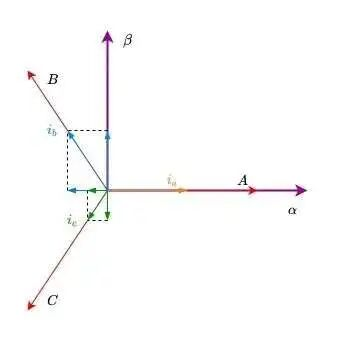
Acquire three-phase current ia, IB, IC. In a three-phase stator coordinate system, the phase difference of the three-phase current of the motor is 120 degrees. After Clarke transformation, the two orthogonal current quantities Iα, Iβ and time-varying signals are obtained. Clark transformation is the process of transforming the three-phase stator coordinate system into the two-phase stationary coordinate system.
Iα and Iβ are transformed by park rotation to obtain the orthogonal current quantities Id and Iq in the rotating coordinate system, where Iq is related to the torque and Id is related to the magnetic flux. When the motor reaches the steady state, Id and Iq are constants, and the rotor position used at this time is the angle value calculated in the last iteration. In actual control, Id is often set to 0.
The reference value of Id determines the magnetic flux of the motor rotor, the reference value of Iq determines the torque output of the motor, and the difference between the actual value and the reference value of the two is used as the input of the current loop PI controller. Iq and Id obtained in the third step are respectively sent to the PI regulator to obtain corresponding outputs Vq and Vd, which are voltage vectors to be applied to the motor winding.
The orthogonal voltage values Vα and Vβ of the two-phase stationary coordinate system are obtained by the inverse transformation of the new motor rotor position, Vq and Vd.
Vα and Vβ are subjected to Clarke inverse transformation to obtain the three-phase voltage actually required, which is input to the inverter bridge to drive the motor to rotate. The SVPWM algorithm is used to determine which sector the synthesized voltage vector is located in, and the conduction time of each three-phase bridge arm switch tube is calculated. Finally, the three-phase inverter drives the module to output the three-phase voltage required by the motor.

4. FOC Advantages and Disadvantages
- The FOC control makes the switching and on-off process of each MOS tube regular, thus ensuring the stable operation and high performance of the motor.
- The FOC enables efficient and smooth motor control with fast dynamic response and low noise.
- From the sampling of three-phase current, through Clark and Park transformation, it is "translated" into direct and quadrature axis components which are easy to control, and then accurately regulated by PID controller.
- For electric vehicle, the efficiency and smoothness brought by FOC technology are directly transformed into longer endurance mileage and more advanced driving texture.
- Requires more complex algorithms and higher computational power compared to simpler control methods.
- Implementation requires precise motor parameters and accurate position sensing.
- Higher development and implementation costs initially.
- More sensitive to parameter variations and requires robust tuning.
Conclusion: The Future of EV Motor Control
FOC control is not only the realization of technology, but also a philosophy of pursuing the ultimate control: making every current "make the best use of everything", only producing useful torque, not loss and noise. With the improvement of chip computing power and the continuous optimization of algorithms, FOC control is becoming more intelligent and efficient.
It will continue to be the "intelligent core" of the electric drive system, silently escorting every electric journey, so that strong power and quiet efficiency can coexist perfectly. In the future, this technology will be more deeply integrated with the vehicle control system, laying the foundation for the realization of higher-level automatic driving and energy management.
Interested in Advanced EV Motor Control Solutions?
Learn how FOC technology can optimize your electric vehicle's performance, efficiency, and driving experience. Get expert consultation on motor control systems.
Schedule Your FOC Technology Consultation