

Have you ever wondered why professional racing cars are so stable when cornering at high speed, while ordinary family cars are prone to sideslip? Or, in everyday driving, do you notice uneven tire wear?
Behind this lies a crucial but often overlooked suspension parameter: the Camber Angle.
As one of the core elements of vehicle suspension system, camber angle not only affects the vehicle handling performance, but also directly relates to driving safety and tire life.
We will deeply analyze the function and principle of wheel camber angle in an easy-to-understand way. Whether you are a car enthusiast, a novice driver, or a learner in the field of engineering, this article will take you through the mystery of suspension design. From the basic definition to the practical application, we will explore step by step how the camber angle can greatly improve the performance of the vehicle in the corner through simple angle adjustment.
What? Camber Angle
Camber is the angle between the vertical (y) axis of the vehicle and the vertical axis of the wheel, viewed from the front to the rear of the vehicle. It is one of the key points in the design of suspension and steering systems.
Positive Camber when the top of the wheel is more distant from the vertical axis of the vehicle than bottom of the wheel; Otherwise, it is Negative Camber.
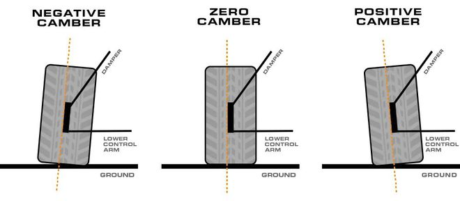
Definition and classification of wheel camber
Camber is the angle between the central plane of the wheel and the longitudinal vertical plane.
According to the inclination direction of the upper end of the tire, it can be divided into:
- Positive camber angle:The upper end of the tire is inclined outward, showing a “V” shape. In traditional design, it is often used to counteract the tendency of wheel inclination caused by suspension deformation after full load.
- Negative camber angle:The upper end of the tire is inclined inward, showing a “eight” shape. Many modern models, especially sports cars or some new energy vehicles that focus on handling, will adopt a certain negative camber design to improve the grip of corners.
- Zero camber angle:The wheel is completely perpendicular to the ground, which is the ideal condition for the maximum contact area of the tire in theory.
What is the function and principle of extraversion?
Increase the contact area between tire and ground when cornering
Negative camber is usually seen on racing cars, which is set to enhance the grip of the vehicle when cornering.
When the vehicle is cornering, due to inertia, the outside wheel load increases, and the body will have a certain degree of roll (when the vehicle turns left, inertia makes the passengers fall to the right). If the wheel has a negative camber angle at this time, it can offset this part of the roll and maximize the tire contact surface of the outside wheel, thus improving the grip and enhancing the stability of cornering.
Contact Patch is the area of each tire in contact with the road surface, and the area of this surface changes continuously as the vehicle travels.
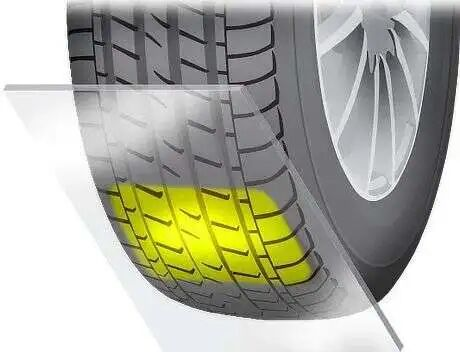
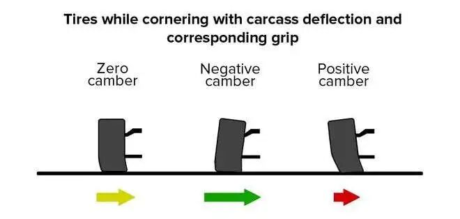
Usually, the wheel will also tilt outward with the body roll, but the relative amplitude is small (such as the lower left), at this time, the contact area of the tire will become smaller.
By increasing the negative inclination angle, we can make up for this situation and increase the tire contact area when cornering (as shown in the middle of the figure below).
Of course, too much negative inclination will go to the extreme in the other direction, which will also have a negative impact on grip.
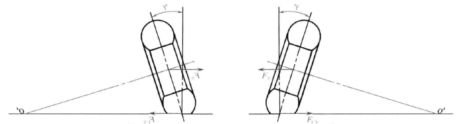
Aligning moment
When the two front wheels of the automobile have a camber angle gamma, they have a tendency to roll around the intersection point O ‘of their respective rotation axes and the ground, and if they are not constrained, they will deviate from the front and roll to the left and right respectively.
In fact, due to the constraint of the front axle, the two wheels can only move forward together, so there must be a lateral force Fy acting at the center of the wheel, pulling the wheel back to roll forward in the same direction. At the same time, the tire ground contact surface produces a lateral reaction force opposite to Fy, which is the camber force FYγ.
Central role of wheel camber
Generally speaking, the role of wheel camber in new energy vehicles is mainly reflected in the following aspects:
- Improve safety and prevent wheel from coming out:this is the most original and fundamental role. Due to assembly clearances between suspension components such as kingpins and bushings, hub bearings, these clearances can cause the wheels to lean inward (i.e., lean inward) when the vehicle is fully loaded. The inward inclination of the wheel will cause the vertical reaction force of the ground to produce a component force that pushes the wheel outward, increase the load of the outer bearing, and in serious cases, there is a risk that the wheel will come out. Presetting a positive camber angle allows the ground support force to generate a component force along the axial direction of the steering knuckle, which “presses” the wheel inward, thus transferring more load to the stronger inner large bearing, effectively improving safety.
- For easy steering and improved driving stability:
- Reduce the steering torque:the wheel turns around the kingpin axis when steering. There is a distance between the kingpin axis and the intersection of the tire centerline with the ground, called the offset. The greater the offset, the greater the steering resistance torque generated by the tire rolling resistance. A reasonable camber angle can reduce this offset, thus making the steering lighter.
- Coordination with the kingpin inclination angle:the front wheel camber angle and the kingpin inclination angle cooperate with each other to further facilitate the steering of the vehicle and enhance the automatic alignment capability.
- Enhanced high-speed stability:For vehicles with the same rear wheel camber angle setting (most independent rear suspension models), the appropriate rear wheel camber angle can make the rear wheel obtain the appropriate slip angle, which is helpful to improve the handling stability of the vehicle at high speed and prevent instability such as “sharp turn”.
- Optimize load distribution and protect components:As mentioned above, the correct positive camber angle can distribute the vertical load more reasonably on the hub bearing, avoid overloading the outboard bearing and lock nut, and thus prolong its service life. On the contrary, if the camber angle is not set properly (for example, the negative camber angle is too large), the wear of the inboard bearing will be aggravated; if the positive camber angle is too large, the wear of the outboard bearing will be aggravated.
- Special significance to electric vehicle:
- Endurance:The setting of the camber angle affects the contact pattern and rolling resistance of the tire. Proper setting can reduce unnecessary resistance, which has practical significance for maximizing the range of new energy vehicles.
- Managing the impact of driving torque:For new energy vehicles with front-wheel drive, proper positive camber angle can reduce the abnormal tire wear caused by torque steering characteristics when the driving wheel accelerates, which helps to prolong the tire life.
Camber angle is a small geometric parameter, but it plays an important role in vehicle dynamics. It not only optimizes the tire contact area when cornering, but also improves the stability of straight-line driving through the return moment.
In practical applications, the setting of camber angle needs to balance a variety of factors: for example, negative camber angle can enhance the performance of corners, but excessive use will lead to increased wear on the inside of tires when driving straight and increase fuel consumption.
As a result, automotive engineers often fine-tune the vehicle according to its purpose, such as racetrack racing, daily commuting, or off-road driving.
With the development of intelligent vehicles and the trend of electrification, the dynamic adjustment technology of camber angle is becoming a research hotspot, which may be able to achieve real-time optimization in the future to adapt to different road conditions.

