

When you sit in a modern electric vehicle, the window slides down silently at the touch of a button. Adjust the knob to change the air volume of the air conditioner.
Behind these seemingly simple and instantaneous responses, there is actually a set of sophisticated low-cost communication network, LIN bus.
In the complex system of electric vehicle, which is composed of battery, motor and supercomputing platform, not all components need the high speed and strong real-time of CAN-bus.
LIN bus is like a silent and efficient “logistics steward”, which is responsible for dealing with those control tasks that do not require high speed and fault tolerance, but are extremely sensitive to cost.
It separates comfort functions such as wipers, windows and seat adjustment from the backbone network, so that CAN and on-board Ethernet can focus more on core areas such as power, chassis and intelligent driving.
The LIN bus is complementary to the CAN bus.
It has lower performance and reliability, but it also costs substantially less. Below we will give a brief overview of the LIN bus and compare it to the CAN bus.
- Low-cost options (if speed/fault tolerance is not critical)
- It is often used in vehicle windows, wipers, air conditioners, etc.
- A LIN cluster consists of one master node and up to 15 slave nodes.
- Single wire (with ground wire), transmission rate 1-20 kbit/s, bus length up to 40 meters.
- Timed Trigger Scheduling with Guaranteed Delay Time
- Variable data length (2, 4, 8 bytes)
- LIN supports error detection, checksumming, and configuration
- 12 V/24 V operation
- Physical layer based on ISO 9141 (K-line)
- Sleep mode and wake-up support
- Most new vehicles are equipped with more than 10 LIN nodes.
Comparison of basic features: LIN vs. CAN vs. Vehicle Ethernet
In the communication architecture of EV, LIN, CAN and on-board Ethernet usually form a hierarchical collaborative network, each playing different roles in bandwidth, real-time and cost.
| Characteristic | LIN bus | CAN bus | In-vehicle Ethernet |
| Communication rate | Up to 20 kbps | Up to 1 Mbps (classic CAN), 5 to 10 Mbps (CAN-FD) | 100 Mbps ~ 10 Gbps |
| Topology | Master-slave structure (single master control unit) | Multimaster bus structure (without central node) | Star/Tree Topology (Switch-Core) |
| Cable type | Single-wire transmission | Twisted pair differential (CAN _ H/CAN _ L) | Single twisted pair or shielded twisted pair |
| Real-time | Low (millisecond latency) | High (microsecond latency) | Medium (optimized to microsecond level depending on TSN technology) |
| Cost | Very low (simplified design), about 1/3 to 1/2 of CAN | Medium (mature hardware) | High (Requires dedicated PHY chip/switch) |
| Number of nodes | Up to 16 (1 master + 15 slaves) | Theoretically up to 110 | Depending on the switch port |
Differences between protocols and application scenarios
Different technical characteristics determine their respective core application scenarios.
- LIN Bus:The Savior of Low Cost Slave Node
- Protocol features:based on the universal UART/SCI interface, the hardware requirements are simple; the communication is scheduled by the master node, which is deterministic; The slave node can realize self-synchronization by analyzing the synchronization field without a high-precision crystal oscillator, thereby further reducing the cost.
- Core application scenario:It is mainly used in non-safety-critical control fields with low requirements for network speed, real-time performance and fault tolerance. In EV, typical applications include:
- Electric door and window control, seat adjustment, lighting.
- Windshield wiper, sunroof, rearview mirror adjustment, etc.
- As a sensor/actuator expansion bus, it connects low-speed devices such as temperature and humidity sensors. A specific case is that in the distributed battery management system (BMS), LIN bus can be used to connect the detection units of each single battery to collect voltage, temperature and other parameters.
- CAN-Bus:the “Backbone” of Automotive Control Network
- Protocol features:non-destructive arbitration (ID priority), broadcast communication, short frame structure (8 bytes of data), high reliability and strong anti-interference capability.
- Core application scenarios:used for safety-critical control and areas requiring high real-time performance.
- Power control:torque request and battery status transmission among VCU (Vehicle Control Unit), BMS (Battery Management System) and MCU (Motor Control Unit).
- Body control:interaction of door and window status (usually as the upper gateway of LIN network).
- Diagnostic system:OBD fault code reading (based on UDS protocol).
- Vehicle Ethernet:“Data Aorta” in the Age of Intelligence
- Protocol features:TCP/IP protocol stack is supported, and the bandwidth is extremely high, but the switch is usually required for data forwarding.
- Core application scenario:carrying high-bandwidth data flood.
- Intelligent driving:raw data transmission of camera and radar (> 100MB/s).
- Infotainment:online navigation, multi-screen interaction.
- OTA upgrade:ECU software flash (GB level data volume).
Example: LIN and CAN Window Control
LIN nodes are usually bundled together in clusters, each with a master node connected to the backbone CAN bus.
For example, in the right seat of a car, you can roll down the left window. To do this, you need to press a button to send a message via one LIN controller to another LIN controller over the CAN bus. This triggers the second LIN controller to roll down the left-hand window.
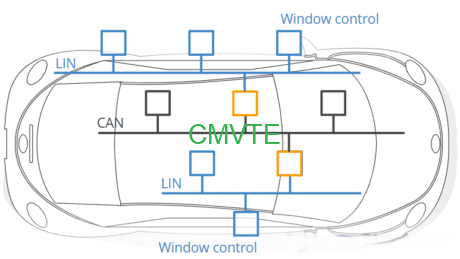
LIN bus application
Today, the LIN bus is the de facto standard for almost all modern vehicles – here are some examples of automotive applications:
- Steering wheel:cruise control, wiper, air conditioning control, radio
- Comfort:equipped with temperature, sunroof, light and humidity sensors
- Powertrain:position, speed, pressure sensors
- Engine:small motor, cooling fan motor
- Air conditioner:motor, control panel (air conditioner is usually complex in structure)
- Doors:side mirrors, windows, seat controls, locks
- Seat:position motor, pressure sensor
- Other:Wiper, rain sensor, headlights, airflow
In addition, the LIN bus is also used in other industries:
- Household appliances:washing machine, refrigerator, stove
- Automation:manufacturing equipment, metal processing
The Future of LIN Bus
The LIN protocol is playing an increasingly important role in providing low-cost feature extensions for modern vehicles.
As a result, LIN bus transceiver usage is expected to grow steadily at 5-10% per year, in line with the expected growth of CAN bus transceivers. Clearly, this anticipated growth is in tandem with the anticipated rise of automotive Ethernet, demonstrating the belief that LIN (and therefore CAN) will continue to play a key role in the automotive space for many years to come.
LIN bus, with its “just right” design philosophy, plays an irreplaceable role in the huge symphony of automotive electronics.
It proves that not all technological advances point to higher bandwidth and faster speeds. In cost-sensitive and function-specific areas, extreme simplicity and optimization is a powerful competitive force in itself.
With the continuous evolution of automobile to “software definition” and global intelligence, on-board Ethernet will assume the responsibility of data backbone, but the reliable and economical control network layer composed of LIN and CAN will still be the basis for realizing massive body and comfort functions.
In the future, we may see more cases of LIN’s deep integration with intelligent gateways, so that the simple actuators it manages can also be integrated into the torrent of vehicle intelligence.
