

You yank the gas engine out of your classic car or farm UTV for an EV conversion — and suddenly your steering turns into a full-arm workout. That is because your old hydraulic power steering (HPS) pump was driven by the engine belt. No engine, no pump, no assist. The fix? A $280 CMVTE EPS kit that outperforms US retailer kits costing $749+ — with zero hydraulic fluid, zero leaks, and zero maintenance.
Does EPS Use Fluid? No — And That Is the Whole Point
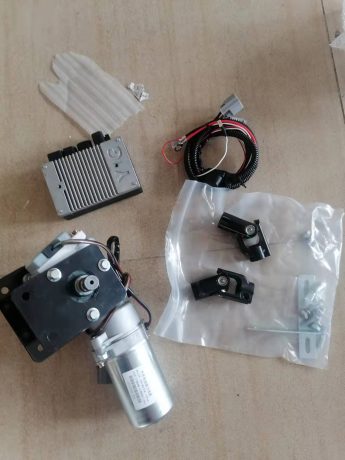
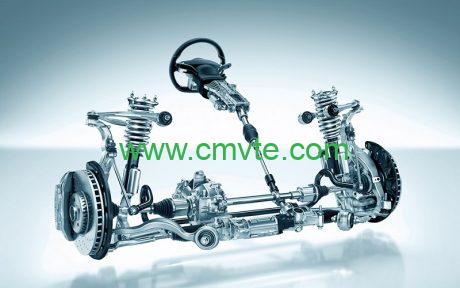
Electric Power Steering (EPS) replaces the hydraulic pump, fluid reservoir, hoses, and steering gear of a traditional HPS system with a single compact electric motor and ECU. There is no fluid to leak, no pump to fail, no belt to snap. The motor reads torque from your steering wheel via a sensor and applies assist instantly — only when you need it. At highway speed, it draws near-zero power. In a parking lot, it delivers full assist without breaking a sweat.
This makes EPS the only practical steering solution for EV conversions. You cannot run a hydraulic pump without an engine. But you can wire a 12V EPS motor directly to your EV battery pack (or step down via a DC-DC converter) and have power steering back in an afternoon.
A common myth is that EPS feels "artificial" compared to hydraulic systems. In reality, modern EPS offers speed-sensitive variable assist — light steering in parking lots, firm feedback on the highway — that no hydraulic system can match. And because there is no pump constantly dragging on the engine (or in your case, on your battery pack), EPS improves your EV's effective range by eliminating parasitic loss.
$280 vs. $749: Why US Retailer EPS Kits Cost 2.5x More
| Feature | CMVTE EPS Kit (12V) | US Parts Retailer Kit |
|---|---|---|
| Price | $280 – $300 | $749 – $900 |
| Torque | 35 Nm (Lite) / 55 Nm (Pro) | ~32 Nm typical |
| Voltage Options | 12V / 24V / 48V | 12V only |
| IP Rating | IP65 – IP67 | IP67 |
| Control | PWM / Analog / CAN Bus | Analog only |
| Warranty | Factory direct support | Limited 1-year |
| Shipping | 130+ countries, DDP | US/CA only typically |
Even with shipping from our Foshan factory to your door, a CMVTE EPS kit lands at roughly one-third the cost of a US retailer equivalent. Because we make the motor, the controller, and the ECU in-house — no import trader, no regional distributor, no markup.
Which EPS Kit Do You Need? Match by Vehicle Weight
CMVTE offers two universal EPS lines, plus custom configurations for unique builds:
- CMVTE Lite (12V, 35 Nm): For vehicles under 1,000 kg — Mini Cooper, Fiat 500, classic Beetle, Suzuki Carry, Kei cars, lightweight UTVs. Plug-and-play install, PWM control, IP65 rated. $280.
- CMVTE Pro (48V, 55 Nm): For vehicles 1,000-2,500 kg — Toyota Corolla, VW Golf, Land Cruiser, Chevrolet C10, farm trucks, heavy UTVs. CAN bus + analog control, IP67 waterproof. $550.
- Custom EPS: Need 24V? Higher torque? Special spline pattern? We can modify shaft dimensions, mounting brackets, and connector types at the factory — no upcharge for customization.
Install in Under 4 Hours
Unlike chasing down a used hydraulic pump from a junkyard and fabricating mounting brackets and hose routing, a CMVTE EPS kit bolts inline with your existing steering column. The kit includes the motor-gearbox unit, ECU, wiring harness, torque sensor, fuse holder, and mounting hardware. Basic steps:
- Disconnect battery and remove steering wheel.
- Cut and remove the old steering shaft section (if needed).
- Mount EPS motor to column using supplied brackets.
- Connect power (12V to battery with 40A inline fuse), ground to chassis, and torque sensor between wheel and motor.
- Calibrate assist level — done.
For EV conversions, run power through your DC-DC converter or direct to the 12V auxiliary battery. The system draws under 2A average during normal driving, so it will not drain your traction pack. Most builders complete the mechanical install in 2-3 hours and wiring in under an hour — no special tools required beyond a cutoff wheel, a drill, and basic hand tools.
CMVTE provides wiring diagrams and calibration instructions with every kit. If you get stuck, our engineers are available via WhatsApp to walk you through it — a level of support no US parts retailer can match when you are buying a shelf-shipped box.

Stop Fighting Your Steering — Switch to EPS Today
Your EV conversion deserves a steering system that is as modern as the electric drivetrain you are installing. Hydraulic pumps are obsolete in the EV world. CMVTE EPS kits are factory-direct, priced without middleman markup, and built to bolt into everything from classic coupes to farm utility vehicles across 130+ countries.
🔧 Contact CMVTE now with your vehicle model and weight — we will recommend the right EPS kit within 24 hours. Ships factory-direct worldwide.

