CAN communication is the cornerstone of automotive intelligence, but small reflected fluctuations in signal transmission can lead to catastrophic failure
This is where termination resistor matching comes into play. This seemingly ordinary electronic component solves the core problem: impedance discontinuities cause signal distortion, ensuring flawless communication quality. In increasingly complex in-vehicle networks, ignoring this can lead to communication delays, data loss, and even security incidents.
The design principle of the CAN termination resistor is very important. It is not only about technical details, but also about the safety and reliability of daily driving. This article will take you into this microcosm, analyzing the basic concepts to practical applications, and revealing why the 120 ohm resistor has become the core guardian of industry standards.
Table of Contents
Toggle1. Basic Concepts
(1) Signal Reflection
According to the principle of transmission line, when the signal encounters impedance discontinuity during transmission (such as entering the load from the transmission line), the reflected wave will be generated, and the reflected signal superimposed on the original signal will change the shape of the original signal, resulting in the loss or distortion of the signal, affecting the quality of communication or even unable to communicate normally.
(2) Impedance
In a circuit with resistance, inductance, and capacitance, the resistance to the flow of current in the circuit is called impedance.
Wherein R is resistance; ωL is inductive reactance; 1/ωC is capacitive reactance.
- When (ωL - 1/ωC) > 0 → Inductive load
- When (ωL - 1/ωC) < 0 → Capacitive load
(3) Impedance Matching
A suitable match between a signal source or transmission line and a load. The load impedance is matched with the internal impedance of the excitation source to obtain a working state of maximum power output.
Impedance matching is divided into low frequency and high frequency. An actual voltage source always has an internal resistance, and an actual voltage source is equivalent to a model of an ideal voltage source in series with a resistance R.
(4) Low Frequency Circuit
Generally, the matching problem of the transmission line is not considered, and only the situation between the signal source and the load is considered. Because the wavelength of the low-frequency signal is very long relative to the transmission line, the transmission line can be regarded as a "short line" (the line length is shorter), and the reflection can be ignored.
(5) High Frequency Circuit
Reflection must be considered. When the frequency of the signal is very high, the wavelength of the signal is very short. When the wavelength is as short as the length of the transmission line, the reflection signal superimposed on the original signal will change the shape of the original signal. If the characteristic impedance of the transmission line is not equal (i.e., mismatched) to the load impedance, a reflection occurs at the load.
(6) Characteristic Impedance
In the process of signal transmission in the transmission line, at a point where the signal arrives, an electric field will be formed between the transmission line and the reference plane. Due to the existence of the electric field, an instantaneous small current will be generated, which exists at every point in the transmission line. At the same time, the signal also increases a certain small voltage, so that in the process of signal transmission, each point of the transmission line will be equivalent to a resistance.
The characteristic impedance of the transmission line is determined by the structure and material of the transmission line, and is independent of the length of the transmission line and the amplitude and frequency of the signal.
Where Z₀ is the ratio of the voltage amplitude to the current amplitude of a wave in a transmission line; L is the inherent inductance of the transmission line per unit length; C is the intrinsic capacitance of the transmission line per unit length.
(7) Equivalent Impedance
The equivalent impedance, Z, is defined as the ratio of voltage to current at that location on the transmission line.
Note: The characteristic impedance is the ratio of the incident wave or the reflected wave, while the equivalent impedance is the ratio of the incident wave and the reflected wave at a specified position after they are superimposed.
For lossless transmission lines, the characteristic impedance is fixed, while the equivalent impedance varies with location.
2. Function of Terminal Resistance
(1) Absorb Signal Reflections and Echoes
The largest source of signal reflections is impedance discontinuity and mismatch. Terminal resistors help absorb these reflections, preventing signal distortion.
(2) Improve Signal Quality
Placed at both ends of the bus to reduce the reflected energy. In the case of high conversion rate, the signal edge energy will produce signal reflection when it meets the impedance mismatch. As the geometry of the transmission cable cross-section changes, the characteristic impedance of the cable changes, which also causes reflections.
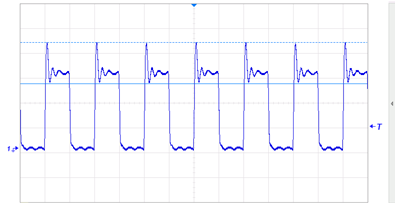
When the energy is reflected, the reflected waveform is superimposed with the original waveform, resulting in ringing. At the end of the bus cable, a sharp change in impedance causes the signal edge energy to be reflected, and ringing occurs on the bus signal. If the ringing amplitude is too large, the communication quality will be affected. Adding a termination resistor at the end of the cable, which is consistent with the characteristic impedance of the cable, can absorb this part of energy and avoid ringing.
(3) Improve Anti-interference Capability
Ensures the bus quickly enters a recessive state and allows the energy of the parasitic capacitor to dissipate more quickly.
A. Anti-interference Capability
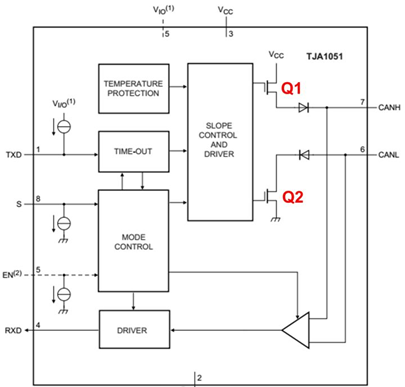
When the bus is dominant ("0"), Q1 and Q2 inside the transceiver are conducted, and a voltage difference is generated between CANH and CANL. When the bus is recessive ("1"), Q1 and Q2 are cut off, CANH and CANL are in passive state, and the voltage difference is 0.
If there is no load on the bus, the value of the recessive time difference resistor is very large, and the external interference only needs a very small amount of energy to make the bus enter the dominant state. If there is differential mode interference, there will be obvious fluctuations on the bus.
B. Quickly Enter Recessive State
During the dominant state, the parasitic capacitance of the bus is charged; These capacitors need to be discharged when returning to the recessive state. In order to discharge the bus parasitic capacitance quickly and ensure that the bus enters the recessive state quickly, a load resistor needs to be placed between CANH and CANL.
3. Terminal Resistance Matching
The ISO 11898 requires a nominal cable impedance of 120 ohms, so a termination resistor of 120 ohms should be used.
Note:
- The characteristic impedance of any cable can be obtained by experiment
- 120Ω is measured, not calculated. It is calculated according to the actual harness characteristics
- The terminal matching resistance is equal to the characteristic impedance of the transmission cable, which is provided by the cable supplier and is generally approximated as Z = √(L/C). Where L is the inductance per unit length of the cable and C is the capacitance per unit length of the cable
4. Terminal Resistor Layout
In the matching of the termination resistor, the termination resistor must be placed at the farthest two ends. If one of them is placed in the middle, the CAN transceiver A1 outside the termination resistor is on the branch, which will greatly increase the signal reflection of the node, thereby affecting the bus communication.
(1) High-speed CAN
The high speed CAN configures a termination resistor for each of the pair of signal lines (CAN_H and CAN_L). This is because there is data flow in both directions on the CAN bus.
(2) Low-speed CAN
Each data line of each device on the low-speed CAN network needs to be configured with a termination resistor. Unlike high speed CAN termination, low speed CAN requires the termination resistor to be terminated at the transceiver rather than at the cable.
5. Judgment of Terminal Matching Resistance
(1) Voltage Amplitude of Differential Signal
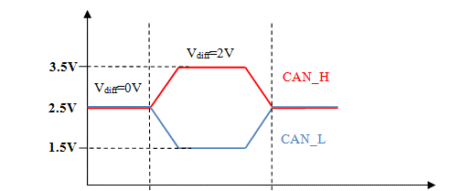
When the two signal lines CAN_H and CAN_L are static, they are both about 2.5V. At this time, the state represents logic 1, which is called recessive. CAN_H higher than CAN_L indicates logic 0, which is called dominant. At this time, the voltage of CAN_H is 3.5V and the voltage of CAN_L is 1.5V.
| CAN Bus State | CAN_H Voltage | CAN_L Voltage | Differential Voltage |
|---|---|---|---|
| Recessive (Logic 1) | 2.5V | 2.5V | 0V |
| Dominant (Logic 0) | 3.5V | 1.5V | 2.0V |
- A differential voltage > 0.9 V on the CAN bus must be recognized as a dominant level
- A differential voltage < 0.5V on the CAN bus must be recognized as a recessive level
- The level between 0.5 and 0.9 of the differential voltage on the CAN bus cannot determine the level polarity
(2) Evaluate Whether Terminal Matching Resistance is Added
The magnitude of the CAN differential voltage is measured to evaluate whether the termination matching resistor is added or not. It has been shown that an incorrect resistor layout can cause a communication breakdown, reminding engineers that the differential voltage magnitude must be rigorously tested in their designs.
Conclusion
With the development of automotive intelligence, electric vehicles and autonomous driving are increasingly dependent on CAN-bus, which may face the challenge of more high-frequency signals in the future. However, the core principle remains the same: optimizing terminal matching is the key to reliability.
The proper matching of CAN terminal resistors is not merely a technical detail but a critical factor ensuring the safety and reliability of modern electric vehicles. By understanding the principles of impedance matching, signal reflection, and proper resistor placement, engineers can design robust communication systems that withstand the demands of next-generation automotive applications.