EV Conversion Kit Parts: Complete Component Breakdown

Understanding the pieces in an electric vehicle (EV) conversion kit is crucial in assuring the electric build is safe, efficient, and reliable. Because there is an increase in interest in doing EV conversions, having some understanding of the pieces in an EV conversion kit allows for avoiding mistakes that could be damaging, and ensuring that performance meets expectations. This guide covers the most important components, detailing their purposes and value, and how systems like those of CMVTE’s high quality systems provide expert quality results for any vehicle platform.

What Is an EV Conversion Kit? 

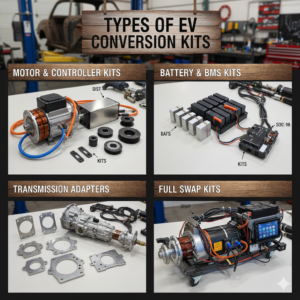
Types of EV conversion kit e1763710868788

An EV conversion kit is an assemblage of tools and elements which allows for the conversion of the vehicle to an electric powertrain, in place of the internal combustion components. The completeness of the conversion kit varies, as some come with the electrical motor along with the control systems, while others have added accessories in the bundle like complete battery systems, coolers, electric wiring, and charging devices. CMVTE is known for customizing their kits to specific vehicle types enabling optimal fitment and performance, while ensuring all elements are compatible with sedans, SUVs, motorbikes, and even commercial vehicles.

Essential Components Inside Every EV Conversion Kit

1. Electric Motor

In every EV conversion, the electric motor is the most important component as it is responsible for providing torque and propulsion. For operational efficiency, most kits have AC or permanent magnet synchronous motors (PMSM) but DC motors are also an option for kits that have lower budgets. The overall performance, driving experience, as well as ability to tow is determined by the power and torque ratings.

2. Motor Controller / Inverter

The motor controllers (inverters) manage the speed, the level of torque, and the power that gets transferred from the battery to the motor. One’s performance and overall ride quality are governed by their voltage, current ratings, and efficiency. More advanced controllers also facilitate regenerative braking to extend range and recover energy. Precision engineering for fast response, protection, and versatile programming makes CMVTE’s controllers in demand for seamless integration across motor performance and battery configurations.

3. Battery Pack(s)

Battery packs are the main determinant of range, power output and charging parameters on your EV. Most modern kits encounter either lithium-ion or LFP cells, although recycled EV packs are sometimes used. Acceleration and endurance are impacted by the pack’s voltage and capacity. Modular builds scale flexibility. CMVTE’s lithium battery packs are high energy, and provide long cycle life, and stable performance. They are designed for advanced seamless integration with BMS across automotive, motorcycle and super duty platforms.

4. Battery Management System (BMS)

By continuously monitoring the voltage, temperature, and overall health of battery cells, the BMS ensures the battery’s safety. To prevent different cells from wearing out at uneven levels, the BMS does cell balancing. It provides protection from overcharging and short circuits, also thermal events such as overheating. With an advanced BMS, batteries operate daily in a reliable manner and their lifespan is prolonged.

5. DC-DC Converter

A DC-DC converter lowers the voltage from high-voltage battery power to 12V to operate lights, electronics, infotainment, and other accessories. Without it, a converted EV cannot run any of its basic functions. Operating reliability and current rating are the critical metrics. DC-DC converters from CMVTE deliver stability of output, with superlative durability and protective safety features to ensure that all low voltage circuits are running, independently of the battery’s state of charge.

6. Onboard Charger

The onboard charger is what the vehicle uses to convert AC power from the grid, to DC power in order to charge the vehicle’s battery. Depending on the plug’s port type (J1772 or Type 2), it is compatible with global chargers and has appropriately tiered Level 1 and 2 options to improve charging efficiency. CMVTE onboard chargers are excellent compact units, highly efficient with impressive voltage versatility which makes them a top choice for both residential and commercial EV conversions.

7. Adapter Plate & Motor Mounts

Adapter plates and mounts join the electric motor to the existing transmission or drivetrain. CMVTE provides motor mounts and adopts to vehicle-class specific designs to optimize alignment, minimize vibrations and prolong durability. For custom builds, universal plates are available but require more fabrication work. CMVTE provides installation enhancing reliability and seamless motor fusion during EV conversions, catering to different vehicle classes.

8. Wiring Harness & High-Voltage Cables

These are the systems that bridge the major components such as motor, controller, charger, and battery pack to one another, and are classified as high voltage wiring and harnessing. They are built to withstand a high degree of heat, voltage, and vibration. Because the assets are a major risk, they come with secure connectors, fuses, and relays. Good layouts mitigate electronically coupled noise and even enhance ease of access during service. CMVTE offers professional grade wiring systems, built to comply with the automotive wiring standard. Built to last.

9. Cooling System Components

Components of EVs all produce heat. That heat has to be managed with either air or liquid systems. Heat exchangers, coolant pumps, cooling plates, and coolant lines are used to maintain stable temperature thresholds of the motors, batteries, and controllers. Absence of heat managed systems also shorten effective operational time thus proper thermal management not only augments efficiency but also prolongs lifespan. Thus, EV systems become effective. CMVTEs liquid cooling systems are built for reliability and have found critical, high demand use in a variety of motorcycles, cars, and even commercial EVs.

10. Throttle Interface / Pedal Sensor

The throttle interface or pedal sensor is the layer that translates the driver’s intent. It also defines the driving feel through responsiveness, acceleration smoothness, and lag. CMVTE seamlessly blends advanced pedal control systems with PMSM motors, modern controllers, and lag-less accurate torque delivery systems for that modern driving experience that is ICE-like, even for converted EVs.

11. Instrumentation & Displays

Data from the EV displays show state of charge (SOC), the range of charge, temperatures, motor activity, etc. Data that is presented clearly in real time is crucial to making safe decisions in driving. CMVTE provides computerized dashboards and displays for EVs that are, made to monitor and integrate easily with their systems, and are professional-grade for keeping drivers informed about the condition of their vehicle.

12. Charging Port & Mounting Hardware

Charging Ports such as J1772, CCS, Type 2, allow the EV to connect to public or home chargers. Appropriate location of the charging port and durable charging port offers structures that CMVTE built weatherproof charging port offers easy to install weatherproof structures that charge ports made for a variety of vehicles and kits.

13. Optional Components

Optional features, including recent DC fast charging, regenerative braking, HVAC electric compressors, EPS power steering units, and brake vacuum pumps, increase the range of power and the comfort of the vehicle. CMVTE provides a complete range of optional components for electric vehicles, enabling builders to modernize functionality and improve performance across systems.

How These Components Work Together

Electric vehicles operate on a system where energy from the battery flows to the motor through the control unit. Auxiliary systems like the battery management system (BMS), DC-DC converters, cooling, and charger provide the necessary level of safety, efficiency, and reliability. When configured properly, the vehicle exhibits high level of refinement, instant power delivery and energy recuperation through regenerative braking. CMVTE develops fully integrated and synchronized electric vehicle systems to guarantee a seamless and effortless operation of all system devices.

Variations in Components by Kit Type

The kits vary based on the type of motor (alternating current (AC) and direct current (DC)), the expected system performance, and the classification of the vehicle. Motorcycle kits prioritize weight, while kits for vintage cars aim to interface with the cruise control systems in the cars. High performance systems use dual motor configurations. CMVTE tailors kits to cars, SUVs, trucks, motorcycles, and even specialist kits for commercial vehicles to ensure every use case gets the best system components.

What’s Not Typically Included in an EV Kit

Some kits may not have batteries, cooling systems, driveline upgrades, and installation tools. For example, some battery systems have to be custom built to optimize system integration with the vehicle. Knowing this helps select the best kit and avoid delays and unexpected costs. CMVTE provides not only standard kits but also fully customized kits to accommodate different needs for either fully integrated systems or standalone devices.

How to Choose the Right EV Kit Based on Components

Your budget, perfo­rmance goals, expected range, and vehicle weight all influence your selection of the appropriate kit. Additionally, the space available for the battery and the compatibility of the drivetrain have major influences. Long-term dependability and reliability, as well as safety and efficiency, are guaranteed when the systems are well-matched. CMVTE offers expert advice to help clients choose the best motors, batteries, controllers, and vehicle-driving-accessory combinations fitted to their vehicle’s particular model and their driving requirements.

Common Problems with EV Kit Components

Typical problems are heating, incorrect charger and battery management systems (BMS), and undersized and faulty wiring and heating motors. These problems are primarily the result of bad installation and component quality.

Cost Breakdown: Components and Their Price Ranges

EV conversion costs depend on battery size and quality, wiring, and the power of the motor. The most costly component is the battery and motor. CMVTE provides exceptional value, as their pricing on motors, batteries, and controllers is factory direct, and their royalties on new systems are based on decades of engineering expertise.

Which components are absolutely essential?

Important things that must be included in an EV kit are traction motor, inverter, battery pack, battery management system, charger, a DC-DC convertor, contactors, high voltage cables, and cooling hardware, because without these systems, there would be no propulsion, no energy management, no charging and no operational safety.

Why don’t some kits include batteries?

Some kits do not include battery packs. This is because pack specs are different depending on the vehicle weight, range, budget, and different physical parameters. This also allows builders to custom choose battery chemistries, voltage, and capacity depending on their project, logistics, shipping restrictions, and the overall battery chemistry availability.

What’s the most expensive component in an EV kit?

The battery pack is usually the most expensive in an EV kit and that is because the cell and enclosure materials and design are the most expensive. With lithium-ion battery packs, it is common to see them cost more than the motors and controllers. This makes it the most expensive out of any components.

Is a BMS required for all battery setups?

Most lithium-ion systems require a battery management system (BMS) because there are multiple voltage, temperature, and balancing monitoring that needs to be done to be safe and preserve battery pack life. Some simpler systems, such as lead acid, can be used without one. These systems, however, do rely on a BMS for protection.

Types of EV Conversion Kits
Previous Post

Types of Electric Vehicle Conversion Kits: AC vs DC Motor Systems Compared

Next Post

Is there an Electric Power Steering for Ford 2011 Explorer

Leave a Reply

Shopping cart