I. Core Analogy: A Car on the Highway
Imagine driving an electric vehicle on a highway:
- When starting off or climbing a slope: You need a large amount of torque, so you press the “current” accelerator hard, and the motor delivers full power.
- When reaching the maximum speed achievable with full current: You have pressed the accelerator to the limit (the current has reached the controller’s maximum), but you want to go faster – what can you do?
- A traditional fuel car would shift gears (increase the mechanical transmission ratio).
- A permanent magnet synchronous motor has no physical gears; its “electronic gear shift” is flux weakening control.
- As the name suggests, flux weakening means actively reducing the intensity of the magnetic field inside the motor.
II. Why Flux Weakening is Needed? – The Bottleneck of Voltage Limit
To understand flux weakening, we must first grasp a physical limitation of permanent magnet synchronous motors (PMSM/BLDC): the voltage limit.
- Back Electromotive Force (Back EMF): When the motor rotates, the internal permanent magnets induce a voltage in the stator windings, and this voltage is directly proportional to the rotational speed – the higher the speed, the larger this “reverse” voltage.
- Voltage Equation: The voltage applied to the motor by the controller (inverter) must overcome this back EMF to continue injecting current and drive the motor. It can be simply understood as:
Controller output voltage ≈ Back EMF + Voltage drop of current across windings
- The Bottleneck: When the rotational speed rises to a certain level, the back EMF will approach or even reach the maximum voltage that the battery or controller can supply. At this point, the controller has no extra “voltage margin” to inject current, leading to a drop in torque and a ceiling on rotational speed.
This is like an electric vehicle with a fixed battery voltage (e.g., 400V) – when the motor spins too fast, the internal reverse voltage generated is nearly 400V, and no more power can be applied to accelerate.
III. Principle of Flux Weakening Control: Trading “Magnetism” for “Speed”
If the available voltage is exhausted but higher speed is still needed, flux weakening control offers an ingenious solution: since back EMF is generated by the rotation of the permanent magnet magnetic field, actively reducing the effective intensity of this magnetic field will lower the back EMF.
How to Weaken the Magnetic Field?
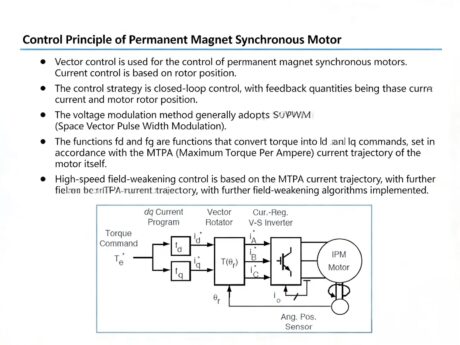
Inject a reverse current component (-Id) into the motor’s direct axis (d-axis, which is aligned with the direction of the permanent magnet magnetic field). The magnetic field generated by this current is opposite to that of the permanent magnets, thus “canceling out” or “weakening” the total magnetic field intensity.
- Normal FOC control (below base speed): Only the quadrature-axis current (Iq) is used to generate torque, and the direct-axis current (Id) is set to 0 to avoid interfering with the permanent magnet field.
- Flux weakening control (above base speed): Two current components are injected simultaneously:
- Quadrature-axis current (Iq): For torque generation.
- Negative direct-axis current (-Id): For magnetic field weakening.
Key Trade-off
Injecting -Id does not generate torque itself but consumes voltage resources. Meanwhile, the total current is the vector sum of Iq and Id and cannot exceed the controller’s current limit. Therefore, in the flux weakening region:
- With the total current unchanged, a portion of the current is allocated to “flux weakening” (Id), leaving less current available for “torque generation” (Iq).
- The result: sacrificing maximum torque capability in exchange for higher rotational speed.
IV. Application Scenarios of Flux Weakening Control
Flux weakening control is used in all scenarios where the motor needs to operate for a long time and with high efficiency above the base speed:
- High-speed cruising of electric vehicles: High torque is required on urban roads, while sustained high speed is needed on highways – the motor enters the flux weakening region at this time.
- Spindles/Electric spindles: Spindles in machining centers require a wide speed regulation range, delivering high torque at low speeds for cutting and low torque at high speeds for finish machining or tool changing.
- Washing machine dehydration: Extremely high motor speed is required for the dehydration process.
- UAV propellers: Higher rotational speed is needed to maintain lift when the air is thin at high altitudes.
- Household appliances (e.g., vacuum cleaners): Pursue high rotational speed to achieve greater suction power.
V. Summary and Key Points
- Essence: A control strategy that breaks through the motor’s voltage limit to achieve operation above the base speed.
- Method: Inject a negative current into the direct axis (d-axis) to actively weaken the permanent magnet magnetic field and reduce the back EMF.
- Trade-off: Allocate a portion of the current to flux weakening, leading to a decrease in output torque at the same current level – trading torque for speed.
- Implementation Condition: Requires a vector control algorithm with Field-Oriented Control (FOC), as only FOC can independently and precisely control the d-axis and q-axis currents.
- Vivid Analogy: Just like driving a car – to reach the top speed, you no longer accelerate with full force (reduce Iq), but instead use a portion of the power to “reduce wind resistance” (inject -Id to weaken the magnetic field), allowing the car to go faster.