

With the improvement of power battery energy density and the increase of driving power, thermal management has upgraded from an “accessory” to the “core of the system”. Poor heat dissipation will lead to a sharp drop in battery life, power limitation, low air conditioning heating efficiency, and even trigger safety protection. This paper systematically sorts out the thermal management solutions for new energy vehicles from four dimensions: heat sources, materials, traditional and cutting-edge technologies, and provides design ideas and future trends to help technicians quickly identify key points.
1. Overview of Thermal Management Requirements for New Energy Vehicles
- Power battery: A large amount of heat is generated during charging and discharging, and a uniform temperature must be maintained in the range of 20 °C–45 °C.
- Motor/Power electronics: High-power output causes the local temperature to exceed 120 °C in an instant, which requires rapid cooling.
- Cabin air conditioning: Both winter heating and summer cooling rely on heat pumps or electric heating, with energy consumption accounting for 5%–15% of the vehicle’s total energy consumption.
- On-board charging: High-power DC fast charging (≥350 kW) generates an instantaneous heat flux of more than 80 kW.
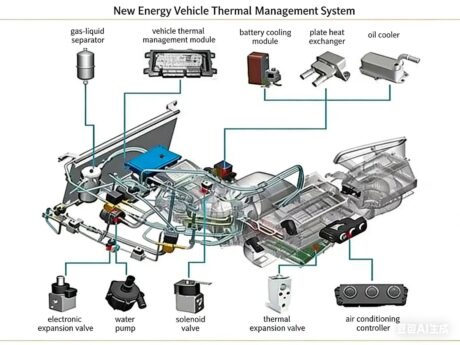
The schematic diagram below shows the main loops of the vehicle thermal management system:
2. In-depth Analysis of Heat Sources
| Component | Thermal Power (kW) | Key Heat Dissipation Challenges |
|---|---|---|
| Power battery (48 kWh) | 5 - 15 | Temperature uniformity, thermal shock, space constraints |
| Motor/Power electronics | 10 - 30 | Local hotspots, instantaneous power peaks |
| Cabin heat pump | 2 - 6 (heating) | COP drop in low-temperature environment, compressor heat dissipation |
| Fast charging module | 8 - 12 | Local overheating caused by high current, need for rapid heat dissipation |
3. Review of Traditional Heat Dissipation Solutions
- Air-cooled radiator + fan: Simple structure and low cost, but insufficient heat transfer coefficient in high-power motor and fast charging scenarios.
- Liquid-cooled cold plate (single/double side): Heat is directly removed by coolant, which has become the mainstream solution for battery packs.
- Heat pipe/Phase change heat pipe: Utilizes latent heat of phase change to quickly transfer heat at local hotspots, commonly used for power electronics heat dissipation.
- PTC electric heater: Provides rapid heating in low-temperature environments, but with high energy consumption and lower efficiency than heat pumps.
4. Cutting-edge Heat Dissipation Technologies and Innovation Paths
4.1 High-efficiency Liquid Cooling System
Liquid cooling has upgraded from a “single cold plate” to a “modular cooling circuit”. The typical structure is as follows:
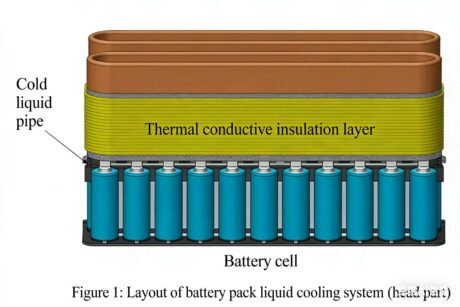
- Double-layer cold plate + high thermal conductivity TIM: Graphene/boron nitride-based thermal interface materials are added between the battery cells and the cold plate, reducing thermal resistance by 30%.
- Zoned flow control: Independent flow regulation in different temperature zones of the battery pack is achieved through solenoid valves to avoid temperature gradients.
- Low-pressure and high-flow coolant circulation pump: Magnetic levitation pumps are adopted to reduce mechanical wear and improve system reliability.
4.2 On-board Heat Pump Technology
The coefficient of performance (COP) of heat pumps for winter heating can reach 2.5 - 3.5, significantly reducing air conditioning energy consumption.
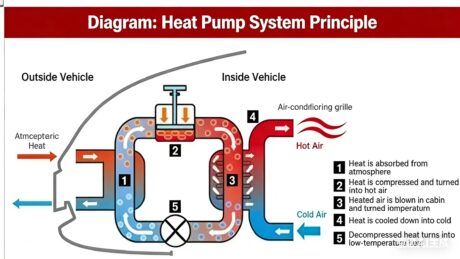
- Bidirectional circulation: The same compressor is used for both heating and cooling, and a switching valve enables rapid mode switching.
- Low-temperature start-up optimization: Electric heating assistance (PTC) is added below -10 °C to increase the compressor starting torque.
- Heat pump + battery insulation: Waste heat discharged by the heat pump can be returned to the battery cooling circuit to realize heat energy recovery.
4.3 Integration of Phase Change Materials (PCM) and Heat Pipes
- PCM-coated battery cells: Phase change materials (melting point 45 °C) are filled in the outer layer of the battery module to absorb latent heat of phase change during high-power discharge and smooth temperature rise.
- Micro heat pipe network: Microporous heat pipes are arranged inside the heat sink of power electronics to realize pump-free passive heat dissipation by capillary action.
4.4 Intelligent Thermal Management Control
Based on real-time temperature monitoring of the on-board CAN bus, combined with AI prediction models, the following functions are realized:
- Power prediction: Pre-adjust the speed of the cooling pump to avoid temperature shock.
- Energy consumption minimization: Turn off part of the cooling circuit under low load to reduce pump power consumption.
- Fault early warning: Quickly locate the failure of heat dissipation components through abnormal thermal curves.
5. Design Ideas for Integrated Thermal Management System
- Layered heat dissipation architecture
① The battery pack adopts double-layer liquid cooling + PCM;
② Motors/power electronics use heat pipes + local liquid cooling;
③ Cabin air conditioning adopts heat pump + PTC assistance.
- Heat recovery closed loop: Waste heat from heat pump exhaust and power electronic radiators is uniformly returned to the battery coolant to realize heat energy reuse.
- Modular pump/valve network: Low-pressure magnetic levitation pumps and solenoid valves are adopted to realize independent control of multiple loops and improve system redundancy.
- Software collaboration: Dynamic optimization of COP, cooling power and energy consumption through the linkage of on-board ECU and cloud models.
6. Future Trends and Challenges
- High thermal conductivity composite materials: Composite heat dissipation materials such as graphene/carbon fiber/boron nitride will further reduce thermal resistance, and the cost is expected to drop by 30% by 2026.
- All-liquid cooling platform: With the improvement of power density, the concept of “full vehicle liquid cooling” may appear in the future, that is, all heat sources share a unified liquid cooling circuit. However, in reality, many areas still cannot realize liquid cooling.
- Heat pump efficiency improvement: Improve low-temperature COP through two-stage compressors and low-temperature refrigerants (R1234yf) to solve the heating problem in extremely cold areas.
- Reliability and safety: Leakage detection of liquid cooling systems, anti-clogging of heat pipes and cycle life of PCM are still key reliability indicators.
7. Summary
Heat dissipation for new energy vehicles is no longer a simple “addition” of a single component, but a comprehensive project across systems, materials and control. Through the collaboration of liquid cooling, heat pumps, phase change materials and intelligent control, it is possible to significantly reduce the overall vehicle energy consumption while ensuring battery life and improving power performance. Grasping the thermal conductivity characteristics of materials, system heat recovery paths and AI-driven thermal management strategies is the key to the commercialization of the next generation of high-efficiency electric vehicles.

