

“With the same permanent magnet rotor and three-phase stator, the differences often lie in the waveform and control algorithm.”
1. Introduction
In the 2025 motor market, Brushless DC Motors (BLDC) and Permanent Magnet Synchronous Motors (PMSM) are the two mainstream technologies. They are almost identical in structure, yet exhibit significant differences in magnetic flux distribution, commutation methods, control algorithms and ultimately performance. This article provides a detailed comparison from six dimensions: structure, magnetic characteristics, driving methods, performance indicators, heat dissipation and reliability, as well as cost and typical applications.
2. Structure and Magnetic Flux Distribution
Both consist of a permanent magnet rotor and a three-phase stator winding as core components, but differ in the spatial distribution of magnetic flux:
- BLDC: The permanent magnet generates a trapezoidal (square-wave) magnetic flux, and the stator adopts a concentrated winding (two adjacent slots per phase), resulting in a trapezoidal back EMF waveform.
- PMSM: The permanent magnet magnetic flux has a sinusoidal distribution, and the stator uses a distributed winding (spanning multiple slots per phase), with a sinusoidal back EMF.
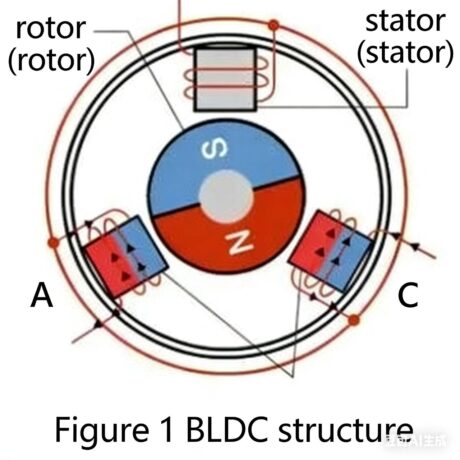
Figure 1: Internal Structure of a BLDC Motor (Concentrated Winding)
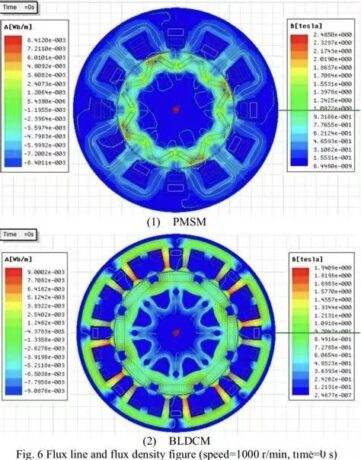
Figure 2: Sinusoidal Magnetic Field Distribution of PMSM (Left) vs Trapezoidal Magnetic Field of BLDC (Right)
3. Back Electromotive Force (Back EMF) and Commutation Methods
Back EMF determines the commutation strategy of the driver:
- BLDC: 6-step (trapezoidal) commutation, with phase switching every 60°, two phases conducting and one phase floating. Commutation points are usually detected by a 3-phase Hall sensor.
- PMSM: Field-Oriented Control (FOC) or Direct Torque Control (DTC) is adopted, with three phases energized at all times. Clarke-Park transformation is used to map the three-phase current to the dq axis, achieving continuous sinusoidal current.
4. Control Algorithms and Implementation Difficulty
From a control perspective, the implementation complexity of the two increases in the following order:
| Item | BLDC | PMSM |
|---|---|---|
| Commutation Method | 6-step (trapezoidal) | FOC / DTC (sinusoidal) |
| Position Detection | 3-phase Hall (or sensorless estimation) | High-resolution encoder or sensorless back EMF estimation |
| Control Hardware | General MCU + MOSFET/IGBT driver | DSP/high-performance MCU + SiC/GaN driver |
| Software Complexity | Relatively simple, commutation table lookup | Requiring PI/PID, coordinate transformation, flux linkage estimation, etc. |
The typical PMSM vector control block diagram is shown below, demonstrating the complete closed-loop structure of Clarke-Park transformation, PI current loop, SVPWM and inverter:
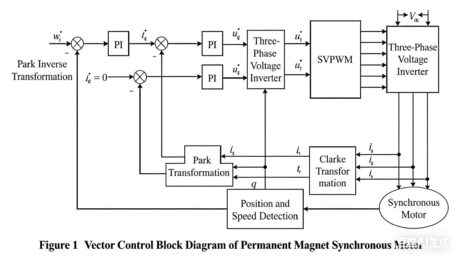
Figure 3: PMSM Vector Control (FOC) System Block Diagram
5. Comparison of Performance Indicators
Under the same volume/mass conditions, the key performance of the two is as follows:
| Indicator | BLDC | PMSM |
|---|---|---|
| Torque Ripple / Noise | Obvious (torque ripple caused by commutation) | Extremely low (continuous sinusoidal current) |
| Efficiency | 90%-92% (decreasing in high-power range) | 93%-96% (sinusoidal wave reduces harmonic loss) |
| Power Density | Approximately 15% higher than PMSM (instantaneous power) | Slightly lower but with larger overall output power |
| Dynamic Response | Limited by 6-step, relatively slow response | FOC enables millisecond-level torque response |
| Control Cost | Low (hardware + software) | Medium to high (DSP, encoder) |
6. Heat Dissipation, Reliability and Service Life
With the improvement of power density, heat dissipation has become a common bottleneck:
- BLDC: Due to the high-order harmonics contained in the commutation current waveform, local hotspots are more obvious, and air cooling or oil cooling is often adopted.
- PMSM: Sinusoidal current reduces local thermal stress, yet water cooling or potting oil cooling is still required to meet the thermal management of systems >200 kW.
Permanent magnet demagnetization is a common reliability risk for both. The demagnetization curve shifts to the left with the increase of temperature, leading to a decrease in magnetic flux density. Common protective measures include:
- Ensuring the maximum rotor temperature < 100 °C in thermal design.
- Using high-coercivity NdFeB+Dy permanent magnets.
- Adding temperature closed-loop compensation in the controller (reducing current peak value).
7. Cost, Supply Chain and Typical Applications
| Dimension | BLDC | PMSM |
|---|---|---|
| Hardware Cost | Low (MOSFET + Hall) | Medium (SiC/GaN + encoder) |
| Supply Chain Maturity | Mature, adaptable to various low-voltage platforms | Rapidly developing, wide bandgap semiconductors driving high-power evolution |
| Typical Scenarios | UAVs, household appliance fans, low-power electric vehicle hub motors, pumps | New energy vehicle powertrains, industrial servos, aerospace electric drives, robot joints |
8. Development Trends and Challenges
- Popularization of wide bandgap semiconductors – The cost of SiC and GaN devices has dropped by more than 30%, driving PMSM toward higher power and higher efficiency.
- Maturity of sensorless control – Sensorless position schemes for BLDC and PMSM based on back EMF estimation have been implemented in high-end EVs.
- AI-assisted magnetic field modeling – Machine learning is used for coupled prediction of magnetic field, temperature and demagnetization, improving design reliability.
- Modular “integrated” driving – The power modules of BLDC and PMSM are converging toward the integration of “motor-drive-heat dissipation”, reducing system assembly costs.
- Standardization and safety certification – ISO/IEC 61800-5-2 (motor drive safety) and IEC 61851 (EV charging) are updated synchronously, promoting industry unification.
9. Conclusion
BLDC and PMSM are not competitive, but rather technical branches targeting different requirements. BLDC remains the first choice for projects emphasizing cost, structural simplicity and low power; PMSM combined with vector control is an indispensable solution for pursuing high efficiency, low noise and precise torque control. With the continuous breakthroughs in SiC/GaN, AI prediction and modular design, the technical barriers between the two are gradually blurring. Future motor drive systems are likely to be compatible with both operating modes on the same platform.


