

There is a huge and sophisticated “neural network” hidden in the cars we drive or ride every day-the car wiring harness.
It consists of thousands of wires, connectors and sensors, with a total length of several kilometers, which are responsible for the transmission of power and signals, and is the physical basis for all electrical functions of the vehicle.
However, the reliability of this network does not depend on how strong the wires themselves are, but on whether the thousands of seemingly tiny “connection points” are unbreakable.
Terminal crimping technology plays a crucial role in these connections. Unlike welding, which relies on high temperature melting, and unlike screw connection, which may loosen, it achieves a stable and lasting bond between conductor and terminal through precise mechanical plastic deformation.
It can be said that the electrical safety, functional stability and even service life of a car, to a large extent, depend on the quality of crimping between them. Today, we will discuss in depth the principle, process control and verification system of this cornerstone process supporting the modern automotive industry.
For automotive wiring harness, whether the circuit is stable, whether the contact resistance is controllable, and whether it will fail under vibration and thermal cycling conditions often depend on the quality of crimping.
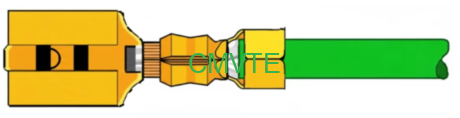
Terminal crimping causes plastic deformation of the terminal and the wire by mechanical pressure, forming a tight contact under stable geometric control. As long as the process window is properly controlled, crimping connection can usually take into account both electrical performance and mechanical strength, which is also the fundamental reason why it has become the mainstream connection mode of automotive wiring harness.
-
Principle of terminal crimping
The essence of terminal crimping is to use the crimping die to exert enough pressure on the wire and terminal, so that the wire core and terminal material are plastically deformed, and a stable and low-resistance metal contact interface is formed locally. This process is generally understood to be a cold connection that does not rely on melting or the introduction of solder.
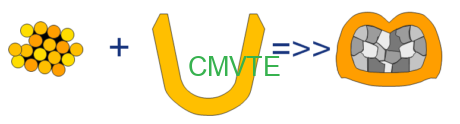
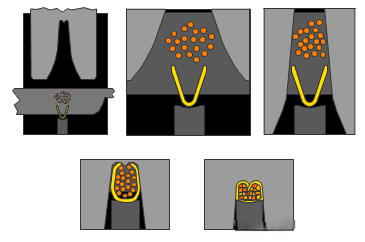
As a result, a qualified crimp point should meet at least two basic requirements.
Firstly, the electrical contact is stable, the contact resistance is in a controllable range, and abnormal heating does not occur under the action of rated current carrying and environmental stress;
First, it has sufficient mechanical retention to withstand pull-out, vibration and bending stresses, and does not loosen or break within the life cycle.
For harness engineers, understanding crimping can’t stop at “just hold it down.”. Crimping forms a connection system that is influenced by materials, structures, equipment and parameters. The hardness of the terminal material, the number of strands of the wire core, the state of the coating, the structure of the crimping wing, the crimping height and the crimping width will directly affect the final quality.
-
Terminal crimping process
Standard terminal crimping usually consists of two areas: core crimping and insulation crimping.
The core crimping is responsible for the conduction and the main mechanical connection functions, while the insulation crimping is responsible for the support and stress buffering of the harness outlet position. Both are indispensable.
Poor crimping in the core area will cause problems such as high resistance, heating and virtual connection. If the support of the insulation area is insufficient, it is easy to concentrate the stress on the root of the conductor in the process of swing and vibration of the wiring harness, which will induce strand breakage and fatigue failure.
From the point of view of equipment mode, there are two common ways: rear feeding and side feeding. Rear feeding is suitable for some terminals with specific structure, and side feeding is more suitable for automatic high-speed crimping equipment, which is more widely used in mass production of automotive wiring harness.
For the production site, the feeding mode is not only the equipment difference, but also affects the mold matching, beat stability and terminal positioning accuracy.
What really determines the stability of crimping quality is not the single equipment itself, but the control ability of the whole process. Including whether the stripping size is stable, whether the conductor is scattered, whether the terminal is accurate, whether the die wear exceeds the limit, and whether the output of the crimping machine fluctuates, all of which will ultimately be reflected in the crimping section and pull-out force.
Many crimping failures are not due to theoretical errors, but because the details of the process are not continuously controlled.
-
Key parameters of terminal crimping
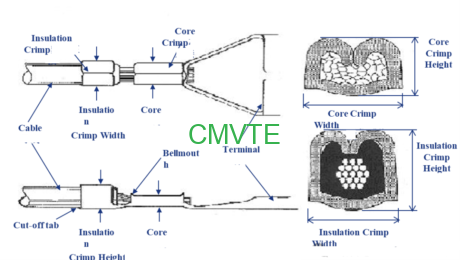
Crimping height is one of the most critical control parameters in the crimping process, and it is also the most commonly used judgment index in the field.
It essentially reflects the degree of material deformation after crimping, and is directly related to the contact state and mechanical properties. When the crimp is too loose, the metal contact between the conductor and the terminal is not tight enough, the gap increases, and the contact resistance increases.
Under the condition of carrying current, this kind of high resistance connection is easy to cause local temperature rise, and in serious cases, terminal annealing, insulation discoloration and even thermal damage will occur. It’s not a good thing to press too tight.
Excessive compression will cause conductor breakage, material hardening, terminal structure damage, pull-out force reduction, and connection life will be significantly shortened.
What is really needed in engineering is a crimp window, not a single point parameter. That is, the crimp height must fall within the validated range and correspond to the wire size, terminal model number, die number, and equipment setting.
It is of little significance to talk about “standard crimp height” without specific combinations. In addition to height, crimping appearance, bell mouth, cutting surface, burr, exposed length of conductor, position of insulation skin, etc., are also items that should be confirmed simultaneously.
-
Verification of terminal crimping
Whether the terminal crimping is qualified cannot be judged only by visual inspection. During the harness development and validation phase, the crimp quality is typically confirmed by cross-sectional analysis, pull-off force testing, and environmental reliability testing.
The significance of section analysis lies in the direct observation of the internal state of the crimping zone. The section can be used to judge whether the conductor is fully compressed, whether the porosity is abnormal, whether the terminal coating is symmetrical, and whether there are broken strands, cracks or obvious structural damage. This type of analysis is often used for new terminal introduction, wire replacement verification, mold commissioning, and anomaly re-judgment.
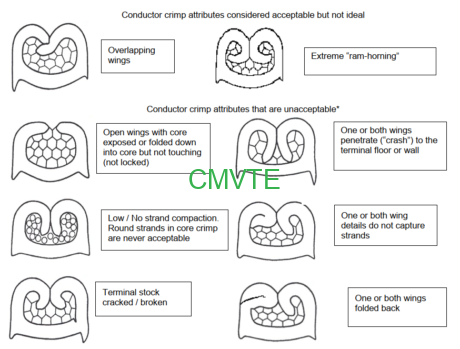
The pull-out force test is more inclined to confirm the mechanical performance, which is used to verify the holding ability of the crimp joint under axial force.
For the automotive wiring harness, the pull-out force is not the greater the better, but to meet the requirements of the corresponding wire diameter and terminal system, and maintain consistency.
If the dispersion between samples is too large, it often means that the process has been unstable. In the vehicle regulation project, only the initial performance is not enough.
The crimping point is usually subject to environmental tests such as vibration, temperature and humidity cycle, salt spray, temperature rise, current cycle, etc.
Common reference standards include GB/T 18290.2, QC/T 1067, and SAE/USCAR-21.
Especially in the development of automotive connection system, USCAR system emphasizes the performance retention under long-term service conditions, which puts forward higher requirements for the design boundary and process control of crimping connection.
Terminal crimping technology is not an ordinary process at the end of harness manufacturing, but a basic capability throughout design selection, process development, process control and reliability verification.
For the automotive wiring harness industry, if the crimping is done well, the reliability of the connection will be the foundation. Crimping can not be controlled, and the function, durability and safety behind it are difficult to really establish.
Back to the essence of engineering, crimping is not to “press on”, but to control the material, structure and process steadily within a verifiable range. This is also the real value of automotive wiring harness crimping technology.
From the microscopic principle of metal plastic deformation to the macroscopic process control and verification system, we systematically combed the overall picture of terminal crimping technology. It is not a simple “clamp” action, but a precise science that integrates material mechanics, electrical engineering and quality management.
In the era of rapid evolution of automotive industry to electrification and intellectualization, the complexity and reliability requirements of wiring harness have been raised to an unprecedented height. More sensors, more current, more severe vibration and thermal environment are all testing the “basic skills” of each connection point.
Crimping technology, as the core of this basic skill, is becoming more and more important. It requires engineers and manufacturers to have a comprehensive ability from theoretical cognition to process control, and to incorporate every parameter and every operation into a quantifiable, traceable and verifiable engineering system.
In the future, with the in-depth application of online detection, artificial intelligence and big data analysis, the crimping process is developing towards a more intelligent and adaptive direction. But the essence of its pursuit is always the same: to build the most trustworthy physical link of automotive electrical system between square inches.
This is the silent but vital engineering art hidden behind every speeding car.

