

Why does the light of the electric tool suddenly dim at the moment of starting? Or, why do some old batteries show full charge and drop out instantly when they are used?
Behind these daily problems, they all point to the three core physical quantities that determine the performance and life of batteries: voltage, internal resistance and capacity. They are like the “vital signs” of a battery, which together describe its health and energy status. However, the relationship between the three is not a simple addition, subtraction, multiplication and division, but a dynamic and mutually restrictive complex game.
The relationship among voltage, internal resistance and capacity can be understood as follows:
The voltage is the “water level” of the battery, the capacity is the “bucket size”, and the internal resistance is the “resistance of the faucet and water pipe”.
They interact with each other, but they are not simple mathematical formulas.

The following is a detailed breakdown of their relationship:
1.Voltage
The potential difference between the positive and negative poles of a battery.
(1) Open-circuit voltage: the voltage when the battery is not connected to any load, mainly reflecting the remaining capacity (state of charge, SOC).
(2) Terminal voltage: the voltage when the battery is connected to the load, which is equal to the open-circuit voltage minus the voltage drop caused by the current flowing through the internal resistance.
2.Internal resistance
The internal resistance of a battery to the flow of electricity. It includes ohmic resistance (material resistance) and polarization resistance (chemical reaction resistance). The smaller the internal resistance, the better the performance of the battery.
3.Capacity
The total amount of electricity (in Ah or mAh) that a battery can discharge under specified conditions. It depends on the quantity and availability of the internal active substance.
The direct relationship between the three
1: Internal resistance → voltage (dynamic voltage drop)
This is the most direct and important relationship.
(1) Formula: terminal voltage = open-circuit voltage-current × internal resistance
(2) Phenomenon:
① When discharging: when discharging with large current, the internal resistance will consume part of the voltage, resulting in a significant drop in the terminal voltage. For example, when the power tool is started, the lights are dimmed.
② When charging, the internal resistance will cause the terminal voltage to be higher than open-circuit voltage. The voltage will rise rapidly when charging with a large current.
③ Conclusion: The greater the internal resistance is, the more violent the voltage fluctuation is during charging and discharging.
Relationship 2: Voltage → Capacity (SOC)
For the open circuit voltage
Within a certain range, the relationship between the open circuit voltage and the residual capacity is monotonic and approximately linear. This is also the basic principle of battery gauge (such as mobile phone power display).
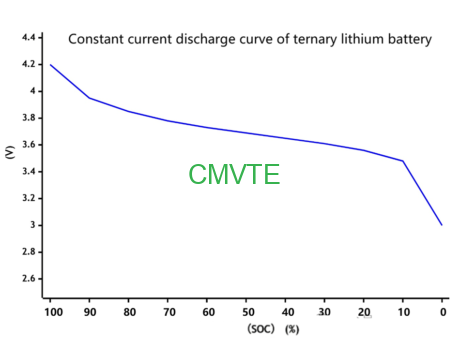
(1) For example: ternary lithium battery, 4.2 V (100%) → 3.7 V (about 50%) → 3.0 V (0%).
(2) Note: This is only accurate after standing (to eliminate the influence of internal resistance) or during small current discharge. When discharging with large current, the terminal voltage will be artificially low, and it will rise after standing.
Relationship 3: Internal resistance → capacity (energy loss and available capacity)
(1) Energy loss: the current flowing through the internal resistance will generate heat (power = current ² × internal resistance). This part of the energy comes from the battery, but it does not become useful work for external output. The greater the internal resistance, the more energy is wasted and the less energy (capacity X average voltage) is available.
(2) Available capacity reduction: When discharging with a large current, the internal resistance causes the terminal voltage to drop to the “cut-off voltage” of the equipment in advance (for example, 3.0 V). Although there is still power inside the battery, the device is no longer working. The greater the internal resistance, the smaller the actual capacity that can be discharged at high current.
(3) Aging index: With the aging of the battery, the internal resistance will increase and the capacity will decay. Although there is no direct formula for the two, the increase of internal resistance is one of the important concomitant phenomena and causes of capacity fading.
Brief summary
- There is no simple equation: the three are parameters describing different dimensions of the battery, not a direct multiplication or addition relationship.
- Internal resistance is the core bridge: it dynamically connects voltage and current and profoundly affects the efficiency of energy release (available capacity).
- An important indicator of health: If you are concerned about battery life, monitoring internal resistance is more effective than monitoring voltage. The voltage can be “artificially high” (4.2 V when the aging battery is just fully charged), but the increase in internal resistance is solid evidence of aging.
- Suggestion for practical use: When it is found that the battery is fully charged quickly, the power drops quickly, the voltage plummets under high load, and the heat is serious, all of which point to a significant increase in internal resistance and a serious attenuation of capacity. The battery should be replaced with a new one.
The battery is not a simple “energy tank”. Voltage, internal resistance and capacity form a delicate triangular relationship. Among them, internal resistance plays a vital role, which is the key judge of battery performance when it changes from “static energy storage unit” to “dynamic energy supply system”.
The next time you’re worried about the battery life of your device, think about it a little more: the problem may not be just “capacity” shrinkage, but more likely “internal resistance” at work. It silently steals energy, pulls down the voltage, and reduces the amount of power available to you.
For ordinary users, although it is impossible to measure the internal resistance directly, the phenomena mentioned at the end of the article-fast charging, rapid power failure, high load fatigue.
Understanding these principles can help us not only pay attention to the nominal capacity, but also pay more attention to its ability to support continuous high current output (which often means lower internal resistance) when choosing batteries (such as outdoor power supply, electric vehicle batteries); in daily use, avoid extreme high temperature, excessive charge and discharge, in order to delay the rise of internal resistance.
Battery technology is still evolving, but understanding its underlying physics has always been the starting point for us to use every bit of energy efficiently and safely. I hope this interpretation can light up the mystery of the operation of this “heart of electricity” for you.

