

A Practical Guide for Commercial Vehicle Retrofit Companies and Fleet Operators
Diesel-powered box vans remain an important part of Europe’s logistics and delivery industry. From parcel distribution and supermarket deliveries to refrigerated transport and mobile workshops, these vehicles are built for demanding daily operations.
However, rising operating costs and increasingly strict urban emission policies are making fleet operators reconsider how long they should continue running diesel vehicles.
Buying a new electric van is one option. Converting an existing vehicle is another.
For companies with relatively new chassis, specialized bodywork or established fleets, electric conversion can be worth investigating. Rather than replacing the entire vehicle, the existing platform may be retained while its diesel powertrain is replaced with an electric drive system.
The challenge is finding a configuration that can handle the vehicle’s weight, payload, driving range and working conditions without making the project unnecessarily expensive.
This guide looks at the main European box van platforms, the commercial considerations behind conversion costs, and the electric powertrain options available for these projects.
1. Which Box Vans Are Suitable for Electric Conversion?
Several established commercial van platforms are worth considering for electric conversion projects in Europe.
The most important factor is not simply the vehicle’s brand. Its chassis condition, drivetrain layout, gross vehicle weight and available space for batteries will have a much greater influence on conversion feasibility.
Mercedes-Benz Sprinter
The Sprinter is widely used in European logistics, parcel delivery and specialist transport.
It is available in different lengths, roof heights and weight categories, with both front-wheel-drive and rear-wheel-drive configurations across different generations.
For box-body applications, particular attention should be paid to the vehicle’s rear axle load, body weight and battery installation space. A vehicle originally designed as a panel van may have very different requirements after being fitted with a large box body.
Fiat Ducato, Peugeot Boxer and Citroën Jumper
These three models share important platform relationships in several generations and are widely used for commercial transport.
They are commonly found in delivery, refrigerated transport and specialist vehicle applications.
Many versions use front-wheel drive, which makes the original gearbox and transmission arrangement an important part of the conversion design.
Although the vehicles share platform characteristics, compatibility should not be assumed across every model year and configuration.
Ford Transit
The Ford Transit has a broad range of commercial applications, from standard delivery vans to larger box-body vehicles.
Its different generations and drivetrain configurations mean that a conversion proposal should be based on the exact vehicle rather than the Transit name alone.
Iveco Daily
The Iveco Daily is particularly relevant to heavier commercial applications.
It is commonly used for larger box vans, refrigerated vehicles and specialised transport. Some versions operate at considerably higher gross vehicle weights than standard delivery vans.
For these vehicles, motor torque, reduction ratio, continuous operating performance and battery weight become especially important.
Other Potential Platforms
Renault Master, Volkswagen Crafter, MAN TGE and Opel Movano are also worth considering, depending on the vehicle generation and configuration.
These models represent potential applications rather than a list of vehicle models already validated by CMVTE.
<AsyncImage query=”European commercial delivery box vans Mercedes Sprinter Fiat Ducato Ford Transit Iveco Daily lined up white vehicles” aspectRatio=”16:9″ width=”100%”/>
2. Is Electric Conversion Economically Worthwhile?
The business case for converting a commercial van depends on more than the price of the electric powertrain.
A company operating a fleet of delivery vehicles needs to consider the remaining life of its existing vehicles, annual mileage, charging arrangements and the cost of replacing those vehicles.
For example, a logistics company may have several vehicles with sound chassis and well-maintained box bodies. Replacing the entire fleet could mean paying for new vehicles and rebuilding specialised equipment.
In this situation, retaining the existing vehicle structure may be commercially attractive.
Understanding the Conversion Cost
A typical conversion budget may include:
- Electric drive system and battery
- Mechanical adaptation and installation
- High-voltage electrical integration
- Auxiliary systems and charging equipment
- Engineering, testing and local approval work
The final cost varies considerably between projects. A standard panel van and a fully equipped 5-tonne box van should not be expected to have the same conversion cost.
As an initial market reference, some industry discussions place light commercial vehicle retrofit projects in the tens of thousands of euros. However, there is no reliable universal price for a complete electric box van conversion.
A quotation should clearly distinguish the electric powertrain supply cost from local installation and vehicle conversion costs.
An Example of Energy Cost Savings
Consider a commercial vehicle with the following illustrative consumption:
| Diesel vehicle | Electric vehicle | |
|---|---|---|
| Consumption per 100 km | 11 litres | 35 kWh |
| Energy price | €1.65/litre | €0.25/kWh |
| Energy cost per 100 km | €18.15 | €8.75 |
The estimated difference is €9.40 per 100 km.
At 30,000 km per year, this represents an illustrative energy cost difference of €2,820 annually.
Over five years, the difference would be €14,100.
This is an example for comparison, not a guaranteed saving. Actual energy consumption and prices vary by vehicle, payload, route, driving style and charging arrangement. The calculation also excludes conversion investment, maintenance, financing, battery depreciation and charging infrastructure.
For a fleet operator, the most useful calculation is a total cost of ownership (TCO) comparison based on actual vehicle operating data.
3. European Emission Policies and the Demand for Electric Commercial Vehicles
Emission regulations are an important reason why European fleet operators are considering electric vehicles.
However, the regulatory situation is not identical across Europe. Different countries and cities have introduced their own low-emission zones and vehicle access requirements.
Netherlands
The Netherlands has introduced zero-emission zones in multiple cities.
Certain existing commercial vans benefit from transitional arrangements depending on their emission class and registration date. Operators should check the current national rules and the specific requirements of each city before making investment decisions.
France
France uses the Crit’Air vehicle classification system. Low-emission zones, known as Zones à Faibles Émissions (ZFE), operate in several metropolitan areas.
Access restrictions depend on the location and applicable local regulations.
Germany
German cities operate environmental zones (Umweltzonen), with access depending on the vehicle’s environmental classification and local requirements.
Belgium
Brussels, Antwerp and Ghent are among the cities with low-emission zones.
Other European countries are also developing policies to reduce emissions from commercial transport.
What Should Fleet Operators Consider?
For companies operating in several European cities, the relevant question is not simply whether a vehicle is electric.
They should establish which vehicle categories are covered by local restrictions, what documentation is required and whether a converted vehicle can be registered and recognised under the applicable local rules.
An electric conversion does not automatically guarantee access to every zero-emission zone. The converted vehicle’s approval and registration status must be checked with the relevant local authorities.
<AsyncImage query=”European low emission zone road sign urban delivery van city street” aspectRatio=”16:9″ width=”100%”/>
4. European Retrofit Companies and Chinese Powertrain Suppliers: Different Roles in the Market
The European retrofit market includes companies that convert complete vehicles, as well as businesses specialising in electric drive systems.
Understanding the difference is important when planning a commercial conversion project.
European Retrofit Companies
Companies such as BEDEO, Qinomic, EFA-S and Magtec illustrate different approaches to vehicle electrification.
BEDEO, for example, has developed electric and range-extended retrofit solutions for selected commercial vans. Its Reborn Electric programme uses rear in-wheel motors and a battery system, while retaining the original diesel powertrain for extended operation.
Qinomic focuses on vehicle electrification and retrofit programmes in France, working with industrial partners on conversion projects.
EFA-S has experience in commercial vehicle electrification, while Magtec develops electric drive systems and repowering solutions for a range of commercial vehicles.
These businesses operate with different products and commercial models. Some focus on complete vehicle conversion, while others concentrate on drive systems and technical integration.
Where Chinese Powertrain Suppliers Fit In
A European conversion company does not necessarily need to manufacture every electric drive component itself.
It can work with a specialist supplier to source the motor, controller and battery system, while retaining responsibility for vehicle adaptation, installation and local customer service.
This creates a practical division of work:
| European retrofit partner | Electric powertrain supplier |
|---|---|
| Vehicle inspection and preparation | Motor and controller supply |
| Mechanical installation | Battery system supply |
| Vehicle-specific adaptation | Powertrain configuration |
| Local testing and approval procedures | Product documentation and technical cooperation |
| Local customer service | Manufacturing and project supply |
For European companies planning to convert multiple vehicles, this model can provide more flexibility in sourcing and system configuration.
The important point is to evaluate the complete project cost, including shipping, duties, installation, testing, warranty and local after-sales arrangements, rather than comparing component prices alone.
5. Choosing the Right Electric Powertrain: 360V and 540V Solutions
A commercial box van requires a powertrain that can handle its actual operating weight, payload and driving conditions. Motor power is important, but it should not be the only factor when selecting an electric drive system.
For commercial vehicle conversion projects, CMVTE offers several powertrain options for engineering evaluation, including 360V and 540V systems.
5.1 360V 60 kW PMSM System
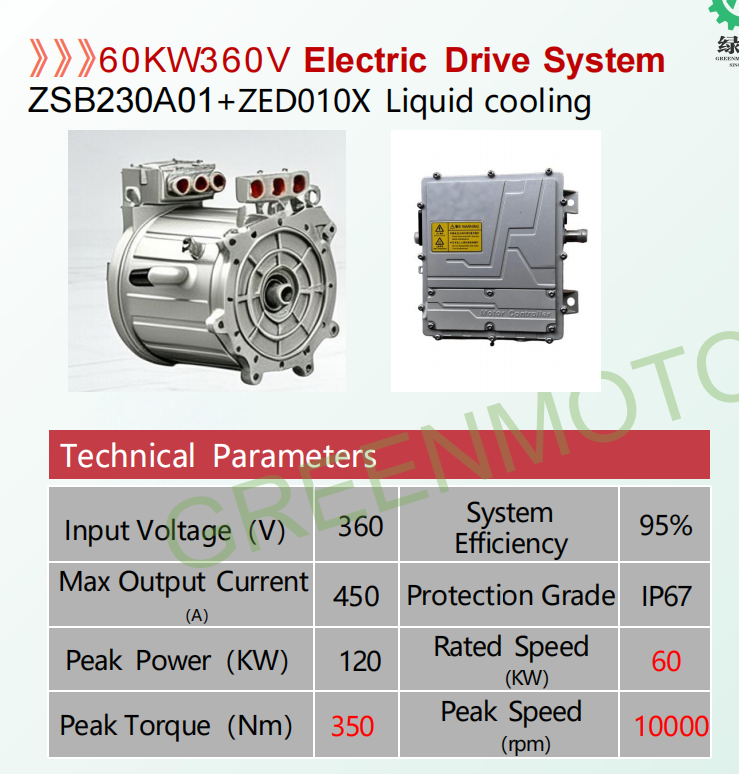
The 360V 60 kW system is a candidate for medium-duty commercial vans and box-body vehicles. Its peak power provides additional output for acceleration, while the final configuration needs to be matched to the vehicle’s transmission and axle ratio.
5.2 360V 70 kW PMSM System
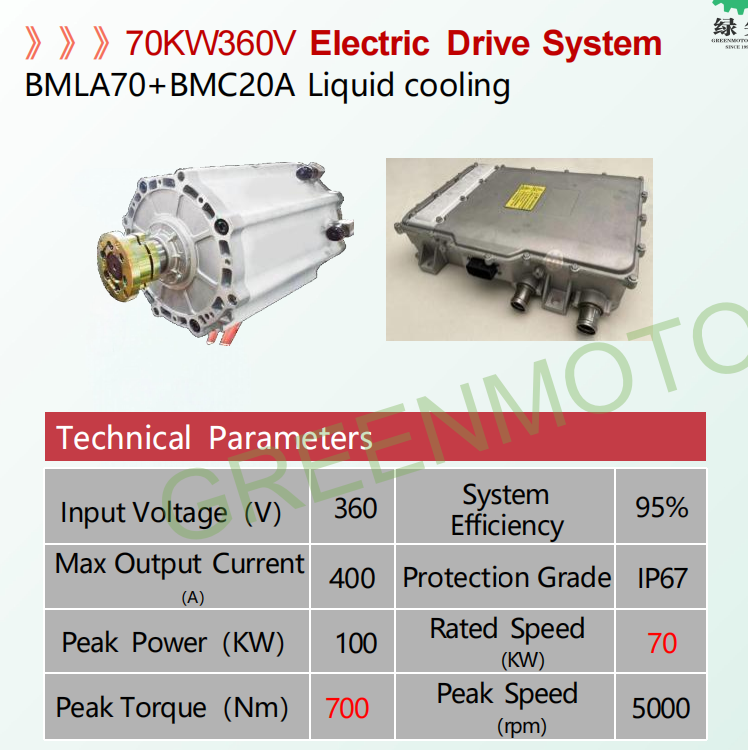
With a stated maximum torque of 700 Nm, this system is worth evaluating for heavier vehicles and applications where starting performance and climbing capability are important.
The motor’s operating speed and the selected reduction ratio should be considered together to achieve the required vehicle speed and wheel torque.
5.3 540V 60 kW PMSM System
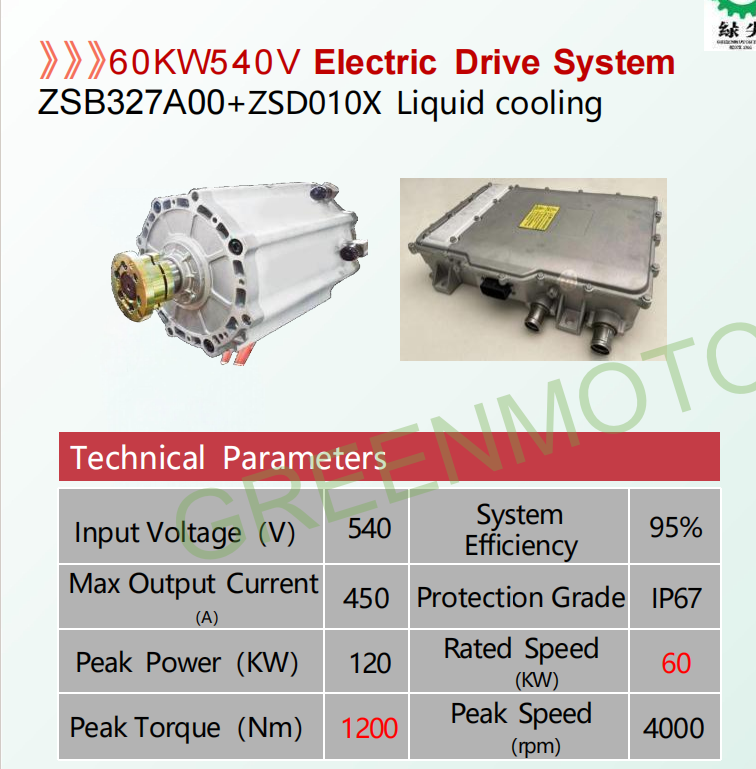
The 540V 60 kW system provides another option for commercial vehicle electrification projects, particularly where a higher-voltage powertrain architecture is being considered.
It may be relevant to heavier commercial vehicle applications, depending on the vehicle’s electrical architecture, battery configuration and operating requirements.
A 540V system should be evaluated as a complete powertrain rather than as a motor-only replacement. The battery pack, motor controller, DC-DC converter, charging equipment and high-voltage protection must all be compatible with the selected system voltage.
5.4 Comparing the Three Options
| Powertrain | Rated Power | Peak Power | Maximum Torque | Main Evaluation Focus |
|---|---|---|---|---|
| 360V 60 kW | 60 kW | 120 kW | 350 Nm | Medium-duty commercial vans |
| 360V 70 kW | 70 kW | 100 kW | 700 Nm | Higher torque requirements |
| 540V 60 kW | 60 kW | 120 kW | To be confirmed | Higher-voltage commercial vehicle architecture |
These are reference configurations, not fixed vehicle-specific recommendations.
The 360V 60 kW and 70 kW systems can be evaluated according to the vehicle’s power and torque requirements. The 540V 60 kW option provides an alternative voltage platform for projects where the complete electrical system is designed around a 540V architecture.
The most suitable option depends on vehicle weight, payload, transmission arrangement, axle ratio, target speed and daily operating conditions.
5.5 Battery Capacity and Driving Range
Motor power and battery capacity serve different purposes.
The motor determines the available driving power and torque, while battery capacity influences how much energy is available for the vehicle’s daily operation.
A delivery van covering 100 km per day has different battery requirements from a vehicle travelling 250 km or more.
For box vans, energy consumption is also affected by cargo weight, body dimensions, aerodynamic resistance, road conditions and driving speed.
Battery capacity should therefore be selected according to the actual duty cycle, rather than using a standard capacity for every vehicle.
CMVTE can discuss the appropriate system configuration once the vehicle platform and operating requirements have been established.
6. How CMVTE Supports Commercial Vehicle Conversion Projects
CMVTE is an electric powertrain supplier focused on motor, controller and battery system integration for vehicle conversion applications.
We work with vehicle conversion companies, fleet operators and project developers that need electric drive systems for existing commercial vehicles.
Our approach is to evaluate the application first and then discuss a suitable powertrain configuration, rather than offering one fixed package for every vehicle.
For commercial box van projects, the 360V 60 kW and 70 kW PMSM systems are two options worth considering.
CMVTE can cooperate with local conversion partners on system selection and technical integration. The local partner remains responsible for vehicle-specific mechanical work and local approval procedures.
A Note on Certification and Road Registration
CMVTE’s motor and controller products have CE certification within their applicable scope.
This does not mean that a complete converted vehicle is automatically approved for road use.
Battery certification, vehicle homologation, conversion approval and road registration requirements vary between countries and vehicle categories. These matters must be assessed separately by the vehicle owner, local conversion company or authorised certification body.
CMVTE does not guarantee road approval or homologation of converted vehicles in European countries. Relevant product documentation and technical cooperation can be provided to support customers and their local partners.
7. Discuss Your Box Van Conversion Project with CMVTE
If you are a European vehicle conversion company, fleet operator or OEM developing an electric commercial vehicle project, CMVTE welcomes enquiries about electric powertrain supply.
To begin a technical discussion, please share your vehicle model, manufacturing year, gross vehicle weight, transmission type, drivetrain layout, target driving range and estimated project quantity, we will review and share proposal with you.

