

Introduction
When discussing electric vehicle motor types, two of the most commonly compared technologies are BLDC motors and PMSM motors.
Both motor types are widely used in electric vehicles and EV conversion projects due to their high efficiency and reliability. However, despite their similarities, there are important differences in performance, control systems, and real-world applications.
If you are new to EV motor technology, you can first read our complete guide on all motor types here:
👉 https://cmvte.com/ev-motor-types-explained/
This article will focus specifically on BLDC motor vs PMSM motor, helping you understand which one is better for your EV or conversion project.
What Is a BLDC Motor?
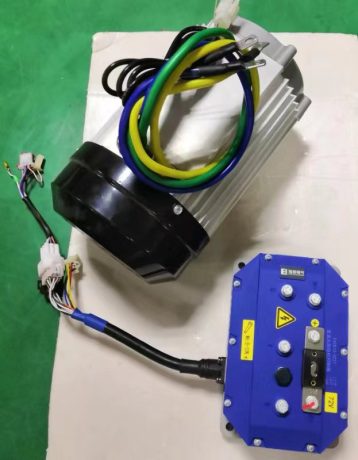
A Brushless DC Motor (BLDC) is an electric motor that uses permanent magnets and electronic commutation instead of mechanical brushes.
Key Features of BLDC Motors
-
trapezoidal back EMF waveform
-
simple control system
-
high efficiency
-
low maintenance
BLDC motors are widely used in:
-
electric scooters
-
e-bikes
-
small EVs
-
light-duty conversion projects
Because of their simplicity and cost-effectiveness, BLDC motors are often used in entry-level electric mobility solutions.
What Is a PMSM Motor?
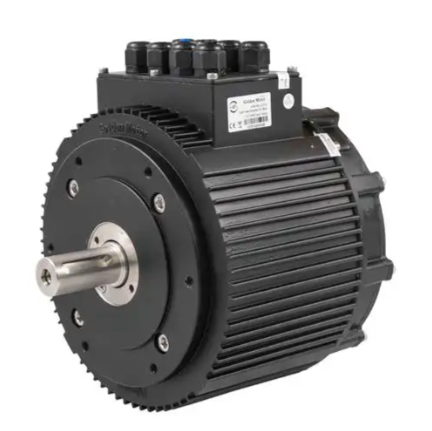
A Permanent Magnet Synchronous Motor (PMSM) is another type of electric motor that uses permanent magnets but operates with a sinusoidal waveform.
Key Features of PMSM Motors
-
sinusoidal back EMF
-
smoother torque output
-
higher efficiency
-
better performance at high speeds
PMSM motors are commonly used in:
-
passenger electric vehicles
-
high-performance EVs
-
commercial EV platforms
Compared to BLDC motors, PMSM motors offer more advanced control and higher overall performance.
BLDC Motor vs PMSM Motor: Key Differences
Although both motors use permanent magnets, the differences between them are significant.
1. Control Method
BLDC motors use simpler control systems with trapezoidal waveforms.
PMSM motors require more advanced control (such as Field-Oriented Control), which allows for smoother and more precise operation.
👉 Result: PMSM offers better driving experience
2. Efficiency
Both motors are efficient, but PMSM motors typically achieve higher efficiency under real driving conditions.
This is especially important in EVs where efficiency directly impacts driving range.
👉 Result: PMSM is more energy-efficient
3. Torque Performance
PMSM motors provide smoother torque output and better performance at both low and high speeds.
BLDC motors can produce torque ripple, which may affect driving smoothness.
👉 Result: PMSM has better torque characteristics
4. Cost
BLDC motors are generally cheaper due to simpler control systems.
PMSM motors are more expensive because they require:
-
advanced controllers
-
precise manufacturing
👉 Result: BLDC is more cost-effective
5. Application
| Motor Type | Typical Use |
|---|---|
| BLDC | scooters, small EVs |
| PMSM | passenger EVs, high-performance vehicles |
Which Motor Is Better for EV Conversion?
Choosing between BLDC vs PMSM motor depends on your specific use case.
Choose BLDC if:
-
you have a limited budget
-
you are converting a lightweight vehicle
-
you need a simple system
Choose PMSM if:
-
you want higher efficiency
-
you need better performance
-
you are converting a passenger vehicle
In most professional EV conversion projects, PMSM motors are preferred due to their superior performance and efficiency.
PMSM is also frequently compared with induction motors in EV drivetrain design, especially when efficiency and material cost are both
important factors.
For a broader comparison beyond BLDC systems, read our guide on induction motor vs PMSM
If your goal is to choose the most suitable motor for a real conversion project rather than compare only BLDC and PMSM, see our practical
guide to the best motor for EV conversion, where we also cover induction and axial flux options.
Real-World EV Applications
Most modern electric vehicles use PMSM motors because they provide:
-
longer driving range
-
smoother acceleration
-
better overall driving experience
BLDC motors are still widely used in small electric mobility devices.
This division shows how different electric vehicle motor types are optimized for different use cases.
PMSM is not only compared with BLDC systems, but also with newer high-performance motor architectures.
For a deeper look at how conventional PMSM designs compare with compact, high-density alternatives, see our article on
axial flux motor vs PMSM.
How This Affects EV Conversion Solutions
For companies offering EV conversion systems, motor selection is a critical part of the overall drivetrain design.
Modern conversion solutions often integrate:
-
PMSM motors
-
advanced controllers
-
battery systems
These integrated systems are designed to deliver optimal performance and reliability.
FAQ
What is the main difference between BLDC and PMSM motors?
The main difference is the waveform and control system. BLDC motors use trapezoidal control, while PMSM motors use sinusoidal control, resulting in smoother performance.
Which motor is more efficient, BLDC or PMSM?
PMSM motors are generally more efficient, especially in real-world EV applications.
Is BLDC or PMSM better for EV conversion?
PMSM is usually better for EV conversion due to higher efficiency and better performance, especially for passenger vehicles.
Conclusion
Both BLDC and PMSM motors are important in the EV industry.
However, when comparing BLDC motor vs PMSM motor, PMSM stands out as the better choice for most electric vehicle applications and EV conversion projects.
BLDC motors remain a good option for low-cost and lightweight applications, but PMSM motors dominate modern electric vehicle design due to their superior efficiency and performance.
If you want to better understand how these motors fit into the broader EV ecosystem, don’t forget to read our complete guide:
👉 https://cmvte.com/ev-motor-types-explained/
