

Choosing between an induction motor and a PMSM isn't a classroom debate—it's a budget, range, and reliability decision that determines whether your conversion project succeeds or stalls. Most guides bury you in theory. We sell kits to DIY builders in 130+ countries, so we'll give you the real-world answer in 5 minutes.
Quick Verdict: Which Motor Wins for Your Build?
| Your Priority | Pick This | Why |
|---|---|---|
| Max range per kWh | PMSM | 95–97% peak efficiency = smaller battery, longer drive |
| Lowest upfront cost | Induction | No rare-earth magnets = 20–30% cheaper motor |
| Compact packaging (Miata, Beetle, UTV) | PMSM | 2–3× torque density = fits tight engine bays |
| Abuse-tolerant (mud, heat, overload) | Induction | No magnets to demagnetize = survives farm/UTV duty |
| DIY-friendly wiring & tuning | PMSM (with our kit) | Pre-matched controller, resolver harness, plug-and-play |
The Efficiency Gap That Costs You Range
PMSM motors hit 95–97% peak efficiency. Induction motors top out around 90–93%. That 5–7% gap sounds small—until you calculate battery cost.
Real example: A 30 kWh pack at $120/kWh = $3,600. A 7% efficiency gain means you need ~2 kWh less battery for the same range. That's $240 saved per build—often more than the motor price difference.
Our PMSM motor lineup (15 kW–200 kW) ships with matched FOC controllers pre-tuned for your voltage (72 V–800 V). No guesswork. No "which controller works" forum threads.
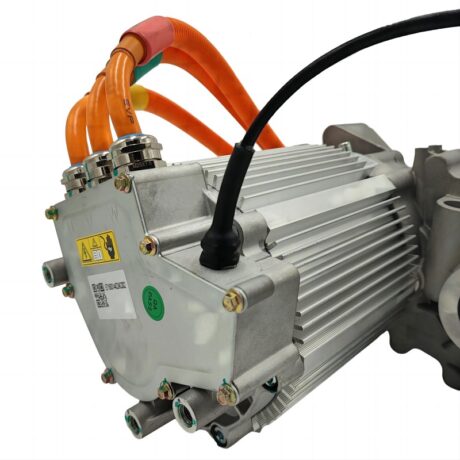
15 kW 96 V PMSM — our bestseller for compact car & UTV conversions
Torque Density: Why PMSM Fits Your Engine Bay
Induction motors need more iron and copper to generate the same flux that permanent magnets give you for free. Result: a 50 kW induction motor weighs 45–60 kg. Our 50 kW PMSM? 22 kg.
That weight savings matters when you're stuffing a motor into a VW Beetle tunnel, Mazda Miata transmission tunnel, or Polaris RZR frame. Less motor weight = more battery capacity = more range.
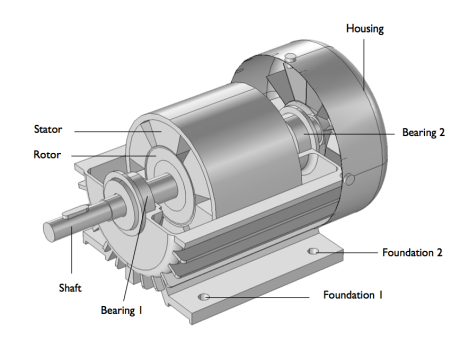
Induction motor rotor assembly — bulky squirrel-cage vs. compact PMSM rotor
When Induction Actually Makes Sense
We're not anti-induction. We stock them. They win for:
- High-temp/abuse environments — farm UTVs, mining buggies, sand rails where sustained 120°C+ stator temps happen
- Budget builds where battery is already fixed — if you're stuck with a 20 kWh pack, a cheaper induction motor lets you finish the build
- Dual-motor AWD "coast" setups — front induction motor freewheels with zero drag; rear PMSM handles cruising
Our induction motors (30–150 kW) use Class H insulation and forged rotor bars for the abuse tolerance DIY builders actually need.
The Hidden Cost Nobody Talks About: Controller Matching
A $800 induction motor + $1,200 generic VFD + 40 hours of tuning = $2,000+ and weekends lost.
Our complete drivetrain kits include:
- Motor (PMSM or induction) — factory-tested at 100% load
- Matched FOC/VFD controller — pre-loaded with your motor params
- Resolver/encoder harness — plug-and-play, no crimping
- DC-DC converter (12 V/24 V), OBC, EPS — all voltage-matched
- Shipping to your door in 15–25 days to 130+ countries, DDP available
Factory-direct pricing means you pay 30–40% less than US/EU retailers for the same spec. No middlemen. No "call for quote" games.
💡 Builder Tip:
Pair a 96 V PMSM with our 35 kW controller and 30 kWh LiFePO₄ pack — that's a complete 0–100 km/h in 6 s kit for under $8,500 landed. Request a spec sheet →
Tesla Switched. So Did the Industry. Here's Why.
Tesla's original Roadster and Model S used induction. Model 3, Y, and every major OEM since chose PMSM. Not for marketing—for range per dollar.
But Tesla buys 1M+ units/year. You buy one. That's why we pre-match and pre-tune—so your single build gets OEM-level integration without OEM volume.
PMSM stator — concentrated windings, high slot fill, factory-varnished
Decision Checklist: 3 Questions, 30 Seconds
- Is your battery pack < 30 kWh? → PMSM (efficiency buys you range)
- Is the motor bay < 350 mm diameter? → PMSM (torque density wins)
- Does the vehicle live in mud/sand/120°C+ heat daily? → Induction (magnet-safe)
Still unsure? Send us your chassis, target weight, and voltage. We'll spec the exact motor + controller + battery combo—free, no obligation. We've done this for 1,000+ builds across 130 countries.


