Recently, we received an inquiry from a customer who is considering converting a classic Ford F-250 XLT 1994 into an electric vehicle. His questions are actually very common:
“For a 3/4-ton gas truck like this, can I still keep the towing capacity after conversion? What would be the right package? And what’s the estimated cost?”
If you’re researching electric conversion for pickup trucks, chances are you’re asking the exact same questions.
Here’s the short answer: Yes, it’s absolutely possible. With the right setup, towing performance can be maintained—or even improved. Most conversions typically cost between $15,000 and $35,000+.
But what really makes the difference is not whether you can convert it — it’s this:
👉 How do you properly match motor torque, battery capacity, and system design for a heavy-duty truck like the F-250 to ensure real towing performance and long-term reliability?
In the following sections, we’ll break down a practical, real-world conversion solution for this truck — including towing capability, recommended configuration, and a transparent cost structure.

What Is the Right Conversion Package for a Ford F-250?
For a heavy-duty truck like the Ford F-250 XLT 1994—originally equipped with a 7.5L V8—the “right conversion package” is far more than just swapping in an electric motor. It’s a complete system engineered around torque delivery, load capacity, and real-world usage.
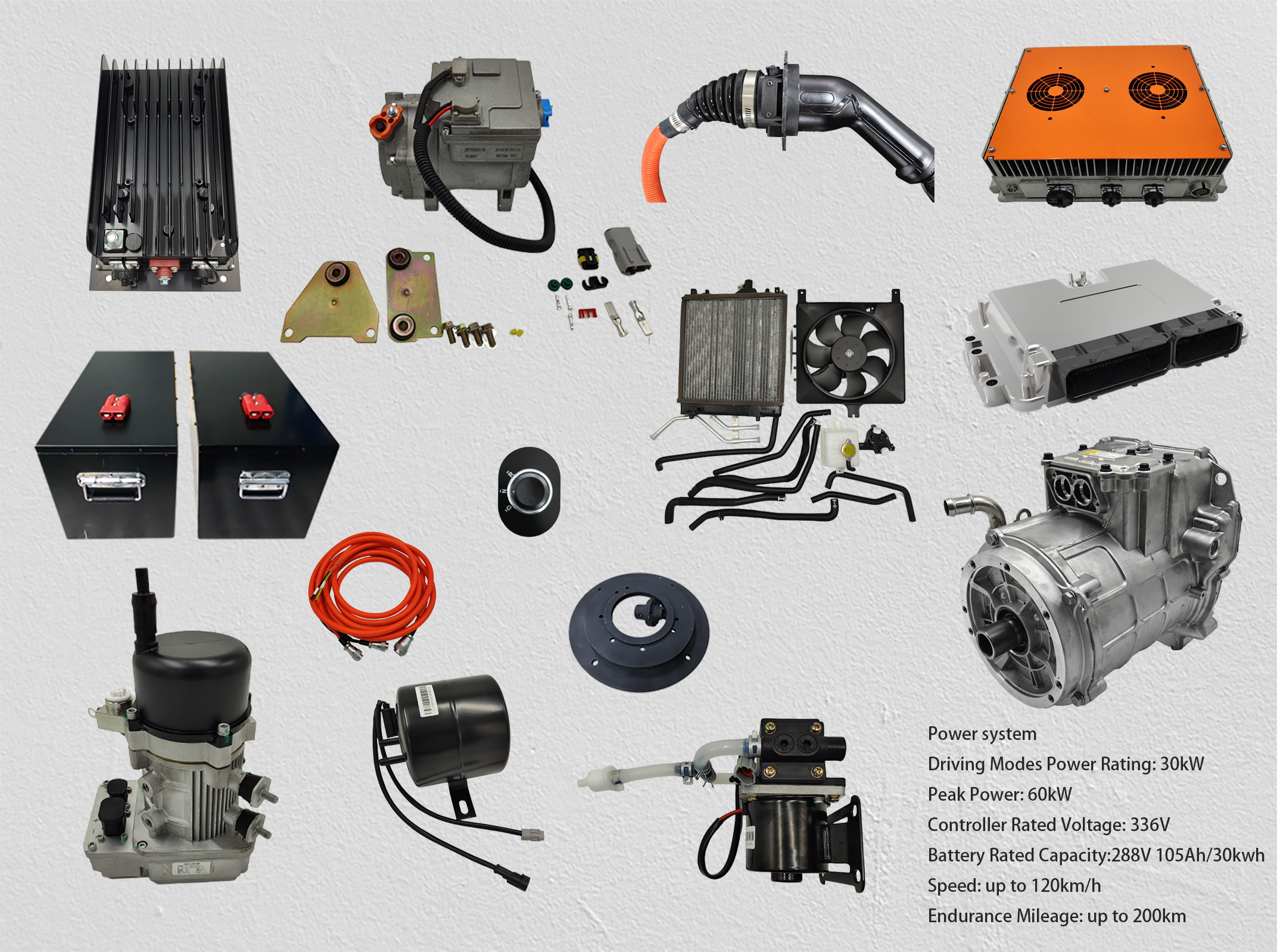
A typical conversion setup for an F-250 includes:
-
High-torque PMSM motor – replaces the engine and defines overall power capability
-
High-voltage battery system – impacts both driving range and sustained performance
-
Controller / inverter – ensures smooth and stable power delivery
-
Adapter or transmission integration – connects the electric drivetrain to the existing system
However, the real challenge isn’t just having these components — it’s this:
👉 How do you match them correctly to the truck’s weight, towing requirements, and usage scenario?
For example:
A moderate setup might work fine for daily driving, but if you expect the truck to tow trailers or carry heavy loads, then motor torque output and battery discharge capability must be designed at a much higher level.
This is exactly why many conversion projects fail—not because of poor components, but بسبب poor system matching.
Will Towing Capacity Drop After Electric Conversion?
This is the biggest concern for most truck owners:
👉 Will towing capacity decrease after converting to electric?
For a truck like the Ford F-250 XLT 1994, the answer is: not necessarily—in many cases, it can actually improve.
Here’s why:
👉 Electric motors deliver torque very differently from internal combustion engines.
A 7.5L V8 engine needs to reach higher RPMs to produce peak torque. In contrast, an electric motor can deliver near-maximum torque from 0 RPM. This leads to:
-
Easier launches when towing heavy loads (especially on inclines)
-
More stable low-speed pulling (no constant gear shifting)
-
Smoother and more controllable power delivery
In other words, with the right motor setup, an electric F-250 can behave more like a high-torque industrial machine than a traditional gas-powered truck.
However, there’s a critical condition:
👉 Towing performance doesn’t depend on the motor alone—it’s determined by motor torque, battery discharge capability, and overall system design.
If the motor is undersized or the battery cannot sustain high current output, performance will drop significantly during long-duration towing (such as highway hauling or uphill loads).
That’s why a professional conversion must consider:
-
Continuous torque (not just peak torque)
-
Battery discharge rate
-
Thermal management
-
How Much Does It Cost to Convert a Ford F-250 to Electric?
-
At this point, almost every truck owner asks the same question:
👉 How much does it actually cost to convert a truck like the Ford F-250 XLT 1994 to electric?A realistic answer is:
👉 Most F-250 conversions fall between $15,000 and $35,000+The wide range exists because this isn’t a fixed product—it’s a system made up of several key components. Here’s a more transparent breakdown:
1️⃣ Motor System (Motor + Controller)
-
Around: $4,000 – $10,000
-
Defines overall power and towing capability
👉 For a heavy-duty truck, this is not where you want to cut corners
2️⃣ Battery System (Battery Pack)
-
Around: $6,000 – $15,000+
-
Depends on range and discharge capability
👉 For towing applications, it’s not just about capacity—it’s about sustained high-current output
3️⃣ Mechanical Integration (Adapters & Mounting)
-
Around: $2,000 – $5,000
-
Includes motor mounts, transmission adapters, wiring
👉 This determines long-term reliability
4️⃣ Labor & Tuning
-
Around: $3,000 – $8,000 (varies by region)
👉 Covers installation, calibration, and safety validation
One key takeaway:
👉 The cost is not determined by the conversion itself—but by the performance level you want.
-
Light-duty use (daily driving) → lower budget possible
-
Heavy-duty towing (work truck) → requires a higher-spec system
This explains why some builds cost $12,000 but underperform, while others at $30,000+ can fully replace a gas truck.
-

-
Best Electric Conversion Setup for a Ford F-250 (Recommended Configuration)
-
If your goal is to ensure that a Ford F-250 XLT 1994 retains real, usable towing capability after conversion (not just “it runs, but struggles”), then the system must be designed around high torque and sustained performance.
Based on CMVTE’s project experience, a balanced and practical setup typically looks like this:
🔧 Recommended Configuration (Reference Setup)
1️⃣ Motor
-
Type: High-power PMSM (Permanent Magnet Synchronous Motor)
-
Power range: 120kW – 200kW
-
Peak torque: 300Nm – 600Nm+ (depending on controller tuning)
👉 This level is sufficient for most F-250 towing needs
2️⃣ Battery System
-
Voltage platform: 300V – 400V
-
Capacity: 60kWh – 120kWh
👉 For towing, prioritize discharge capability, not just range
3️⃣ Drivetrain Setup
-
Retain original transmission (recommended) or use a custom reduction system
-
High-strength adapter to connect motor and transmission
👉 Keeping the transmission helps multiply torque—ideal for heavy-duty use
4️⃣ Control & Thermal Management
-
High-performance controller (supports high current output)
-
Dedicated cooling system (motor + battery)
👉 Critical for maintaining performance during long towing sessions
One key insight:
👉 Bigger power doesn’t always mean better performance—matching is everything.
Many builds fail because:
-
Oversized motors increase cost but reduce efficiency
-
Battery systems can’t support the motor properly
-
Poor thermal design leads to power drop under load
That’s why at CMVTE, we focus on:
👉 Delivering fully matched conversion kits, not just individual components. -
-
Real-World Performance – Can an Electric F-250 Actually Replace a Gas Truck?
-
Even after discussing specs and configurations, most people still wonder:
👉 How does an electric Ford F-250 XLT 1994 actually perform in real-world use? Can it truly replace a gas truck?The answer is: Yes—but only with the right setup and realistic expectations.
Let’s break it down into three common use cases:
🚚 Scenario 1: Trailer Towing
Electric F-250 conversions perform exceptionally well when towing:
-
Easier launch (no need to build RPM)
-
Better low-speed control (especially for reversing and maneuvering)
-
Smooth, linear torque delivery
👉 For short to medium-distance towing, it can often outperform gas trucks
However:
-
Long-distance, high-speed towing → requires strong battery and cooling
-
Range will decrease significantly (true for all EVs)
⛰️ Scenario 2: Hill Climbing & Heavy Load
This is where electric systems shine:
-
High torque without downshifting
-
No lag in power delivery on inclines
👉 In demanding environments (construction, farms), it behaves more like industrial equipment than a traditional vehicle
🛣️ Scenario 3: Daily Driving
Outside heavy-duty use, the benefits are even clearer:
-
Near-silent operation
-
Lower maintenance (no oil, fewer moving parts)
-
Smoother driving experience
👉 This is often the “hidden benefit” that surprises most users
One important reality:
👉 An electric conversion is not a perfect 1:1 replacement—it’s a better solution for specific use cases.
-
Long-distance highway towing → requires planning (battery size or charging strategy)
-
Local work / farm / industrial use → ideal for electric conversion
This is why more users are switching—not just for cost, but for better efficiency and usability in the right scenarios.
-
-
Conclusion & FAQ – What You Should Know Before Converting
-
1. Can a Ford F-250 be converted to electric?
Yes. A truck like the Ford F-250 XLT 1994 is structurally ideal for conversion due to its strong chassis and space for battery integration.
2. Will towing capacity decrease after conversion?
Not necessarily. With a properly matched motor and battery system, towing performance can be maintained or even improved due to instant torque delivery.
3. How much torque is needed for towing?
For a heavy-duty truck, a system capable of 300Nm – 600Nm+ motor torque (combined with transmission multiplication) is typically required for practical towing use.
4. How much does it cost to convert a pickup truck to electric?
Most projects fall between $15,000 and $35,000+, depending on battery size, motor power, and system complexity.
5. Is electric conversion worth it for a work truck?
If your usage involves local transport, towing, or industrial work, the answer is often yes—due to lower operating cost, higher torque efficiency, and reduced maintenance.
-
So, going back to the original question: Is it worth converting a Ford F-250 XLT 1994 to electric?
In one sentence:
👉 Yes—it’s absolutely possible, and in towing or heavy-load scenarios, it can even outperform a gas truck… as long as the system is properly designed.
This article answered three key questions:
-
✔ Is conversion possible? → Yes
-
✔ Will towing capacity drop? → No, it can even improve
-
✔ What does it cost? → $15,000 – $35,000+ depending on setup
But the real deciding factor is always this:
👉 System matching—not individual components.That’s why more customers turn to companies like CMVTE—not just for parts, but for complete, well-matched, real-world conversion solutions.
-
- ford-mustang-ev-conversion-kit
- ford-ranger-ev-conversion-solution
- ford-model-a-conversion-solution