

Episode 2 – Stripping the Hilux Down to Its Bare Essentials
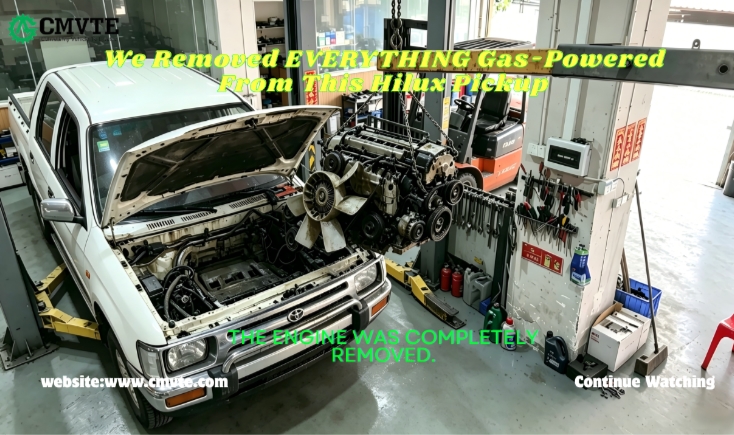
Last week, we introduced our Toyota Hilux EV Conversion Project and shared why we chose one of the world’s most trusted pickup trucks as the platform for this build.
This week, the real work begins.
The diesel engine is gone.
The fuel tank is gone.
The exhaust system is gone.
The radiator, cooling lines, air intake, and every major internal combustion component have been removed.
At first glance, it might look like we’ve taken the truck apart just for the sake of it—but in reality, this is one of the most important stages of the entire conversion.
Why Remove Everything?
One of the questions we hear most often is:
“Can’t you just replace the engine with an electric motor?”
The short answer is no.
An electric powertrain is fundamentally different from a diesel drivetrain. Many of the original components are no longer needed, while new systems require their own dedicated space.
Removing the internal combustion engine (ICE) components creates room for:
- ⚡ The electric motor
- 🔋 High-voltage battery packs
- 🔌 Motor controller and power electronics
- ❄️ Cooling system for the EV components
- 🔧 High-voltage wiring and safety equipment
Every component has to be carefully planned to achieve proper weight distribution, easy maintenance, and long-term reliability.
This isn’t simply an engine swap—it’s a complete powertrain transformation.
More Than Just Removing Parts
Although this stage may appear straightforward, it’s far more than unbolting old components.
Every bracket, mounting point, and cable routing is carefully inspected because many of them may be reused later in the project.
The cleaner and more organized the chassis is now, the easier it becomes to install the electric drivetrain accurately in the following stages.
As the old saying goes:
A successful build starts with good preparation.
Where the Project Stands Today
After completing this stage, our Hilux is now a clean rolling chassis, ready for its new electric heart.
With the diesel drivetrain removed, we can finally begin the engineering work that determines how well the finished vehicle will perform.
And that’s where things start to get really interesting.
🎥 Watch Episode 2
In this episode, you’ll see the complete teardown process, including the removal of:
- Engine
- Fuel tank
- Exhaust system
- Radiator
- Cooling pipes
- Other fuel-powered components
By the end of the video, the Hilux is fully prepared for its electric future.
We Removed EVERYTHING Gas-Powered From This Hilux Pickup
What’s Coming Next?
With the engine bay now completely empty, it’s time to answer one of the biggest engineering questions in any EV conversion:
How do you connect an electric motor to the original Hilux transmission?
In Episode 3, we’ll take all the critical measurements and design a custom adapter plate that connects the electric motor to the factory gearbox.
This adapter may look like a simple piece of metal, but it’s one of the most important mechanical components in the entire conversion. It determines alignment, reliability, and how efficiently the motor transfers power to the drivetrain.
If you’re curious about the engineering behind an EV conversion, you won’t want to miss the next episode.
Thinking About Converting Your Own Hilux?
Every conversion project is unique.
Whether you’re converting a Toyota Hilux, Isuzu D-Max, or another pickup truck, selecting the right motor, battery system, controller, and drivetrain configuration is the key to a successful build.
At GMT, we’ve already helped customers convert vehicles such as the Toyota Hilux and Isuzu D-Max, and we’re continuing to document our own Hilux EV conversion project step by step.
If you’re planning a similar project, we’d be happy to help.
Simply reply “HILUX” to [email protected], and we’ll provide a preliminary Bill of Materials (BOM), recommended system configuration, and an estimated project budget tailored to your vehicle.

