

The motor is the heart of your truck conversion. Pick the right one, and you get efficiency, torque, and years of reliable service. Pick the wrong one, and you could waste $5,000+ on a system that underperforms — or needs replacing entirely.
For truck EV conversions, three motor types dominate the market. Here is how they compare and which one fits your build.
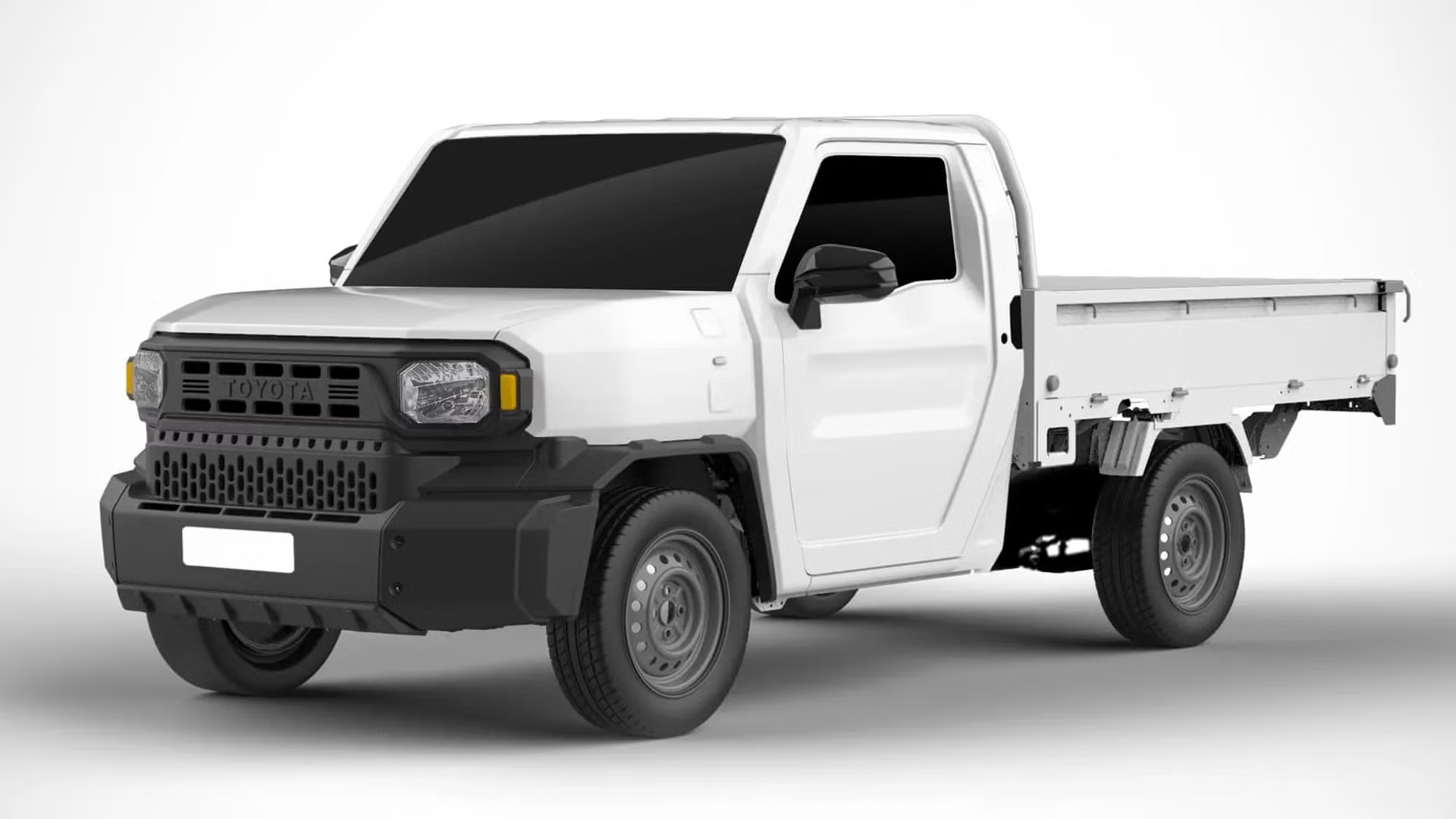
Motor Type 1: PMSM — The Efficiency King
Permanent Magnet Synchronous Motors (PMSM) are the gold standard for modern EV conversions. They use permanent magnets embedded in the rotor, eliminating the need for electrical current to create a magnetic field.
Pros: 95% peak efficiency, highest power density, instant torque from 0 RPM, excellent regenerative braking, compact size.
Cons: Higher upfront cost than AC induction, uses rare-earth magnets, requires more sophisticated controller.
Best for: Builds where range, performance, and efficiency matter most. CMVTE's PMSM motors range from 20kW to 500kW+ — covering everything from a VW Beetle conversion to a Class 8 semi truck.
Motor Type 2: AC Induction — The Workhorse
AC induction motors are the oldest and most proven electric motor technology. They are simple, robust, and have been used in industrial applications for over a century.
Pros: Lower upfront cost, no rare-earth magnets, simple construction, good high-RPM performance, very reliable.
Cons: Lower efficiency (85-90%), larger and heavier for the same power output, generates more heat (needs better cooling), less torque at low RPM.
Best for: Budget-constrained builds, heavier vehicles where space is less of a concern, or applications where maximum efficiency is not the priority. A US Parts Retailer Kit often uses AC induction motors to hit a lower price point — but you pay for that saving in higher electricity costs over time.
Motor Type 3: BLDC — The Lightweight Option
Brushless DC (BLDC) motors are common in smaller EV applications — golf carts, e-trikes, and light utility vehicles.
Pros: Simple control, good efficiency at low speeds, compact and lightweight, low cost.
Cons: Limited power output — typically under 15-20kW for a single unit. Not suitable for full-size truck conversions without multiple motors. Less efficient at high speeds.
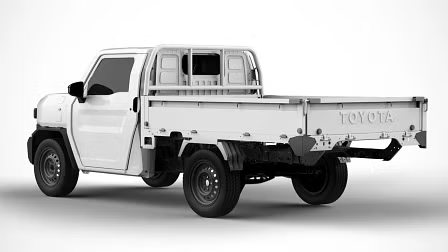
Best for: Light-duty utility trucks, farm vehicles, kei trucks, and small commercial EVs where top speed and highway capability are not required.
Quick Comparison
| Factor | PMSM | AC Induction | BLDC |
| Peak Efficiency | 95% | 85-90% | 85-92% |
| Torque at 0 RPM | Maximum | Reduced | Good |
| Power Density | Highest | Medium | Low |
| Controller Cost | Higher | Moderate | Low |
| Best Power Range | 20-500kW+ | 30-300kW | 1-20kW |
| Maintenance | Very low | Very low | Very low |
Matching Motor to Truck Type
Full-size pickup (F-150, Silverado, Ram 1500): PMSM 70-120kW continuous, 144V-360V. This is the sweet spot for torque, efficiency, and weight.
Medium-duty truck (Isuzu NPR, Hino): PMSM 80-150kW or dual AC induction for cost-sensitive builds. Voltage 300-400V.
Light utility (kei truck, farm vehicle): PMSM 15-40kW at 96V, or BLDC 5-15kW at 72V for budget builds.
Heavy-duty / Class 8 (Freightliner, Kenworth): PMSM 250-500kW, 600V+, with liquid cooling and integrated gearbox.

What Comes in a Complete Motor Kit
Whichever motor type you choose, a proper conversion kit should include more than just the motor. Look for a package with: the electric motor, matching motor controller (VCU-compatible), wiring harness with pinout documentation, adapter plate or bellhousing for your transmission, and cooling system components. CMVTE packages everything in one shipment — no piecing together parts from different suppliers or guessing which controller works with which motor.
Regenerative braking also differs by motor type. PMSM delivers the strongest regen at low speeds — ideal for stop-and-go truck driving. AC induction regen is weaker below 20 km/h, meaning you rely more on your friction brakes in city traffic. BLDC regen is minimal and best suited to light vehicles that rarely exceed 40 km/h.
The $5,000 Mistake
Here is where most DIY builders get it wrong: they choose a motor based on upfront price alone. An AC induction motor might save you $2,000-3,000 at purchase compared to a PMSM. But over 100,000 miles, the PMSM's 5-10% efficiency advantage saves you $3,000-5,000 in electricity — plus you get better acceleration and more payload capacity from the lighter motor.
The US Parts Retailer Kit market pushes AC induction because it is cheaper to source and margin is higher. CMVTE, as a manufacturer, offers both PMSM and AC induction options — and we will tell you honestly which one fits your truck, budget, and driving pattern.
CMVTE: The Manufacturer Advantage
CMVTE has been designing and manufacturing electric motors since 1995. Our PMSM and AC induction motors are built in our Foshan factory, tested before shipping, and backed by nearly 20 years of EV conversion experience from Dr. Kevin Wang's team. Every motor comes with the matching controller, VCU integration support, and wiring documentation. Shipped to 130+ countries.
Not sure which motor fits your truck? Ask Dr. Kevin Wang's team for a free recommendation


