

If your company operates a fleet of pickup trucks for logistics, delivery, mining, construction, utilities or field services, you may already be asking a simple question:
Can we convert our existing pickup trucks to electric instead of replacing the entire fleet?
The answer is: in many cases, yes.
But fleet electrification is very different from converting one private vehicle.
For a single pickup, the main question may be whether the vehicle can reach the desired speed and range.
For a fleet operator, the real questions are much broader:
- How far does each vehicle travel every day?
- How much cargo does it carry?
- Can it return to the depot for charging?
- How long can the vehicle stay out of service?
- What battery capacity is actually needed?
- Can the same conversion solution be used across multiple vehicles?
- What will happen to operating and maintenance costs?
This is why we believe a successful pickup fleet conversion should start with the fleet’s operating conditions, not simply with a motor or battery.
At CMVTE, we develop complete EV conversion systems for commercial vehicles and have already applied our electric powertrain solutions to real pickup conversion projects.
Why Are Companies Looking at Electric Pickup Fleets?
Pickup trucks are popular commercial vehicles because they are versatile.
They can transport goods, carry technicians, operate on construction sites, support mining operations and handle local distribution.
But when a company operates dozens of pickups, fuel and maintenance become a significant operating expense.
A typical fleet may have:
- High annual mileage
- Frequent engine maintenance
- Regular oil and filter changes
- Fuel consumption throughout the working day
- Long periods of idling
- Increasing vehicle operating costs
For a fleet of 5 vehicles, this may be manageable.
For a fleet of 50 or 100 vehicles, the same costs become much more significant.
This is where electric conversion becomes worth evaluating.
Instead of purchasing an entirely new electric fleet, companies can consider retrofitting the existing pickup platform with an electric powertrain.
The chassis, body, suspension and other usable vehicle systems can remain in place, while the internal-combustion powertrain is replaced by an electric system.
Is Your Pickup Fleet Suitable for EV Conversion?
Not every pickup fleet is a good candidate.
The best candidates generally have relatively predictable operating patterns.
For example:
Local logistics
A pickup leaves the depot in the morning, completes multiple deliveries and returns to the same location in the evening.
Industrial operations
The vehicle operates within a defined industrial or mining area and returns to a fixed parking location.
Construction and engineering
The pickup transports workers, tools and equipment between a company base and nearby project sites.
Utility and service fleets
Technicians use pickups for daily service routes and return to the depot after work.
These applications have one important characteristic:
The vehicle’s daily operation is relatively predictable.
That makes battery sizing and charging much easier.
Don’t Start With “How Many kWh Do I Need?”
One of the most common mistakes in EV conversion projects is starting with the battery.
A fleet customer may say:
“We want 300 km of range.”
But that does not necessarily mean a 300 km battery is the best solution.
We first need to understand how the vehicle is actually used.
Consider two pickup fleets.
Fleet A
- 100–150 km per day
- Mostly urban roads
- Moderate payload
- Returns to the depot every evening
- Overnight charging available
Fleet B
- 250–300 km per day
- Highway operation
- Heavy payload
- High average speed
- Limited charging opportunities
Both vehicles may use the same pickup model.
But they should not necessarily use the same battery.
The first fleet may benefit from a smaller, lighter and lower-cost battery.
The second fleet may require significantly more energy capacity and a different charging strategy.
The battery should be designed around the duty cycle.
What Information Do We Need From a Pickup Fleet?
Before developing a conversion solution, we normally look at several basic parameters.
You do not need to prepare a complicated engineering document.
The following information is usually enough to begin an initial evaluation:
| Fleet Information | Why It Matters |
|---|---|
| Pickup model | Determines mechanical and electrical integration |
| Model year | Helps identify drivetrain and vehicle architecture |
| 2WD / 4WD | Determines the drivetrain conversion approach |
| Manual / automatic | Affects motor and transmission integration |
| Daily mileage | Determines battery capacity |
| Typical payload | Determines motor and battery requirements |
| Average speed | Helps determine continuous motor power |
| Maximum speed | Determines motor speed and gearing |
| Road conditions | Affects power and energy consumption |
| Number of vehicles | Determines standardization and production requirements |
| Charging location | Determines charging strategy |
This information allows us to move from a generic EV conversion discussion to an actual fleet engineering proposal.
From One Pickup to a Fleet: Our Real-World Approach
A fleet project should not start by converting 50 vehicles at once.
We normally recommend a pilot-first approach.
Step 1 — Evaluate the Existing Pickup
We review the vehicle and its operating conditions.
This includes the drivetrain, vehicle weight, payload, daily mileage and expected performance.
Step 2 — Design the Electric Powertrain
The system can include:
- Electric motor
- Motor controller
- Battery pack
- BMS
- VCU
- DC-DC converter
- On-board charger
- High-voltage protection
- Cooling system
- Charging system
- Wiring and integration components
The exact configuration depends on the vehicle and application.
Step 3 — Convert One Pilot Vehicle
The first vehicle is used to validate the mechanical installation, electrical system and actual driving performance.
Step 4 — Test Under Real Fleet Conditions
This is an important step.
The vehicle should not only be tested inside the workshop.
It should operate under conditions similar to the customer’s actual fleet:
- Real payload
- Real routes
- Real driving speeds
- Real working hours
- Real charging conditions
The collected data can then be used to optimize the final fleet configuration.
Step 5 — Standardize the Solution
Once the pilot vehicle meets the requirements, the conversion process can be standardized for the rest of the fleet.
This is where the economics of fleet conversion become much more interesting.
A Real Example: Converting a Toyota Hilux to Electric
At CMVTE, we don’t only design EV conversion systems on paper.
We also work on real vehicles.
One of our pickup conversion projects is based on the Toyota Hilux, a platform widely used for commercial and utility applications around the world.
The conversion process involves much more than removing the original engine and installing an electric motor.
The complete project includes mechanical integration, motor and controller installation, battery integration, high-voltage wiring, control system integration and road testing.
For this type of pickup application, we can develop a high-voltage electric powertrain using a PMSM motor and integrated control system.
For example, one of our pickup solutions is based around a 360V, 70 kW electric motor system, with higher peak power available when required.
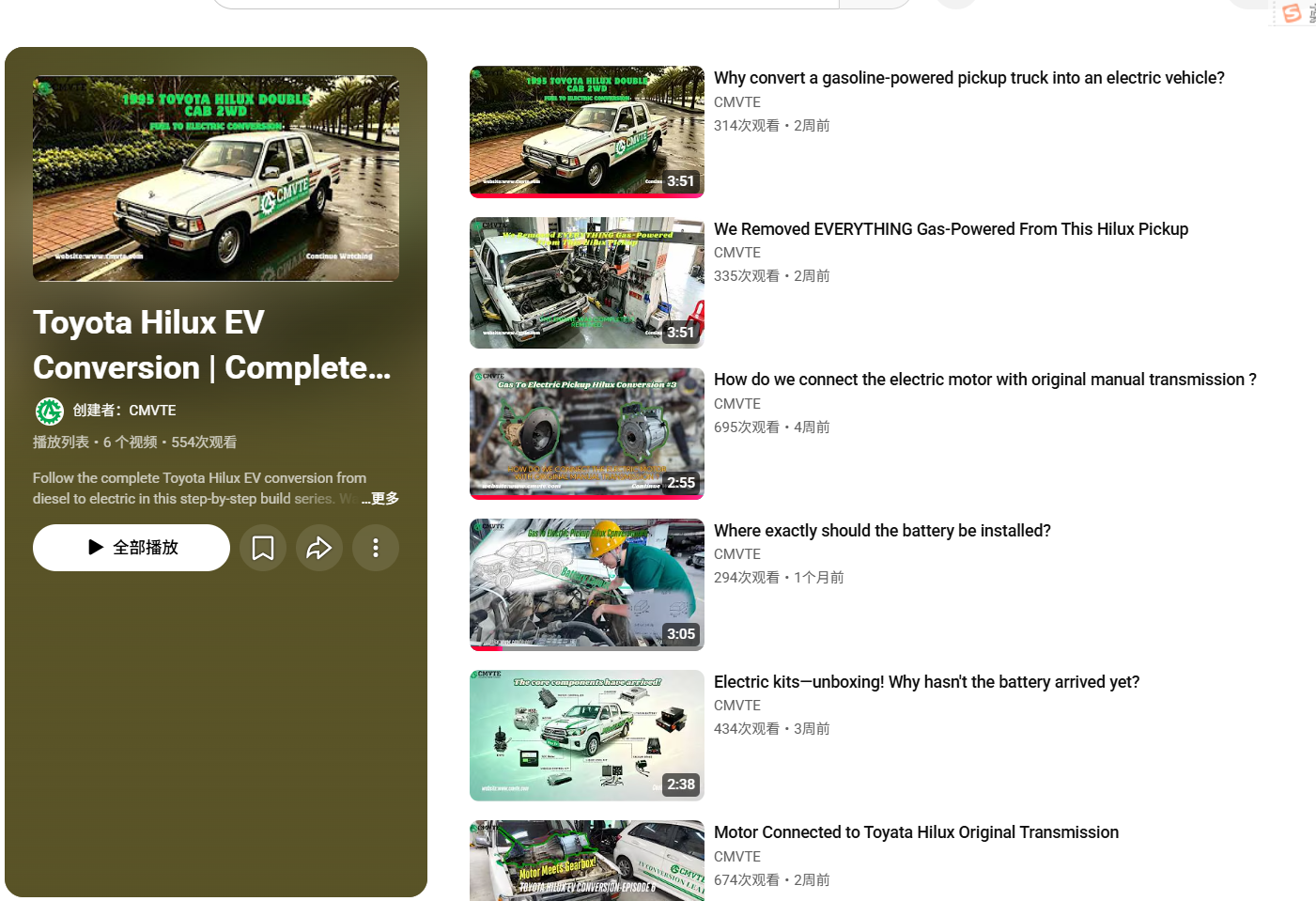
You can check our Hilux EV conversion Step by step build videos here: Toyota Hilux EV Conversion | Complete Electric Pickup Build Series – YouTube
The system can also be configured with a battery capacity selected according to the customer’s actual daily driving requirements.
This is important because there is no single “Hilux EV kit” that is perfect for every fleet.
A Hilux used for urban delivery, for example, may need a very different battery configuration from one used for long-distance highway transportation.
What Does a Real Pickup Conversion Look Like?
One of the biggest concerns for fleet customers is whether the proposed system can actually be installed in the vehicle.
That is why we document the conversion process.
A typical pickup conversion includes:
Original vehicle
↓
Remove the internal-combustion powertrain
↓
Install the electric motor and drivetrain
↓
Install the battery pack
↓
Install controller, BMS, VCU and high-voltage components
↓
Connect charging and DC-DC systems
↓
Complete software and control integration
↓
No-load testing
↓
Road testing
↓
Final calibration
The installation itself is only one part of the project.
The final objective is to make all of the components operate together as one system.
We can provide customers with real project photos and conversion videos so they can see the installation process rather than relying only on a specification sheet.
Why a Complete System Matters for Fleet Projects
A fleet operator is not simply buying an electric motor.
The motor is only one part of the system.
A commercial EV conversion needs the following systems to work together:
Battery → BMS → VCU → Controller → Motor → Vehicle
At the same time:
Charger → Battery → BMS
and:
Battery → DC-DC → Original 12V/24V Vehicle Systems
If these systems are not properly integrated, the project may encounter problems with charging, thermal management, communication, safety or vehicle operation.
This is why we focus on three-electric integration rather than supplying individual components independently.
The objective is to provide a complete powertrain solution that can be installed, tested and eventually standardized across a fleet.
What About the Original Transmission?
This is another question we frequently receive from pickup customers.
There is no universal answer.
Depending on the vehicle and project requirements, the original transmission may be retained, modified or replaced with another drivetrain configuration.
The decision depends on:
- Motor speed
- Motor torque
- Tire diameter
- Differential ratio
- Vehicle weight
- Target speed
- Acceleration requirements
- Road gradient
- 2WD or 4WD configuration
For some pickup applications, retaining part of the original drivetrain can simplify the conversion.
For others, a direct-drive or different reduction solution may be more appropriate.
The important point is that the motor, reduction ratio and vehicle drivetrain must be designed together.
Battery Capacity: Bigger Is Not Always Better
Fleet customers sometimes assume that a larger battery automatically means a better vehicle.
Not necessarily.
A larger battery means:
- Higher cost
- Higher vehicle weight
- More space required
- Potentially longer charging time
If the vehicle only travels 120 km per day, installing a battery designed for 400 km may not make economic sense.
A better approach is to consider:
Daily mileage + payload + energy consumption + charging opportunity + required reserve
For example, if the vehicle returns to the depot every evening, the battery can be charged overnight and may not need to support several days of operation.
This can significantly affect the economics of the project.
Charging Is Part of the Fleet Design
A fleet conversion project should always consider charging at the same time as the vehicle.
For a depot-based fleet, overnight AC charging may be enough.
For high-utilization vehicles, faster charging may be required.
The correct charging solution depends on:
- Daily mileage
- Number of vehicles
- Working hours
- Parking time
- Available electrical capacity
- Battery capacity
- Required turnaround time
For example, a fleet of 50 pickups cannot simply be treated as 50 individual EVs.
The charging infrastructure becomes a fleet-level engineering problem.
The goal is to make sure the vehicles are ready when the working day starts.
How Much Can a Fleet Save?
This is where every fleet operator should be careful.
We do not recommend promising a fixed percentage of savings before understanding the customer’s actual operation.
The economics depend on several variables:
- Annual mileage
- Local fuel price
- Local electricity price
- Vehicle fuel consumption
- Electricity consumption
- Maintenance costs
- Battery cost
- Charging infrastructure
- Vehicle utilization
- Conversion cost
The right comparison is therefore not:
“EV conversion kit price vs. new vehicle price.”
It is:
Total Cost of Ownership
Current Fleet
Fuel + maintenance + engine-related repairs + other operating costs
versus
Converted Fleet
Electricity + charging + maintenance + battery lifecycle cost + conversion investment
For a high-mileage commercial fleet, this calculation can be much more meaningful than the initial conversion price alone.
Why Convert an Existing Pickup Instead of Buying a New EV?
There are situations where purchasing a new electric pickup is the better solution.
But fleet operators may already have vehicles that are structurally suitable for continued operation.
The company may already own:
- The vehicles
- Spare parts
- Maintenance infrastructure
- Drivers
- Service facilities
- Fleet management systems
Replacing the entire fleet means replacing the vehicle platform.
Conversion takes a different approach:
Keep the usable vehicle platform and replace the internal-combustion powertrain with an electric one.
This can be particularly interesting when the existing pickups are still in good mechanical condition but the engine or fuel costs have become a problem.
Of course, each vehicle must be evaluated individually.
A pickup that is structurally damaged or near the end of its useful life may not be a good conversion candidate.
Why Fleet Standardization Is So Important
Converting one vehicle is a retrofit project.
Converting 50 vehicles is a production process.
If every vehicle requires a different motor, battery, controller and installation method, the project becomes expensive and difficult to manage.
For fleet customers, we therefore focus on creating a repeatable conversion architecture.
Where possible, we can standardize:
- Motor system
- Controller
- Battery platform
- BMS
- VCU
- DC-DC converter
- Charger
- Wiring
- Mechanical mounting
- Installation procedure
Once the first vehicle has been validated, the same engineering solution can be applied to additional vehicles.
This reduces development work for each vehicle and makes fleet maintenance easier.
From Pilot Vehicle to Full Fleet
A practical fleet electrification project can follow this structure:
1. Fleet Assessment
Understand the vehicles and their daily operation.
2. Engineering Proposal
Select the appropriate motor, battery, controller, charging system and drivetrain configuration.
3. Pilot Conversion
Convert one representative pickup.
4. Real-World Testing
Measure actual range, energy consumption, charging performance and vehicle behavior.
5. Optimization
Adjust the configuration if necessary.
6. Fleet Standardization
Create a repeatable conversion package.
7. Batch Conversion
Convert additional vehicles according to the standardized process.
This approach reduces risk and allows the fleet operator to make decisions based on real data.
Why Work With CMVTE?
CMVTE is not simply a motor supplier.
Our focus is on complete electric powertrain integration for vehicle conversion projects.
Our team can support customers with:
- Electric motors
- Controllers
- Battery systems
- BMS
- VCU
- DC-DC converters
- Chargers
- High-voltage systems
- Mechanical integration
- Cooling systems
- Complete EV conversion solutions
We also understand that fleet customers need more than a component list.
They need to know:
Will it fit the vehicle?
Will it perform under real operating conditions?
Can the solution be repeated across multiple vehicles?
Can we provide technical support during installation?
Can the system be adapted to our fleet’s actual requirements?
These are the questions we focus on when developing commercial EV conversion projects.
Have a Pickup Fleet? Let’s Start With One Vehicle.
If you operate a fleet of pickups for logistics, delivery, mining, construction, utilities or other commercial applications, you don’t need to start with a complicated engineering specification.
Send us the basic information:
- Pickup model
- Model year
- 2WD or 4WD
- Manual or automatic transmission
- Number of vehicles
- Average daily mileage
- Typical payload
- Required cruising speed
- Typical route
- Charging location
If possible, also provide photos of the vehicle and its engine bay.
Based on this information, we can evaluate:
Motor power
→ Battery capacity
→ Voltage platform
→ Drivetrain configuration
→ Charging solution
→ Conversion method
→ Fleet scalability
The goal is not to install the biggest motor or the largest battery.
The goal is to build an electric pickup that works for the way your fleet actually operates.
If you already operate a pickup fleet and are considering electrification, send us your vehicle information and operating requirements. We can start by evaluating one representative vehicle and develop the solution from there.

