

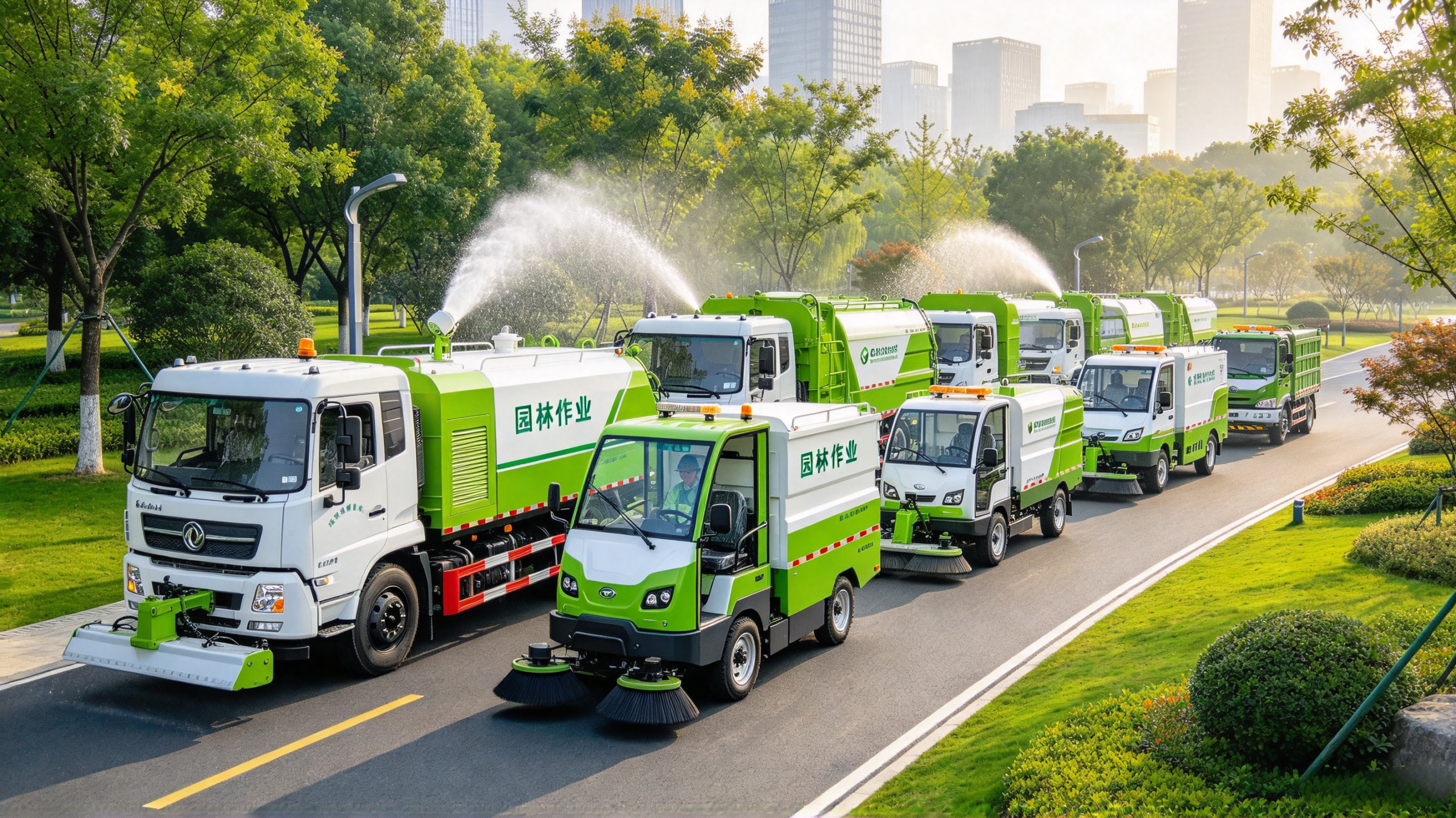
Landscaping companies, parks departments, municipalities, golf courses, property maintenance contractors, and grounds-management organizations all depend on vehicles that perform a very specific job: carrying people, tools, materials, and equipment from one work site to another, often over short daily routes with frequent stops.
This makes landscaping and grounds-maintenance fleets an interesting application for fleet electrification.
Unlike long-haul transportation, many landscaping vehicles operate on predictable routes, return to the same depot or yard every day, and accumulate significant amounts of low-speed and stop-and-go driving. At the same time, replacing an entire fleet with new electric vehicles may require a substantial capital investment.
For some operators, converting existing vehicles to electric power can provide another path.
Instead of replacing a proven pickup truck, van, utility vehicle, or light-duty work vehicle, fleet operators can evaluate whether the existing platform can be repowered with an integrated electric drive system.
For landscaping and municipal fleets, the objective is not simply to install an electric motor. The real objective is to create a reliable, repeatable vehicle that can perform the same daily work with an electric powertrain.
What Is Landscaping Fleet Electrification?
Landscaping fleet electrification is the process of replacing conventional gasoline or diesel-powered vehicles used for landscaping, grounds maintenance, parks maintenance, property services, and municipal operations with electric vehicles or converted electric vehicles.
A landscaping fleet may include:
- Pickup trucks used to transport crews, tools, and materials
- Cargo vans used by landscaping and maintenance teams
- Small utility trucks
- Light-duty work trucks
- Municipal parks and recreation vehicles
- Grounds-maintenance vehicles
- Service vehicles for golf courses and large properties
- Special-purpose utility vehicles
- Older fleet vehicles with specialized bodies or equipment
For many of these applications, the vehicle itself is only part of the investment. The fleet may already have service bodies, tool storage, hydraulic equipment, trailers, racks, or other specialized equipment installed.
Replacing the complete vehicle can therefore mean replacing much more than an engine.
An EV conversion allows the operator to investigate whether the existing chassis and working equipment can remain in service while the internal-combustion powertrain is replaced with an electric system.
Why Landscaping Fleets Are Different From Passenger Cars
A passenger vehicle is usually evaluated according to range, acceleration, comfort, and charging time.
A commercial landscaping vehicle needs to be evaluated differently.
The important questions include:
- How many kilometers does the vehicle travel every day?
- How many hours does it operate?
- How much payload does it carry?
- Does it tow a trailer?
- Does it operate on paved roads, grass, gravel, or construction sites?
- How frequently does it stop and restart?
- Does it return to the same depot every evening?
- What auxiliary equipment does it operate?
- Does it need four-wheel drive?
- What are the local temperature and weather conditions?
- How much battery space is available?
- How many vehicles in the fleet use the same platform?
These factors determine the appropriate motor, battery, voltage platform, drivetrain configuration, and charging system.
A larger battery is not automatically a better fleet solution. Likewise, selecting the highest-power motor available can unnecessarily increase system cost and weight.
The right approach is to design the electric powertrain around the actual duty cycle.
Existing Vehicles Can Be Part of the Electrification Strategy
One of the biggest questions for a fleet operator is whether electrification requires purchasing an entirely new vehicle.
Not necessarily.
If an existing vehicle has a structurally sound chassis, suitable payload capacity, a useful body, and a known maintenance history, it may be possible to evaluate it for electric conversion.
This can be particularly relevant for landscaping and municipal fleets that operate specialized vehicles.
For example, a company may already have a fleet of pickup trucks with:
- Service bodies
- Toolboxes
- Crew seating
- Trailer hitches
- Racks
- Hydraulic or auxiliary equipment
- Specialized municipal equipment
Replacing the vehicle may require replacing or rebuilding these systems as well.
With EV conversion, the fleet operator can instead investigate whether the existing vehicle platform can be retained while the engine, fuel system, exhaust system, and related components are replaced with an electric powertrain.
The feasibility depends on the vehicle, operating requirements, local regulations, and conversion engineering.
Start With the Fleet Duty Cycle, Not the Motor
A common mistake in EV conversion projects is to start by asking:
“What size motor should we buy?”
For commercial fleet electrification, a better starting point is:
“What does this vehicle actually do every day?”
Consider a landscaping pickup that travels 60–100 km per day, carries a small crew and tools, operates mostly below highway speed, and returns to the company yard every afternoon.
Its requirements are very different from a construction truck traveling 250 km per day with a heavy payload.
The first vehicle may not require a large battery or high-power motor.
A fleet conversion assessment should normally consider:
- Vehicle curb weight
- GVWR
- Payload
- Trailer and towing requirements
- Average and maximum speed
- Daily mileage
- Operating hours
- Terrain
- Gradeability
- Tire size
- Differential ratio
- Existing transmission
- Available battery installation space
- Auxiliary electrical loads
- Climate and seasonal conditions
- Charging availability
This information provides the foundation for selecting the electric powertrain.
Choosing the Right Electric Powertrain
For light-duty landscaping and utility vehicles, a complete EV powertrain may include:
Electric motor + motor controller + battery + BMS + VCU + charger + DC/DC converter + high-voltage protection + wiring harness + display/instrumentation.
CMVTE develops electric drive systems across different voltage and power ranges, allowing the system to be matched to different vehicle sizes and duty cycles.
For example, a lightweight commercial or utility vehicle may be evaluated around a 96V 15kW platform.
A heavier vehicle may require a 96V or 144V higher-power system.
Larger work vehicles may require 144V systems or higher-voltage liquid-cooled platforms.
The exact configuration should be determined from the vehicle weight, payload, speed, gradeability, daily operating cycle, and drivetrain configuration.
For vehicles where the original manual transmission is suitable, retaining the transmission can also be an option. This can provide useful gear reduction and help preserve the original drivetrain characteristics.
For some applications, an electric drive axle or other drivetrain configuration may be more appropriate.
The objective is to select the simplest architecture that meets the fleet’s actual requirements.
Battery Capacity Should Match Daily Operation
Battery sizing is one of the most important decisions in landscaping fleet electrification.
A fleet vehicle that travels 80 km per day does not necessarily need a battery capable of traveling 400 km.
An oversized battery adds cost, weight, and installation complexity.
A better approach is to calculate the vehicle’s expected energy consumption and then add an appropriate operating reserve.
For example, a fleet operator should evaluate:
Daily distance × expected energy consumption = daily energy requirement
Then consider:
- Reserve capacity
- Seasonal temperature
- Heating and cooling loads
- Payload changes
- Terrain
- Battery aging
- Charging schedule
This can produce a much more practical battery specification.
For municipal fleets that return to a central depot every evening, overnight charging can make a relatively moderate battery capacity sufficient for the daily duty cycle.
Charging Infrastructure Can Be Simpler Than Expected
Many landscaping fleets operate from a fixed location.
Vehicles leave the depot in the morning, perform their routes during the day, and return to the same location in the afternoon or evening.
This operating pattern can simplify charging.
Instead of requiring high-power public charging, a fleet operator may be able to use scheduled depot charging.
The charging strategy should be developed together with the vehicle configuration.
Important factors include:
- Number of vehicles
- Daily mileage
- Vehicle return time
- Available electrical capacity
- Required charging window
- Charger power
- Number of vehicles charging simultaneously
- Seasonal energy requirements
The objective is to make sure vehicles are ready for the next working shift without unnecessarily overbuilding the charging infrastructure.
Don’t Forget Auxiliary Equipment
Landscaping vehicles are work platforms, not simply transportation vehicles.
This is one of the most important differences between landscaping fleet electrification and ordinary passenger-car conversion.
A converted vehicle may need to power:
- Hydraulic equipment
- Pumps
- Refrigeration
- Work lights
- Tool systems
- Auxiliary compressors
- Cab heating and air conditioning
- Communication equipment
- Municipal service equipment
These loads can significantly affect energy consumption.
Therefore, the EV conversion assessment should include the complete vehicle duty cycle rather than calculating range only from driving distance.
Why a Pilot Vehicle Is Usually the Best Starting Point
Fleet operators do not need to electrify 20, 50, or 100 vehicles immediately.
A more practical approach is to start with one representative vehicle.
The pilot vehicle should represent the fleet’s typical configuration.
The process can be:
Step 1: Fleet Assessment
Collect vehicle specifications, daily mileage, payload, operating conditions, and charging requirements.
Step 2: Powertrain Proposal
Select the motor, controller, battery, BMS, charger, DC/DC converter, and other required components.
Step 3: Pilot Conversion
Convert one vehicle and document the mechanical and electrical installation.
Step 4: Real-World Testing
Operate the vehicle under actual landscaping or municipal working conditions.
Measure:
- Energy consumption
- Driving range
- Charging performance
- Vehicle speed
- Gradeability
- Payload performance
- Temperature behavior
- Auxiliary energy consumption
Step 5: Optimize the Configuration
If necessary, adjust battery capacity, motor power, cooling, controls, or other system parameters.
Step 6: Standardize the Fleet
Once the pilot vehicle is validated, the same architecture can be adapted for additional vehicles.
This is where fleet electrification becomes much more scalable.
From One Electric Vehicle to a Standardized Fleet
Converting one vehicle is a retrofit project.
Converting a fleet is a production and engineering project.
If every vehicle requires a completely different system, installation becomes difficult to control.
For fleet customers, standardization can therefore be just as important as the initial vehicle conversion.
Where possible, the following can be standardized:
- Motor system
- Controller
- Battery platform
- BMS
- VCU
- Charger
- DC/DC converter
- Wiring architecture
- Battery enclosure concept
- Mechanical mounting
- Installation procedure
- Testing procedure
A standardized system can make future conversions easier and can simplify maintenance and spare-parts management.
This is especially useful for landscaping contractors and municipal organizations operating multiple vehicles of the same or similar model.
EV Conversion vs. Buying New Electric Work Vehicles
There is no single electrification strategy that works for every fleet.
Purchasing new electric vehicles may be the right choice when a suitable factory-built vehicle is readily available and meets the fleet’s requirements.
EV conversion may be worth evaluating when:
- Existing vehicles are still structurally useful
- The fleet has significant investment in vehicle bodies and equipment
- Suitable factory-built electric replacements are difficult to source
- The vehicle has a predictable daily route
- Vehicles return to a central depot
- The fleet wants to extend the useful life of existing platforms
- A specialized vehicle configuration is required
- The fleet wants to develop a customized electric work vehicle
The correct decision should be based on the vehicle, duty cycle, local regulations, total cost of ownership, and fleet replacement strategy.
What CMVTE Can Provide for Landscaping Fleet Electrification
CMVTE focuses on electric vehicle conversion and electric powertrain integration for commercial, utility, industrial, and special-purpose vehicles.
Our system approach can include:
- PMSM electric motors
- Motor controllers
- Vehicle Control Units
- Custom lithium battery systems
- Battery Management Systems
- On-board chargers
- DC/DC converters
- Wiring harnesses
- Cooling systems
- Dashboard and display systems
- High-voltage safety components
- Electric drive axles and drivetrain components
The appropriate system depends on the vehicle and application.
Our role is not simply to supply a motor and battery. For fleet projects, the objective is to develop a practical electric powertrain architecture that can be evaluated on a pilot vehicle and, where appropriate, standardized for additional vehicles.
CMVTE already supports electric conversion projects involving pickups, vans, light commercial vehicles, utility vehicles, buses, agricultural vehicles, and other special-purpose platforms.
Is Your Landscaping Fleet Ready for Electrification?
If you operate a landscaping company, municipal parks department, grounds-maintenance fleet, golf-course fleet, property-service company, or other commercial work-vehicle fleet, you do not necessarily need to start with a complete fleet replacement.
Start with one vehicle.
Send us the vehicle model, year, curb weight or GVWR, daily mileage, payload, maximum speed, drivetrain, available battery space, and typical operating conditions.
CMVTE can evaluate the vehicle and recommend an appropriate electric powertrain configuration.
A typical fleet electrification project can start with:
Existing Work Vehicle → Vehicle Assessment → EV Powertrain Proposal → Pilot Conversion → Real-World Testing → Fleet Standardization
The goal is not to build the most powerful electric vehicle.
The goal is to build an electric work vehicle that fits the way your fleet actually operates.
Planning to electrify a landscaping or municipal fleet?
Contact CMVTE with your vehicle information and fleet requirements to discuss a pilot EV conversion project.


