

How Much Will Electrification of a Forklift Fleet Cost?
Forklift fleet electrification is becoming an increasingly attractive option for warehouses, logistics centers, manufacturing plants, ports, distribution centers, and industrial facilities.
As companies face rising fuel costs, stricter environmental requirements, increasing maintenance expenses, and growing demand for cleaner industrial operations, replacing diesel or LPG forklifts with electric powertrains is becoming a practical business decision.
But one question usually comes first:
How much will it cost to electrify a forklift fleet?
The answer depends on much more than the price of an electric motor.
A successful forklift electrification project needs to consider the complete electric powertrain, battery capacity, charging infrastructure, hydraulic system, vehicle integration, operating conditions, and expected return on investment.
For fleet operators, the better question is not simply:
“How much does an electric forklift cost?”
It is:
“What will the total cost of ownership be over the entire operating life of the forklift fleet?”
This article explains the main cost factors and introduces Green Motor Tech’s 96V and 144V high-torque PMSM electric drive solutions for forklift electrification.
1. What Determines the Cost of Forklift Electrification?
When converting an existing forklift or developing a new electric forklift, the electric powertrain may include:
- Traction motor
- Motor controller/inverter
- Reduction gearbox or transmission
- Battery pack
- Battery Management System (BMS)
- DC-DC converter
- On-board charger or external charging system
- Vehicle Control Unit (VCU)
- Accelerator/throttle
- Display and CAN communication
- Electric hydraulic pump
- Electric steering system, if required
- Wiring, connectors and protection components
- Motor and controller mounting
- Mechanical integration
Therefore, the total cost can vary significantly depending on the forklift’s rated capacity, operating hours, required range, lifting requirements, battery chemistry, voltage platform, and working environment.
A small warehouse forklift operating a single shift has very different requirements from a heavy-duty forklift operating continuously in a factory, port, logistics center, or industrial facility.
This is why forklift electrification should be designed around the actual duty cycle, rather than simply selecting a motor based on its rated kW.
2. Why 96V and 144V Are Important for Forklift Electrification
For medium- and heavy-duty industrial vehicles, the voltage platform is one of the most important decisions in electric powertrain design.
Green Motor Tech focuses on 96V and 144V high-torque PMSM systems, providing multiple power levels to match different forklift sizes and operating conditions.
Our current motor platform includes:
96V 15/30kW PMSM – Air Cooling
For medium-duty applications, the 96V 15/30kW PMSM provides:
- Rated power: 15kW
- Peak power: 30kW
- Maximum torque: approximately 170 N·m
- Cooling: Air-cooled
- Application: medium-duty forklifts and industrial vehicles
This system is suitable for applications where the forklift requires strong starting performance but does not need the continuous power level of a larger heavy-duty system.
The combination of 15kW continuous power and 30kW peak power provides additional power reserve for acceleration, ramp climbing and short-duration high-load operation.
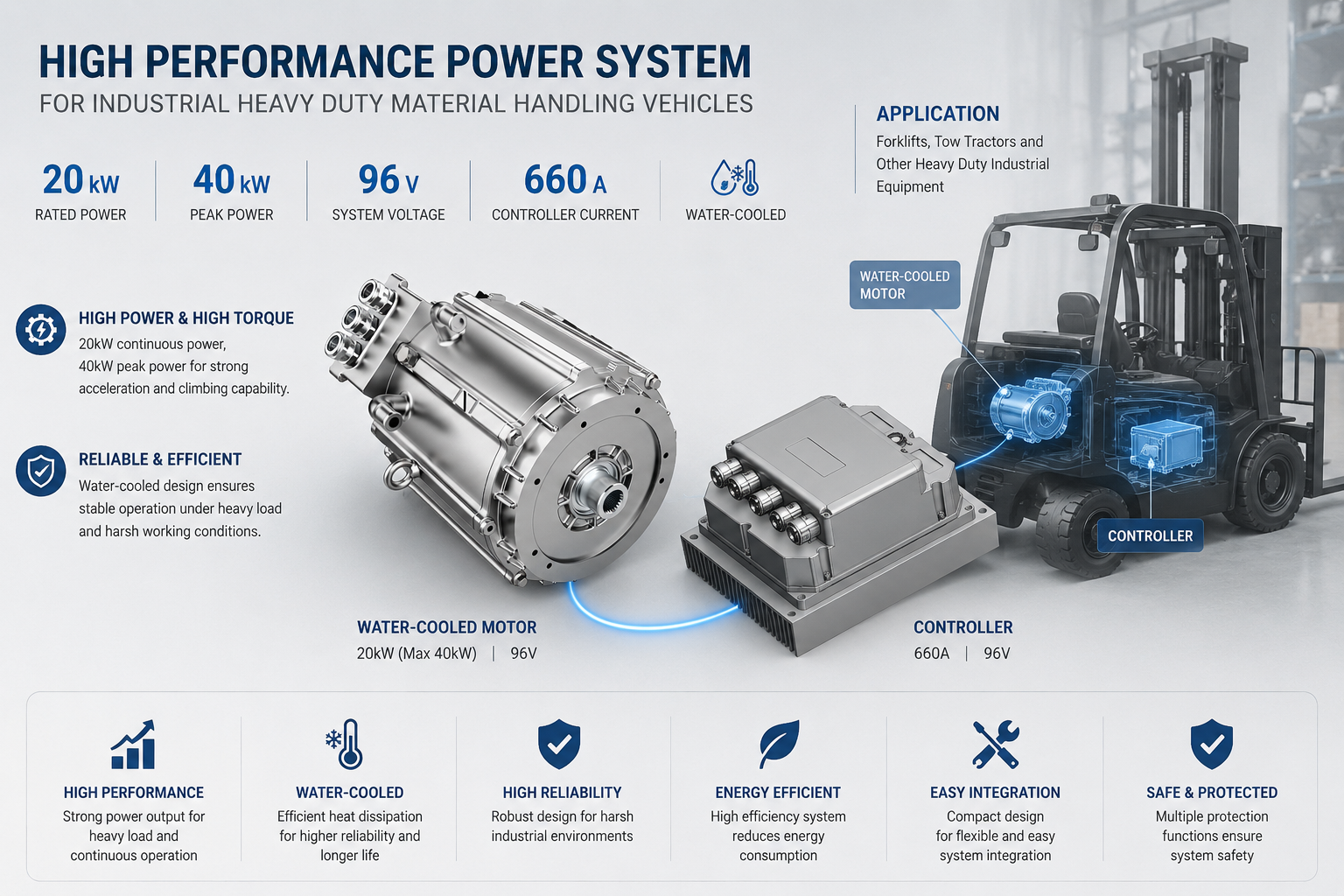
3. 96V 20/40kW PMSM: A Higher-Torque Solution
For applications requiring more power and stronger performance, Green Motor Tech also provides a 96V 20/40kW PMSM platform.
Key specifications include:
- Rated power: 20kW
- Peak power: 40kW
- Maximum torque: approximately 210 N·m
- Cooling options: Air-cooled or liquid-cooled
- Application: medium- and heavy-duty industrial vehicles
The availability of both air-cooled and liquid-cooled configurations provides greater flexibility when designing forklift powertrains.
Air-cooled configuration
The air-cooled version can be suitable when:
- Installation space is limited
- The operating environment allows sufficient airflow
- The duty cycle is moderate
- The customer wants a simpler thermal system
Liquid-cooled configuration
The liquid-cooled version can be more suitable for:
- Long operating hours
- High-load operation
- Frequent acceleration and braking
- High ambient temperatures
- Heavy-duty industrial applications
- Continuous operation
For forklifts operating multiple shifts per day, thermal management is particularly important.
A motor may have sufficient peak power on paper, but if heat cannot be effectively removed during continuous operation, the actual usable performance can be significantly reduced.
4. Why High Torque Matters More Than Peak Power Alone
Forklifts are fundamentally different from passenger vehicles.
A forklift frequently needs to:
- Start from a standstill with a heavy load
- Climb ramps
- Reverse repeatedly
- Operate at low speed
- Accelerate and decelerate frequently
- Maneuver in confined areas
- Carry maximum loads
- Operate for long hours
Therefore, low-speed torque is one of the most important parameters in forklift electrification.
For example, our 96V 15/30kW PMSM provides approximately 170 N·m, while the 96V 20/40kW PMSM provides approximately 210 N·m.
The actual wheel torque is then determined by the combination of:
Motor torque × gearbox reduction ratio × final drive ratio
This means that selecting a forklift motor should never be based on kW alone.
The complete system needs to be evaluated according to:
- Vehicle weight
- Payload
- Wheel diameter
- Gearbox ratio
- Maximum speed
- Gradeability
- Traction requirements
- Duty cycle
The ultimate objective is to provide enough wheel torque to move the fully loaded forklift reliably and efficiently.
5. 144V PMSM Solutions for Higher-Power Forklifts
When the forklift becomes larger or requires higher continuous power, a 144V architecture can provide additional performance headroom.
Green Motor Tech also offers multiple 144V PMSM platforms, allowing customers to select the appropriate power level according to the vehicle’s load and operating conditions.
Our 144V motor solutions include:
144V 15/30kW PMSM
- Rated power: 15kW
- Peak power: 30kW
- Application: medium-duty industrial vehicles and forklifts
- Suitable for applications requiring a higher-voltage architecture while maintaining moderate power requirements
This platform can be considered when the customer wants to move from a conventional lower-voltage architecture to a higher-voltage system while keeping the required power within the 30kW peak range.
144V 25/45kW PMSM
For larger and more demanding forklift applications, the 144V 25/45kW PMSM provides:
- Rated power: 25kW
- Peak power: 45kW
- High starting and acceleration capability
- High-voltage electrical architecture
- Suitable for medium- to heavy-duty applications
This power level provides a useful middle ground between a 30kW peak system and a much larger 65kW-class drive.
144V 40/65kW PMSM – High-Torque Heavy-Duty Solution
For heavy-duty forklifts and industrial vehicles requiring significantly higher power, Green Motor Tech offers a 144V 40/65kW PMSM.
Key specifications include:
- Rated power: 40kW
- Peak power: 65kW
- Maximum torque: approximately 252 N·m
- Voltage platform: 144V
- Application: heavy-duty forklifts and industrial vehicles
With approximately 252 N·m maximum motor torque, this platform provides a significant increase in torque capability compared with the 96V 15/30kW and 20/40kW platforms.
It can be particularly attractive for applications involving:
- Higher vehicle weight
- Higher payload
- Steeper ramps
- Long operating hours
- Higher acceleration requirements
- Heavy industrial logistics
- Port and warehouse operations
- High-frequency loading and unloading
6. 96V vs. 144V: Which Is Better?
There is no universal answer.
The correct voltage depends on the forklift’s power requirement and operating conditions.
A simplified comparison is:
| Electric Drive | Continuous Power | Peak Power | Max. Torque | Cooling | Typical Application |
|---|---|---|---|---|---|
| 96V 15/30kW | 15kW | 30kW | 170 N·m | Air | Medium-duty forklifts |
| 96V 20/40kW | 20kW | 40kW | 210 N·m | Air / Liquid | Medium & heavy-duty |
| 144V 15/30kW | 15kW | 30kW | — | Application dependent | Medium-duty |
| 144V 25/45kW | 25kW | 45kW | — | Application dependent | Medium/heavy-duty |
| 144V 40/65kW | 40kW | 65kW | 252 N·m | Application dependent | Heavy-duty |
The most suitable system should be selected based on the complete vehicle specification.
For example:
96V 15/30kW
→ Suitable when cost, simplicity and moderate power are priorities.
96V 20/40kW
→ Suitable when stronger torque and higher performance are required.
144V 25/45kW
→ Suitable for applications requiring additional power and a higher-voltage architecture.
144V 40/65kW
→ Suitable for heavy-duty forklifts and industrial vehicles where high torque and high peak power are critical.
7. Why Higher Voltage Can Be Valuable
The relationship between electrical power, voltage and current is:
P = V × I
For the same power demand, increasing voltage reduces current.
For example, at approximately 40kW:
At 96V:
I ≈ 417A
At 144V:
I ≈ 278A
This difference becomes important when designing:
- Battery busbars
- High-voltage cables
- Connectors
- Contactors
- Fuses
- Motor controllers
- Thermal management
Therefore, as forklift power requirements increase, a 144V architecture can offer advantages in managing high current and designing a more efficient high-power electrical system.
This does not mean that 144V is always better.
For smaller forklifts, a 96V platform may provide a more economical solution.
The correct voltage should be determined by the actual power requirement.
8. Battery Capacity Is Another Major Cost Factor
After the motor and controller, the battery is often one of the largest components of an electric forklift project.
Battery capacity depends on:
- Forklift power
- Operating hours
- Average load
- Average speed
- Hydraulic lifting requirements
- Number of shifts
- Charging strategy
- Ambient temperature
- Required operating reserve
For example, a forklift operating eight hours per day does not necessarily need the same battery capacity as a forklift operating 16 or 24 hours per day.
For multi-shift fleets, operators can consider:
Large battery + opportunity charging
or
Battery swapping
instead of simply installing an extremely large battery.
The optimal solution should be based on the actual energy consumption of the vehicle.
9. Don’t Forget the Hydraulic System
A forklift’s traction motor is only one part of the energy system.
The hydraulic system used for:
- Lifting
- Lowering
- Tilting
- Fork positioning
can consume a significant amount of energy.
Therefore, an electric forklift conversion may require an electric hydraulic pump rather than simply replacing the original engine with a traction motor.
A complete system may include:
Traction Motor + Controller + Gearbox + Battery + Hydraulic Motor/Pump + VCU + DC-DC + Charger
This integrated approach can provide better overall energy management and control.
10. Converting an Existing Forklift vs. Buying a New Electric Forklift
Fleet operators generally have two options.
Option 1: Buy New Electric Forklifts
The main advantages are:
- Factory-integrated electric system
- New chassis and components
- Optimized electric architecture
- Easier warranty management
However, replacing an entire fleet can require substantial capital investment.
Option 2: Convert Existing Forklifts
For companies with a large fleet of existing forklifts, conversion can be an attractive alternative.
If the existing:
- Chassis
- Mast
- Fork assembly
- Steering system
- Wheels
- Hydraulic structure
- Mechanical components
are still in good condition, the powertrain can potentially be replaced with an electric system.
A typical conversion could involve:
Diesel/LPG engine → PMSM traction motor
Mechanical transmission → Electric drive + gearbox
Fuel tank → Battery
Engine control → VCU
Alternator → DC-DC converter
Engine-driven hydraulic pump → Electric hydraulic pump
This approach can extend the useful life of existing forklift assets while reducing the amount of hardware that needs to be replaced.
11. The Real Question: What Is the Total Cost of Ownership?
The initial purchase price is only one part of forklift economics.
Fleet operators should calculate the Total Cost of Ownership (TCO).
This can include:
Initial investment
- Motor
- Controller
- Gearbox
- Battery
- Charger
- VCU
- DC-DC converter
- Hydraulic system
- Mechanical integration
- Installation
Operating costs
- Electricity
- Battery charging
- Maintenance
- Replacement parts
- Labor
- Downtime
Potential savings
- Fuel reduction
- No engine oil changes
- Reduced engine maintenance
- Reduced exhaust-system maintenance
- Lower brake wear through regenerative braking
- Reduced routine service requirements
- Potentially lower operating noise
- Longer usable life of existing forklift chassis
For a fleet operating several thousand hours per year, these savings can have a significant impact on the project’s payback period.
12. How Much Will Your Forklift Electrification Project Cost?
There is no single price that applies to every forklift.
A proper quotation requires the following information:
- Forklift rated capacity
- Gross vehicle weight
- Maximum payload
- Wheel diameter
- Existing transmission/axle ratio
- Maximum speed
- Maximum gradeability
- Operating hours per shift
- Number of shifts per day
- Required operating range
- Battery charging method
- Hydraulic pump power
- Existing engine power
- Available motor installation space
- Existing gearbox or drive axle structure
Once these parameters are available, the appropriate powertrain can be selected.
For example:
Medium-duty application
→ 96V 15/30kW PMSM
→ 170 N·m maximum torque
Higher-performance medium-duty application
→ 96V 20/40kW PMSM
→ 210 N·m maximum torque
→ Air-cooled or liquid-cooled
Higher-voltage medium-duty application
→ 144V 15/30kW PMSM
Medium/heavy-duty application
→ 144V 25/45kW PMSM
Heavy-duty application
→ 144V 40/65kW PMSM
→ 252 N·m maximum torque
The final selection should then be matched with the appropriate gearbox ratio and wheel size to achieve the required wheel torque and gradeability.
13. Green Motor Tech: High-Torque Electric Drive Solutions for Forklifts
Green Motor Tech provides electric powertrain solutions for vehicle manufacturers, fleet operators, engineering companies and EV conversion projects.
Our product portfolio includes:
- PMSM motors
- BLDC motors
- AC motors
- Motor controllers
- VCU
- DC-DC converters
- Battery systems
- Chargers
- Electric hydraulic solutions
- Complete EV conversion systems
For forklift electrification, our 96V and 144V PMSM platforms provide multiple power options from 15kW to 40kW continuous power and up to 65kW peak power, allowing the system to be matched to different forklift sizes and operating conditions.
Our high-torque solutions include:
96V 15/30kW — 170 N·m
96V 20/40kW — 210 N·m
144V 15/30kW
144V 25/45kW
144V 40/65kW — 252 N·m
The 96V 20/40kW platform is available with both air-cooled and liquid-cooled configurations, providing flexibility for different duty cycles and thermal requirements.
Rather than supplying only an electric motor, Green Motor Tech can support the complete powertrain matching process, including motor, controller, gearbox, battery, VCU and auxiliary systems.
Conclusion: Electrification Is an Investment, Not Just a Motor Replacement
The cost of electrifying a forklift fleet cannot be determined simply by asking how much an electric motor costs.
The complete calculation should include:
Motor + Controller + Gearbox + Battery + Charger + Hydraulic System + VCU + Installation + Operating Cost
More importantly, the system must be designed around the real working conditions.
For medium-duty forklifts, a 96V 15/30kW PMSM with 170 N·m torque can provide a practical and cost-effective solution.
For applications requiring more power, the 96V 20/40kW PMSM with 210 N·m torque, available in both air-cooled and liquid-cooled configurations, provides additional performance and thermal flexibility.
For higher-voltage applications, Green Motor Tech offers 144V 15/30kW, 25/45kW and 40/65kW PMSM platforms, with the 40/65kW system delivering up to approximately 252 N·m of torque for demanding heavy-duty applications.
The goal is not simply to replace an internal-combustion engine with an electric motor.
The goal is to build an electric forklift powertrain that delivers:
High torque + reliable operation + efficient energy use + manageable thermal performance + lower lifetime operating cost.
If you are planning to electrify a single forklift or an entire fleet, the first step is to evaluate the existing vehicle specifications and duty cycle.
Once the vehicle weight, payload, speed, gradeability, operating hours and hydraulic requirements are known, the appropriate 96V or 144V high-torque electric drive system can be selected.
The cheapest system to purchase is not always the cheapest system to operate. The right electrification solution is the one that delivers the best total cost of ownership over the entire life of the fleet.

