

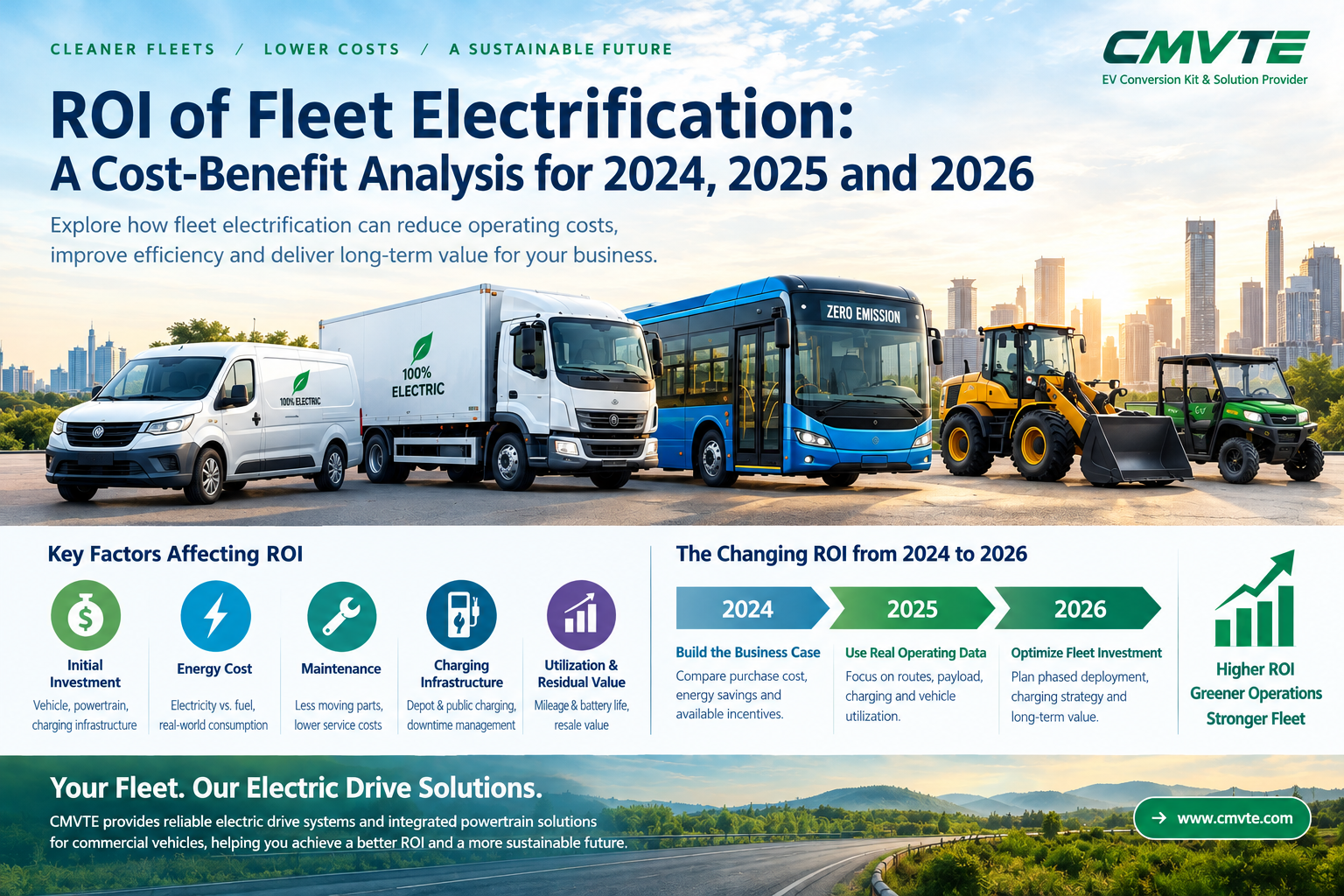
Fleet electrification is no longer just an environmental initiative. For logistics companies, municipal fleets, commercial vehicle operators, and OEMs, it is increasingly a financial decision that requires careful analysis of operating costs, capital investment, vehicle utilization, and long-term business value.
But is fleet electrification actually profitable?
The answer depends on the vehicles being operated, the routes they serve, annual mileage, energy prices, charging infrastructure, and the electrification strategy selected.
This article examines the return on investment (ROI) of fleet electrification from 2024 to 2026, explains how to calculate total cost of ownership (TCO), and outlines a practical framework for evaluating commercial vehicle electrification projects.
1. Fleet Electrification ROI: What Has Changed from 2024 to 2026?
The economic case for fleet electrification has evolved as electric powertrain technology, battery systems, charging infrastructure, and commercial deployment experience have developed.
However, there is no single ROI figure that applies to every fleet or market.
2024: Establishing the Business Case
In 2024, fleet electrification decisions increasingly focused on comparing the higher initial investment of electric vehicles with their potential energy and maintenance savings.
For high-mileage commercial vehicles, lower energy costs per kilometer can create substantial savings over time. However, vehicle purchase prices, battery costs, charging infrastructure, and financing remain important considerations.
Fleet operators began evaluating electrification based on actual operating conditions rather than vehicle purchase price alone.
2025: Moving from Estimates to Operational Data
By 2025, the focus had shifted further toward real-world operating economics.
Route length, vehicle payload, charging availability, electricity tariffs, and daily utilization became critical factors in determining whether an electric vehicle could replace a conventional vehicle without affecting productivity.
The International Energy Agency’s Global EV Outlook 2025 highlighted the importance of energy costs and charging infrastructure in heavy-duty vehicle economics. Its analysis found that battery-electric trucks were significantly more energy-efficient than comparable diesel trucks, although infrastructure costs and regional energy prices affected the overall business case.
For fleet operators, the key question was no longer simply whether electric vehicles were cheaper to operate, but whether their operating savings could justify the additional investment.
2026: Optimizing Fleet-Level Investment
In 2026, fleet electrification planning should go beyond comparing individual vehicles.
Businesses need to consider the economics of an entire fleet, including vehicle replacement schedules, charging infrastructure utilization, route allocation, battery capacity, and financing costs.
A phased electrification strategy can help operators prioritize vehicles with the strongest financial case before committing to a large-scale deployment.
For some fleets, purchasing new electric vehicles may be the best option. For others, electrifying existing vehicles or integrating electric powertrains into new commercial vehicle platforms may be worth evaluating.
The objective is to identify the lowest-risk, most cost-effective electrification pathway for each application.
2. The Five Main Factors That Determine Fleet Electrification ROI
2.1 Initial Vehicle and Powertrain Investment
The initial investment includes more than the vehicle itself.
Depending on the project, it may include:
- Vehicle purchase or conversion costs
- Electric motor and controller
- Battery pack and battery management system
- Powertrain integration and engineering
- Charging equipment and electrical upgrades
- Installation, commissioning, and training
For fleet electrification projects, these costs should be evaluated against the expected service life and annual utilization of each vehicle.
For existing commercial vehicles with useful remaining service life, an EV conversion may be worth comparing with purchasing a new electric vehicle. The result depends on the conversion cost, vehicle condition, battery requirements, engineering work, and expected operating life.
2.2 Energy Cost per Kilometer
Energy savings are often one of the largest potential contributors to fleet electrification ROI.
The cost of operating an electric vehicle depends on its energy consumption and the electricity price paid by the operator.
For example, consider a commercial vehicle that travels 100 kilometers per day.
An illustrative comparison might use the following assumptions:
| Parameter | Diesel Vehicle | Electric Vehicle |
|---|---|---|
| Energy consumption | 12 L/100 km | 25 kWh/100 km |
| Energy price | $1.20/L | $0.15/kWh |
| Energy cost per 100 km | $14.40 | $3.75 |
Under these assumptions, the electric vehicle saves $10.65 per 100 kilometers in direct energy costs.
These figures are illustrative, not industry averages. Actual consumption and energy prices vary significantly by vehicle class, payload, terrain, driving conditions, and region.
The calculation also excludes charging losses, which should be included in a detailed project assessment.
2.3 Maintenance and Repair Costs
Electric powertrains generally have fewer moving mechanical components than conventional internal combustion powertrains.
Depending on the vehicle and operating conditions, electrification may reduce expenditure on engine oil, filters, exhaust systems, and certain transmission-related maintenance.
Regenerative braking may also reduce friction brake wear.
However, electric vehicles still require maintenance. Tires, suspension components, cooling systems, electrical components, and battery systems can generate costs throughout the vehicle’s life.
A reliable ROI model should use actual maintenance records wherever possible rather than assuming that every electric vehicle will achieve the same percentage reduction.
2.4 Charging Infrastructure and Downtime
Charging infrastructure can materially affect the financial performance of an electric fleet.
Depot charging may be economical for vehicles that return to a central location every day. Vehicles operating longer routes may require opportunity charging, additional charging time, or more complex infrastructure.
Relevant costs include chargers, installation, grid connections, transformer upgrades, electricity demand charges, and ongoing maintenance.
Charging also affects productivity.
If a vehicle cannot complete its assigned route and recharge within the available operating schedule, the operator may need additional vehicles or changes to dispatch planning.
Charging strategy should therefore be designed around the fleet’s actual duty cycle.
2.5 Vehicle Utilization and Residual Value
Higher annual mileage can increase the value of energy savings because the vehicle accumulates more operating cost reductions over its service life.
However, utilization must be balanced against battery degradation, maintenance requirements, and vehicle availability.
Residual value also matters. The future resale value of an electric commercial vehicle may depend on battery health, warranty coverage, vehicle condition, and demand in the secondary market.
For long-term fleet investments, these factors should be included in the financial model.
3. How to Calculate Fleet Electrification ROI
A useful starting point is to compare the additional initial investment with the expected annual operating savings.
Annual Operating Savings = Annual Fuel Savings + Annual Maintenance Savings − Additional Annual Operating Costs
Simple Payback Period = Additional Initial Investment ÷ Annual Net Operating Savings
For example, assume an electric commercial vehicle costs $20,000 more upfront than a comparable diesel vehicle.
If it generates $8,000 in annual net operating savings, the simple payback period is:
$20,000 ÷ $8,000 = 2.5 years.
This is an illustrative calculation, not a prediction for a particular vehicle or market.
A complete investment analysis should also account for charging infrastructure, financing, taxes, incentives, battery replacement risk, residual value, and the expected service life of the vehicle.
For larger projects, fleet operators should consider discounted cash flow and net present value (NPV), which account for the time value of money.
4. Which Commercial Fleets Are Best Suited for Electrification?
Not every vehicle should be electrified at the same time. The strongest candidates are often those with predictable operating patterns and high utilization.
Urban Delivery and Logistics Fleets
Delivery vehicles frequently follow repeatable routes and return to a depot overnight.
This can simplify charging planning and allow operators to reduce energy costs while maintaining predictable vehicle schedules.
Municipal and Utility Vehicles
Street maintenance vehicles, service vehicles, and certain municipal fleets may operate within defined geographic areas.
Electrification can be attractive when daily mileage, auxiliary power requirements, payload, and charging windows are compatible with the available electric powertrain.
Sightseeing Buses and Low-Speed Commercial Vehicles
Vehicles operating on fixed routes, in industrial parks, at resorts, or in other controlled environments may benefit from predictable duty cycles.
These applications can provide practical opportunities to evaluate electrification before expanding to more demanding operating conditions.
Heavy-Duty and Specialized Vehicles
Tractors, buses, trucks, and specialized commercial vehicles require more detailed engineering analysis.
Motor power, continuous torque, battery capacity, payload, gradeability, cooling, drivetrain configuration, and auxiliary loads can determine whether an electric solution meets the operating requirements.
For these applications, technical feasibility and financial feasibility must be evaluated together.
5. New Electric Vehicles or EV Conversion: Which Offers Better ROI?
Fleet electrification does not always require replacing every existing vehicle.
For some applications, purchasing a new electric vehicle may provide the most straightforward route to deployment, particularly when the vehicle manufacturer already offers an appropriate model and established service support.
For other applications, converting an existing vehicle may be worth investigating.
An EV conversion project may be attractive when:
- The existing vehicle is structurally sound and has useful service life remaining.
- Replacing the vehicle would require significant capital investment.
- The vehicle performs a predictable, well-defined duty cycle.
- A suitable electric motor, controller, and battery configuration can be integrated safely.
- The conversion can meet local vehicle regulations and operating requirements.
However, conversion economics depend on more than the price of an electric drive system.
Engineering, installation, certification, battery packaging, maintenance, and vehicle downtime must also be included.
A conversion project should be assessed against both the cost of purchasing a new electric vehicle and the cost of continuing to operate the existing vehicle.
6. A Practical Framework for Fleet Electrification in 2026
Before investing in fleet electrification, operators should follow a structured evaluation process.
Step 1: Analyze vehicle usage.
Collect annual mileage, daily routes, payload, operating hours, terrain, and idle time.
Step 2: Establish the baseline TCO.
Calculate current fuel, maintenance, insurance, financing, downtime, and replacement costs.
Step 3: Evaluate technical feasibility.
Confirm the required motor power, torque, battery capacity, range, charging time, payload, and auxiliary power requirements.
Step 4: Calculate the full electric operating cost.
Include electricity, charging infrastructure, installation, maintenance, financing, and battery-related costs.
Step 5: Run sensitivity analysis.
Test how the business case changes with electricity prices, fuel prices, annual mileage, battery costs, incentives, and vehicle utilization.
Step 6: Start with a pilot fleet.
Deploy a limited number of vehicles, measure actual operating performance, and compare results with the original assumptions before scaling up.
This approach helps businesses reduce investment risk and develop a fleet electrification strategy based on operational evidence.
7. How CMVTE Supports Commercial Vehicle Electrification
CMVTE provides electric drive systems and integrated powertrain solutions for vehicle electrification projects.
Depending on the application, a project may involve electric motors, controllers, battery systems, and supporting components, with configuration and integration requirements determined by the vehicle and its operating conditions.
For commercial vehicle operators, OEMs, and fleet electrification partners, the first step is to establish the vehicle’s technical requirements and operating profile.
This includes vehicle weight, target speed, daily driving distance, payload, drivetrain configuration, gradeability, auxiliary loads, and charging requirements.
These parameters help determine whether a proposed electric powertrain is technically suitable and whether its expected operating savings justify the investment.
Rather than selecting a system based on motor power alone, fleet operators should evaluate the complete vehicle application and its lifetime operating costs.
Conclusion: Fleet Electrification ROI Starts with the Right Application
The ROI of fleet electrification in 2024–2026 cannot be reduced to a single savings percentage or payback period.
The strongest business cases typically emerge when vehicle utilization, energy prices, charging arrangements, maintenance costs, and technical requirements align.
For fleet operators, the most effective strategy is to identify suitable vehicles, establish a reliable TCO baseline, evaluate technical feasibility, and validate assumptions through real-world operating data.
Whether the project involves new electric commercial vehicles or converting existing vehicles, a structured ROI analysis can help businesses make more informed investment decisions.
Planning a commercial vehicle electrification project?
Contact CMVTE to discuss your vehicle application, operating requirements, and electric powertrain options.

