

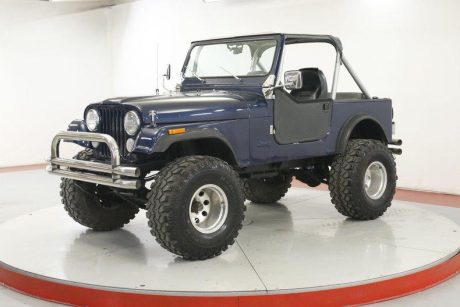
The Jeep CJ-5, CJ-7, and Wrangler YJ/TJ are among the most popular donor vehicles for EV conversion worldwide. Their simple body-on-frame construction, ample engine bay space, and rugged drivetrain make them straightforward to electrify. This guide covers compatible Jeep models, CMVTE motor and battery options, and the key considerations for an off-road-capable electric build.
Why Convert a Jeep to Electric?
Beyond the environmental benefit, an electric Jeep delivers practical advantages for both street and trail use. Instant electric torque improves low-speed rock crawling without the stall risk of a combustion engine. Regenerative braking provides controlled descents on steep grades. Operating costs drop to roughly $0.03-0.05 per km versus $0.15-0.25 for petrol, and the elimination of oil changes, exhaust systems, and cooling fans reduces annual maintenance significantly.
Jeep Models Best Suited for Conversion
| Model | Suitability | Key Advantages |
| CJ-5 / CJ-7 | ★★★★★ | Spacious engine bay, simple wiring, strong aftermarket support |
| Wrangler YJ / TJ | ★★★★☆ | Robust frame, easy transfer case retention, parts availability |
| Wrangler JK / JL | ★★★☆☆ | More electronics to integrate, but larger platform for batteries |
| Cherokee XJ | ★★★☆☆ | Unibody construction requires careful battery placement |
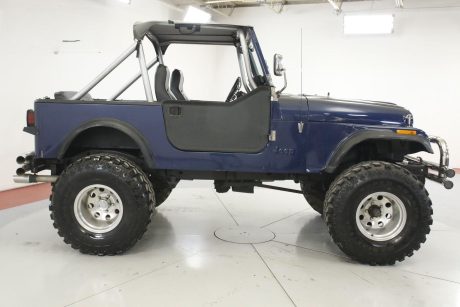
The CJ and Wrangler models benefit from a separate frame and removable body panels, which simplify motor mounting, cable routing, and battery installation. The original transfer case can be retained to maintain 4WD capability.
CMVTE Motor Options for Jeeps
| Motor | Peak Power | Peak Torque | Cooling | Best For |
| CVx 80 | 80 kW (107 hp) | 200 Nm | Air | CJ-5, light trail use |
| CVx 120 | 120 kW (161 hp) | 280 Nm | Liquid | CJ-7, Wrangler YJ/TJ, daily + off-road |
| CVx 160 | 160 kW (215 hp) | 380 Nm | Liquid | JK, JL, heavy build with large tyres |
The CVx 120 is the most popular choice for Jeep conversions. It provides 280 Nm of torque from 0 RPM — ideal for low-speed rock crawling — and retains enough power for highway driving. The motor couples to the original transmission via a CMVTE adapter plate, keeping the gear shifter and clutch pedal operational. For builds targeting extreme off-road use, the CVx 160 delivers 380 Nm for turning large mud-terrain tyres.
Battery Configuration for Off-Road Use
Jeep conversions require battery packs that withstand vibration, water crossings, and impact. CMVTE recommends prismatic LFP cells with IP67-rated enclosures and active BMS. Common configurations:
- 25 kWh LFP — fits CJ-7 under the hood and transmission tunnel area. 80-120 km range for mixed driving.
- 35 kWh LFP — fits CJ-7 or Wrangler with packs in the engine bay and beneath the rear cargo area. 120-180 km range. Recommended for most builds.
- 50 kWh NMC — requires JK/JL or a custom tray beneath the chassis. 180-250 km range. Suitable for long-distance overland builds.
Battery packs must be secured with steel brackets to prevent movement during off-camber driving. Adding a skid plate beneath the battery protects against rock strikes.
Conversion Approach
A CMVTE Jeep conversion retains the original transmission and transfer case. The motor replaces the engine and bolts to the bellhousing. The clutch pedal actuates a hydraulic or cable mechanism that engages the CMVTE motor's neutral/idle state. The transfer case, driveshafts, and axle ratios remain unchanged, preserving the Jeep's 4WD capability.
Key steps:
- Remove the engine, radiator, exhaust, and fuel system.
- Mount the CMVTE motor to the transmission via the adapter plate.
- Install battery packs in the engine bay (original engine mounts can support the tray) and beneath the rear cargo floor.
- Route the CMVTE wiring harness and mount the controller in a waterproof enclosure.
- Install the DC-DC converter for 12V systems and an electric vacuum pump for brake assist.
- Configure regen braking and throttle mapping through the controller.
Total build time for a shop with EV experience is 2-4 weeks.
Off-Road Performance
Electric torque at 0 RPM gives converted Jeeps superior low-speed control. The CMVTE controller allows the driver to set regen braking force — useful as a one-pedal driving aid on descents. The instant torque response eliminates the lag of a combustion engine at low RPM, making technical rock sections smoother. Water fording capability is maintained as long as the battery and controller enclosures remain sealed; CMVTE's IP67-rated packs handle water immersion up to 1 metre.
Cost Summary
| Build Level | CMVTE Kit | Battery | Estimated Total |
| Basic (CJ-5, street) | CVx 80 — $3,500 | 25 kWh — $3,500 | $8,000-$10,000 |
| Mid (CJ-7, mixed use) | CVx 120 — $5,500 | 35 kWh — $5,000 | $12,000-$16,000 |
| High-perf (JK/JL, off-road) | CVx 160 — $7,500 | 50 kWh — $7,500 | $17,000-$22,000 |
CMVTE Advantage
CMVTE has supplied Jeep conversion kits to customers in the US, Australia, Europe, and South America. Every kit is designed, assembled, and tested at our Foshan factory. Dr. Kevin Wang's engineering team provides remote support throughout your build, including guidance on battery placement, motor alignment, and controller configuration.
Tell us your Jeep model and intended use — we will recommend the right motor, battery, and drivetrain configuration

