

EPS Warning Light After an EV Conversion — What Changed?
When you convert a vehicle to electric, the power steering system is directly affected. The original belt-driven hydraulic pump that ran off the engine is gone. If you installed an Electric Power Steering (EPS) system — or retained a factory EPS unit — the dashboard warning light means something different than on a stock car.
This guide covers the common causes of the EPS warning light in the context of EV conversions and explains what to check before calling a shop.
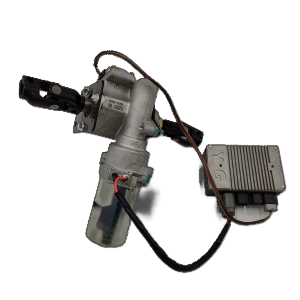
EPS Warning Light: Symptoms vs. Likely Cause
| Symptom | What the Driver Feels | Most Likely Cause (EV Conversion) |
|---|---|---|
| Light on, steering normal | Warning light stays on but assist still works | Sensor communication error during 12V system integration; ECU needs reset |
| Light on, heavy steering | Full loss of power assist | Low 12V battery voltage or blown EPS fuse; DC-DC converter not charging the aux battery |
| Light on, intermittent assist | Steering comes and goes, gets heavy then light | Loose ground connection, wiring harness interference, or ECU overheating |
| Light flashing, notchy feel | Steering feels jerky or uneven, especially at low speed | Torque sensor zero-point drift after EPS relocation; needs recalibration |
| Light off, but heavy steering | No warning light but steering is stiff | Mechanical binding in steering column after motor/controller repositioning |
Why the EPS Warning Light Comes On in an EV Conversion
1. Low 12V Auxiliary Battery Voltage
EPS systems are sensitive to voltage. If your DC-DC converter is not properly sized or wired, the 12V battery may drop below the EPS minimum operating voltage (~11.5V). The ECU detects this and triggers the warning light. This is the #1 cause in EV conversions.
2. Sensor Communication Errors
The torque sensor, steering angle sensor, and speed sensor all communicate with the EPS ECU. When you relocate or rewire these sensors during a conversion, a poor crimp or mismatched wire gauge can cause intermittent signal loss.
3. ECU Overheating (Protection Mode)
If the EPS ECU is mounted near the motor controller, inverter, or battery pack, it can exceed its thermal limit. Many EPS units enter a "protection mode" when overheated, turning off assist and illuminating the warning light.
4. Ground Loop or Poor Ground Connection
EV conversions introduce multiple high-current paths. A poor ground connection between the EPS unit and the chassis creates voltage offset that confuses the EPS sensors.
5. EPS Programming / Calibration Lost
Factory EPS units are often programmed for the original vehicle's weight and steering geometry. When transplanted into a different vehicle (common in EV conversions), the torque sensor zero-point may be off, causing the ECU to register a fault.
Step-by-Step Troubleshooting for EV Conversions
| Step | Action | Expected Outcome |
|---|---|---|
| 1 | Measure 12V battery voltage at rest and with the DC-DC converter running | Should be 12.6V+ at rest, 13.8–14.4V with DC-DC running |
| 2 | Check EPS fuse rating and continuity | Replace if blown; confirm amperage matches EPS spec |
| 3 | Inspect all EPS wiring connections for secure crimps and correct gauge | No loose or corroded terminals |
| 4 | Perform an EPS reset: disconnect 12V battery for 10 minutes, reconnect | Warning light clears; assist returns (indicates soft fault) |
| 5 | Check EPS ECU temperature after a 15-minute drive | If hot to touch, relocate ECU or add heat shielding |
| 6 | Verify EPS ground wire connects directly to chassis, not to battery negative | Clean ground with < 1 ohm resistance to chassis |
| 7 | Use an OBD-II scanner to read EPS fault codes | Codes like C1401, U0140, P0605 indicate sensor or ECU issues |
FAQ
Will the EPS warning light come on if my 12V battery is too low?
Yes. EPS requires a stable 12V supply. If your DC-DC converter is not keeping the auxiliary battery charged, the EPS will detect undervoltage and trigger the warning. Check your DC-DC converter output first.
Can I drive with the EPS warning light on in an EV conversion?
You can, but steering will be heavy — especially at low speed. In an EV, there is no engine idle to provide any hydraulic backup, so the steering effort is entirely manual. Not recommended for parking or tight maneuvers.
How do I reset the EPS warning light after an EV conversion?
Disconnect the 12V auxiliary battery for 10 minutes. This clears the ECU's temporary fault memory. If the light returns, there is a persistent hardware or wiring issue that needs diagnosis.
Does the EPS from a donor car need to be reprogrammed for the conversion?
In many cases, yes. The EPS ECU contains calibration data for the original vehicle's weight and steering geometry. A standalone EPS controller (like those used in EV conversions) bypasses this issue. CMVTE offers EPS and EHPS units pre-configured for conversion use.
What is the difference between EPS and EHPS for EV conversions?
EPS uses a fully electric motor on the steering column or rack. EHPS (Electro-Hydraulic Power Steering) uses an electric pump to drive a hydraulic system. EPS is simpler to install and more common in modern conversions. Browse CMVTE's EPS/EHPS line for options.
Prevent EPS Problems — Use Components Built for EV Conversions
Factory EPS units from donor cars were not designed for EV conversion conditions. CMVTE's EPS and EHPS systems are engineered specifically for converted vehicles, with correct voltage tolerance, thermal management, and easy integration.
EPS warning light won't go away? Describe your conversion setup and the error code — our team can help identify whether it is a wiring issue, a component mismatch, or a faulty EPS unit. Contact us with your vehicle details.
Related EPS guides:

