

In the parking lot or service area, those charging piles that “replenish energy” for electric vehicle? We are accustomed to plugging in the charging gun, scanning the QR Code, and then leaving at ease, waiting for the car to “revive with full blood”.
Behind this seemingly simple process, there is actually a complex and crucial security system running. Among them, the “unknown hero” who guards the safety of every charge is the insulation monitoring protection.
The power battery pack of the electric vehicle has an internal voltage of hundreds of volts, which is enough to kill instantly. The cables and internal components connecting vehicles and charging piles have been exposed to the outdoors for a long time, withstanding the test of wind and sunshine, vibration and wear, humidity and even corrosion.
How to ensure that the flowing high-voltage electricity is firmly “locked” in the established path and never leaks out to hurt people or damage things? This leads to the core of our in-depth discussion today-insulation.
It is not only a concept in electrical textbooks, but also a “firewall” that must be maintained at all times between danger and safety.
The Necessity of Insulation Monitoring: The Cornerstone of Safe Operation
In the charging process of electric vehicle, charging piles, vehicle batteries and power grids constitute a high-voltage electrical system. The voltage of DC fast charging pile can reach more than 400 V, even 800 V or higher. If the insulation performance of the system to the ground decreases or fails, it will directly lead to serious safety risks.
The core necessity of insulation monitoring is reflected in three aspects:
- Personal safety:insulation failure may lead to leakage of high-voltage electricity through the equipment shell or charging gun and other accessible parts, posing a fatal electric shock threat to operators or users.
- Equipment and battery safety:Leakage current may damage the delicate electronic components inside the charging pile, such as PCB circuit board
。 More importantly, insulation failure may interfere with or destroy the normal operation of the battery management system (BMS), causing battery overcurrent, short circuit and even thermal runaway.
- Grid security:Leakage current generated by insufficient insulation can interfere with the power quality of the utility grid, affect the stability of the grid, and cause potential damage to other equipment under the same grid.
Therefore, real-time and accurate insulation monitoring is the most basic and critical line of defense in the safety design of charging piles.
What is insulation?
Insulation, in the fields of electricity and heat, refers to the ability or condition of preventing fire from greatly limiting the flow of electric current (charge) or the transfer of heat.
Simply put, it is a substance or material that does not allow electricity or heat to pass through it easily.
This concept is generally associated with two main areas:
- Electrical insulation
2.Thermal insulation
- Electrical insulation
Definition: It refers to the characteristic that the material is extremely difficult to conduct electricity. An electrical insulator has few charges (electrons or ions) inside that can move freely.
- Principle: In an insulator, the outermost electrons of an atom are tightly bound by the nucleus and cannot move freely as in a conductor. Therefore, it is difficult to form a current even under the action of an applied electric field (voltage).
- Purpose:
- Safety: Prevent electric shock and short circuit.
- Function: Confine the current to a specific wire path, ensuring that electrical energy is delivered to the device that needs it.
2.Thermal insulation
- Definition: a material that effectively blocks the transfer of heat (conduction, convection, radiation).
- Principle: Thermal insulation materials usually have a porous structure (pockets filled with air), and air is a poor conductor of heat. These stationary air pockets effectively slow down the flow of heat.
- Purpose:
- Keep the object warm (cold or warm).
- Improve energy efficiency (e.g., reduce indoor heat loss in winter and outdoor heat gain in summer).
- Protect human body or equipment from high or low temperature.
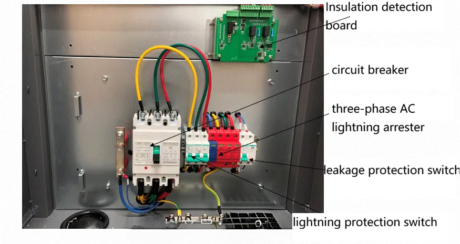
Why should the charging pile do insulation monitoring?
Charging pile must do insulation monitoring, which is one of the most important and basic protection measures in the safety design of electric vehicle, the core reason can be summarized as three words: security.
Specifically, the importance of insulation monitoring is reflected in the following aspects:
- Prevent electric shock and ensure personal safety (the most important reason)
- High-voltage system: The working voltage of the power battery pack of the electric vehicle is usually between 400 V and 800 V, which is much higher than human body safety voltage (usually considered to be below 36 V). Once such a high voltage leaks, it will cause fatal electric shock accidents after human contact.
- Risk of insulation failure: The components and cables inside the charging pile, as well as the cables, battery packs and motors of the vehicle itself, may cause the insulation performance to decline (i.e. insulation failure) due to wear, aging, vibration, impact, moisture or chemical corrosion.
- Prevent short circuit and fire risk
- Evolution of insulation failure: Insulation problems are usually a gradual process. An initial slight insulation breakage may only result in a tiny leakage current, but if left untreated, the breakage will intensify and may eventually develop into a complete arcing short.
- Consequences of short circuit: The short circuit of high-voltage system will produce huge current and high-temperature arc, which can easily ignite the surrounding cables, plastics and other materials and cause fire. The charging process is unattended, and the consequences of a fire are unimaginable.
- Dealing with the particularity of direct current
- AC vs DC: The household electricity is alternating current (AC), and its current direction is constantly changing. The leakage protector (RCD) can be used to detect whether the current vector sum is zero, so as to quickly cut off the power supply.
- The challenge of DC charging: The output of the fast charging pile is direct current (DC). When DC leaks electricity, it will not cross zero like AC, and the arc generated will be more difficult to extinguish. Moreover, the conventional AC leakage protector is completely ineffective against DC leakage.
4.Meet the requirements of national mandatory standards and regulations
Electric vehicle charging standards all over the world require that charging equipment (especially DC charging piles) must have insulation monitoring and fault protection functions. This is a prerequisite for the product to be marketed.
Insulation monitoring for charging piles, just like installing lightning rods and relay protection for high-voltage power grid, is an indispensable safety bottom line. Its main purpose is to:
- Personal safety: real-time prevention of high-voltage electric shock risk.
- Property protection: early warning to avoid fire caused by short circuit and protect vehicles and charging equipment.
- Necessary technology: It is the core technical pillar of DC charging safety to make up for the failure of traditional leakage protection in DC system.
- Mandatory regulations: meeting national and international safety standards is a necessary condition for the legal marketing of products.
Core Principle and Technology of Insulation Monitoring
The core objective of insulation monitoring is to measure the insulation resistance of HVDC system (positive and negative bus) to ground in real time. At present, the mainstream technical principles are as follows:
- Bridge balance method (unbalanced bridge method): This is one of the most classical and widely used methods. Its principle is to connect a group of balanced resistance bridges between the positive and negative poles of the DC system and the ground. When the insulation is good, the bridge is balanced, and the voltages of the positive and negative poles to the ground are equal; when the insulation resistance of one pole decreases, the voltage balance is broken, and a voltage difference is generated. The monitor calculates the actual insulation resistance value by measuring this voltage difference and combining it with the known bridge arm resistance. This method is relatively simple in structure and low in cost, but there is a “detection blind area” in the traditional balanced bridge method, that is, when the insulation of the positive and negative poles decreases to the same extent, the bridge may still maintain balance and fail to alarm. The improved unbalanced bridge method can avoid this problem.
- Low-frequency signal injection method:This method injects a low-frequency AC signal with a specific frequency (such as 1-10Hz) into the DC system. By detecting the current amplitude and phase of the signal in the positive and negative ground loops, the insulation resistance is calculated according to Ohm’s law. The advantage of this method is that it can effectively avoid the interference of distributed capacitance and inductance components in the DC system, and has strong anti-interference ability, especially suitable for complex electromagnetic environment or multi-loop monitoring scenarios.
- DC (Bias) Injection Method: This method calculates the insulation resistance by injecting a safe low voltage DC signal (typically < 10 V) into the system and measuring the resulting leakage current. Another variant is the DC leakage current direct detection method, which uses high-precision sensors to directly capture the positive and negative leakage current to ground, and triggers an alarm when the leakage current exceeds the threshold. The principle of this method is direct and the response is quick.
These techniques are usually implemented by specialized insulation monitoring devices (IMDs) or insulation monitors. The core performance parameters of the device include:
- Insulation resistance threshold:according to the national standard, the insulation resistance of the charging pile shall meet the requirement of ≥ 500Ω/V. For example, a 750 V DC pile should have an insulation resistance of not less than 375 kΩ. In practical applications, the warning value (such as 500 Ω/V) and the fault value (such as 100 Ω/V) are usually set for hierarchical management.
- Response time:It is required to be able to quickly detect and respond to an insulation fault within a few hundred milliseconds to a few seconds to ensure safety.
With the continuous improvement of electric vehicle endurance and fast charging power, the voltage platform is moving towards 800V or even higher, which poses unprecedented challenges to insulation materials, monitoring accuracy and response speed.
In the future, insulation monitoring technology will be more intelligent and integrated, and may be able to predict insulation life with large data to achieve a leap from “post-fault protection” to “pre-fault warning”. But no matter how the technology evolves, its core goal remains the same: to provide the most noisy guardian for every quiet charge.
As users, we may not need to delve into its complex principles, but we should have a basic understanding: choosing charging equipment (including household charging piles) that meets the national standards and has reliable insulation monitoring functions is a manifestation of responsibility for ourselves, our families and our cars. Safety is never accidental, but comes from the awe and perseverance of every detail.

