

The SsangYong Rexton — now sold as the KGM Rexton — occupies a specific place in the market. It is a body-on-frame, seven-seat SUV with a 3,500kg braked towing capacity, a ladder chassis, and a part-time 4WD system on diesel models. It was never the most refined vehicle in its class, but it was built around a simple promise: carry people, carry loads, and pull heavy things without complaint.
That promise is exactly what makes converting a Rexton to electric interesting — and complicated. A conversion that ignores towing is straightforward engineering. A conversion that tries to preserve the Rexton’s defining capability requires confronting the tension between battery weight, range, and load.
The CMVTE Rexton conversion solution does not sidestep that tension. It answers it with a specific architecture: a 60kW continuous / 120kW peak 540V PMSM liquid-cooled motor, a 537.6V 105Ah LiFePO4 battery pack (56.45 kWh total), and a direct-drive layout that retains the original rear axle and driveshaft. The question is what that architecture actually delivers in a vehicle that weighs over 2.2 tonnes before a trailer is attached.
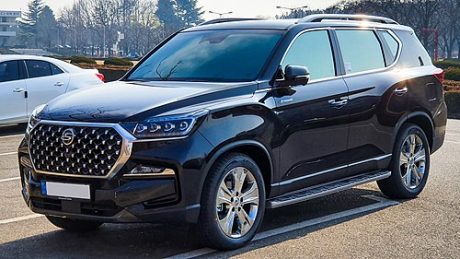
What the Conversion Keeps — and What It Removes
CMVTE’s conversion philosophy for the Rexton is minimum structural disruption. The kit does not replace the entire driveline. The original diesel engine and the old transmission are removed; the motor connects to the original drive axle via a flange, and the drive axle remains connected to the original rear axle. This is a direct-drive configuration, not a full powertrain transplant.
The retained components matter for a towing vehicle. The Rexton’s ladder frame, rear axle, and braking hardware were engineered around a 2,100–2,230kg kerb weight and a 3,500kg towing rating. Keeping the rear axle means the load-bearing and towing-relevant structural elements remain the ones the factory validated. What changes is the torque source and the energy storage — not the chassis architecture that makes towing possible.
The components that must be addressed are the accessories previously driven by the engine: power steering, the brake vacuum pump, and the air conditioning compressor. CMVTE supplies a 3kW DC-DC converter (250–750V input to 12V/24V output) to maintain the vehicle’s low-voltage electrical system, and the kit includes provisions for electric power steering and a vacuum-assisted brake pump to preserve steering and braking feel. These are not optional accessories in a 2.2-tonne SUV; they are the difference between a drivable conversion and a vehicle that feels fundamentally wrong to operate.
The Battery: 56.45 kWh in a Vehicle Built for a 70-Litre Tank
The Rexton’s diesel variants carry a 70-litre fuel tank and return roughly 8.3–9.9 L/100km combined, depending on the variant and test cycle. At 8.7 L/100km, a full tank represents roughly 800km of theoretical range before towing. That is the baseline the conversion is measured against, and it is a baseline no 56.45 kWh pack in a 2.2-tonne body-on-frame SUV will match.
The arithmetic is unforgiving. A 56.45 kWh LiFePO4 pack in a vehicle with the Rexton’s frontal area, mass, and drivetrain losses will realistically deliver somewhere in the 250–300km range under mixed driving, before any towing load is added. That figure is an estimate, not a manufacturer claim — CMVTE does not publish a certified range for this conversion — but it follows from the pack size and vehicle class. For comparison, the Rexton’s diesel range is roughly 2.5 to 3 times that figure on a full tank.
The more consequential number is towing range. Towing a 3,500kg trailer roughly doubles energy consumption in a conventional electric vehicle, and the Rexton conversion is no exception. A 250–300km unladen estimate can collapse toward 120–150km under heavy towing — enough for local trips to a launch ramp or a nearby site, but not enough to replace a diesel Rexton for long-distance caravan touring. This is not a flaw in CMVTE’s kit. It is the physics of energy density applied to a vehicle that was designed around liquid fuel.
What the conversion offers in return is silence, instant torque, and the elimination of diesel maintenance — plus the ability to retain the vehicle’s structural towing hardware. Whether that trade is acceptable depends entirely on how the Rexton is actually used.
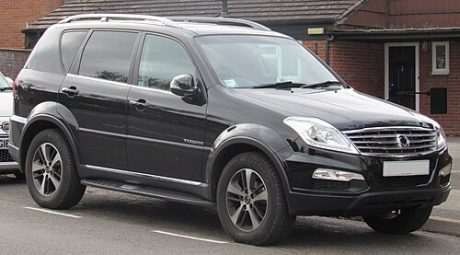
60kW Continuous / 120kW Peak: Enough for a Towing SUV?
The motor’s continuous rating is 60kW, with a 120kW peak available for short bursts. For a 2.2-tonne SUV, 60kW continuous is modest. The diesel Rexton produces 133kW and 420Nm in its most common 2.2-litre form. The electric motor’s advantage is not peak power but torque delivery at low speed — the characteristic that matters when pulling away from a standstill with a trailer attached.
The 540V architecture is the correct choice for a vehicle of this mass. A lower-voltage system would require higher current to deliver the same power, generating more heat and demanding heavier cabling. 540V keeps current manageable and aligns with the 56.45 kWh pack’s operating range of 420–613.2V. The liquid-cooled motor is also appropriate for a vehicle that may be asked to work continuously rather than cruise lightly.
The honest assessment is that 120kW peak is sufficient for the Rexton’s role as a local tow vehicle and load carrier, but it is not a performance conversion. It will not make a Rexton fast. It will make it functional, quiet, and cheaper to run per kilometre — provided the daily duty cycle fits within the range envelope.
The TÜV Question: High Voltage Changes the Approval Math
For European owners, the Rexton conversion faces a compliance path that is more demanding than a low-voltage golf-cart conversion but not fundamentally different in structure. In Germany, changing the fuel type or energy source of a registered vehicle triggers a mandatory technical inspection by TÜV, DEKRA, GTÜ, or an equivalent recognised body. The conversion must receive a new operating permit (Betriebserlaubnis) before the vehicle is road-legal.
What makes this conversion more involved is the high-voltage system. TÜV’s conversion guidelines apply specifically to drive systems operating above 60V DC or 30V AC, and the inspection covers the mounting and routing of HV components, HV cable and connector safety, and electromagnetic compatibility (EMC). A 540V pack places the Rexton squarely within that scope.
CMVTE’s component-level credentials help at the margins: the kit uses EVE or Gotion LiFePO4 cells, the charger and DC-DC converter are IP66-rated, and the battery BMS communicates via CAN bus. But component certification is not vehicle approval. The completed Rexton still requires an individual inspection (Einzelabnahme) covering the installation, high-voltage safety, and EMC. For a DIY conversion, the vehicle must be presented to TÜV in completed form; for a workshop-assisted build, the installer typically manages that process. The realistic budget for the conversion kit itself sits in the €6,500–€18,000 range depending on battery configuration, with installation and certification adding further cost.
Who This Conversion Is Actually For
The Rexton conversion makes sense for a specific owner profile: someone who already has a Rexton with a tired or failed diesel engine, who values the vehicle’s ladder frame and towing hardware, and whose actual driving is local, predictable, and short-distance. A farm vehicle, a estate runabout, a boat-yard tow rig, a community service vehicle — these are duty cycles where 250km of unladen range and 120–150km of towing range are not limitations but adequate margins.
It does not make sense for the owner who bought a Rexton specifically for long-distance caravan touring. That use case depends on the 800km diesel range and rapid refuelling that the conversion cannot replicate with a 56.45 kWh pack. Pretending otherwise would be dishonest.
The Rexton’s value was never in its efficiency. It was in its structural honesty — a vehicle that could carry and pull weight without pretending to be something softer. A 540V conversion keeps that structure intact. It changes the energy source, not the underlying purpose. The question for any owner considering it is not whether the conversion is “better” than diesel. It is whether the Rexton’s remaining life is better served by keeping the frame and changing the fuel, or by letting the vehicle go. For a subset of owners, the answer is clearly the former.

