

Permanent Magnet Synchronous Motors (PMSM) and Induction Motors (Asynchronous Motors) are two common motor types with significant differences in multiple aspects. This article provides a detailed comparison of working principles, torque characteristics, control methods, power density & efficiency, cost & maintenance, and applications – helping you choose the right motor for your specific use case.
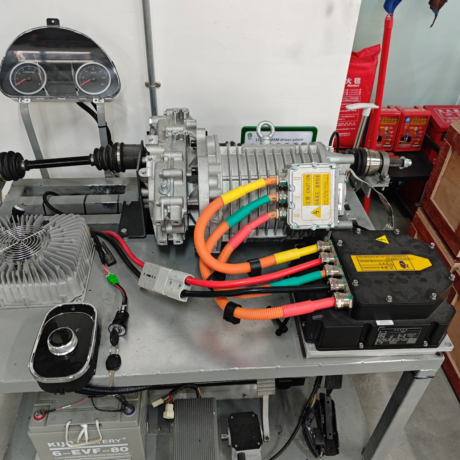
🟢 Permanent Magnet Synchronous Motor (PMSM)
PMSM uses permanent magnets embedded in the rotor to create a constant magnetic field. When the stator windings are energised, the rotating magnetic field interacts with the rotor’s permanent magnet field, causing the rotor to turn. Because of the permanent magnets, the rotor rotates synchronously with the stator’s rotating field – hence the name synchronous motor.
Synchronous motor working principle core: rotor speed is strictly synchronised with the stator’s rotating magnetic field – zero slip. This gives PMSM excellent speed stability under varying loads.
🔵 Induction Motor (Asynchronous Motor)
The induction motor has no permanent magnets on the rotor. Instead, the rotor consists of squirrel‑cage aluminium or copper bars (or wound windings). When the stator creates a rotating magnetic field, it induces an electromotive force in the rotor bars, generating current. This current interacts with the magnetic field to produce torque. However, due to the phase lag, rotor speed is always slightly less than synchronous speed – hence “asynchronous”.
Induction motor vs asynchronous motor refer to the same machine. “Induction” highlights that rotor current is induced; “asynchronous” highlights the speed difference. The terms are interchangeable.
2. Torque Characteristics
PMSM
Excellent torque characteristics. Below base speed, PMSM delivers constant maximum torque (high starting torque). In the field‑weakening region, torque gradually decreases with speed, but overall output remains smooth. This makes PMSM ideal for applications requiring high starting torque and fast response – e.g. electric vehicles, servo drives.
Induction Motor
Torque characteristics are relatively weaker. Starting torque is modest, and torque tends to drop as speed increases – especially in the high‑speed range. For applications demanding high starting torque or constant power at high speed, induction motors generally underperform compared to PMSM. However, with a VFD and vector control, high‑frequency performance can be improved.
3. Control Methods
PMSM
Control is relatively complex, requiring precise regulation of stator current amplitude, frequency, and phase to achieve decoupled torque and speed control. Common advanced techniques: vector control (FOC) and direct torque control (DTC). These monitor and adjust motor state in real time for efficient, stable operation. For position servo applications, an encoder is needed for closed‑loop control.
Induction Motor
Control is simpler. Common methods: direct‑on‑line starting, V/f control (scalar), and high‑performance vector control (field‑oriented control). While adequate for general industrial needs, induction motors typically cannot match PMSM in high‑precision speed control or fast dynamic response. However, sensorless vector control for induction motors is mature and cost‑effective.
4. Power Density & Efficiency
PMSM
Excellent power density and efficiency. The simple rotor structure (no excitation current) allows PMSM to deliver higher torque and efficiency per unit volume. Typical PMSM efficiency exceeds 90%, with premium units reaching >96% and a flat efficiency curve across load ranges.
Induction Motor
Lower power density and efficiency. Rotor requires induced current to produce torque, leading to rotor copper loss and iron loss. Efficiency typically ranges from 80% to 94%, with a notable drop at light loads. For the same power rating, induction motors are larger and heavier than PMSM. However, they remain economical when size and efficiency are not critical.
※ The image below illustrates the structural differences – a typical synchronous motor diagram shows the PM rotor, while an induction motor diagram shows the squirrel‑cage rotor.

5. Cost & Maintenance
PMSM
Manufacturing cost is higher due to expensive permanent magnet materials (e.g. neodymium‑iron‑boron) and complex processes (magnetisation, corrosion protection). However, the high efficiency and power density can recover the cost through energy savings and increased productivity. Maintenance cost is low because of the simple, brushless, slip‑ring‑free construction – long service life and high reliability.
Induction Motor
Manufacturing cost is lower due to simple construction, mature processes, and no rare‑earth magnets. But lower efficiency and power density may require larger frame sizes or additional control hardware in performance‑sensitive applications, increasing system cost. Maintenance is generally higher for wound‑rotor types (brushes and slip rings wear), while squirrel‑cage motors are very robust and low‑maintenance.
6. Suitable Applications
✅ PMSM – Preferred when high efficiency, high power density, and precise speed control are required
- Electric vehicles (EV/HEV) – traction motors
- Industrial automation – robotics, CNC machines, servo drives
- Wind power generation – increasingly replacing induction generators
- High‑efficiency HVAC compressors, elevator gearless machines
✅ Induction Motor – Ideal for low cost, ruggedness, and less demanding applications
- Household appliances – washing machines, AC compressors, fans, vacuum cleaners
- Industrial drives – pumps, fans, conveyors, crushers
- Large power systems – as generators or doubly‑fed wind generators
- General machinery where efficiency, size, and speed control are not critical
Note: As permanent magnet costs decrease and control technology improves, PMSM is expanding into traditionally induction‑motor domains (e.g. pumps, fans). However, for very high power, ultra‑high speed, or extreme environments, induction motors retain irreplaceable advantages.
Summary
PMSM and induction motors differ significantly in working principle, torque characteristics, control methods, power density & efficiency, cost & maintenance, and applications. Choose based on your specific needs:
- ✔ Choose PMSM when you need high efficiency, high power density, precise speed control, and the budget allows.
- ✔ Choose Induction Motor when low cost, simplicity, and ruggedness are priorities, and size/efficiency are less critical.
We hope this guide helps you understand the core differences and make the right motor selection decision.
Talk to our motor specialists – for EVs, industrial drives, wind power, and custom applications.
Frequently Asked Questions
❓ Which motor is more efficient, PMSM or induction motor?
PMSM is generally more efficient, especially at partial loads. Typical PMSM efficiency is 90‑96%, while induction motors range from 80‑94% and drop more at light loads.
❓ Can I replace an induction motor with a PMSM directly?
Not usually. PMSMs require a dedicated drive (vector or DTC) and may need different mounting dimensions, cooling, and control algorithms. A direct swap requires system‑level changes.
❓ Why are PMSMs more expensive?
Because of the cost of rare‑earth permanent magnets (neodymium‑iron‑boron) and the complex manufacturing process (magnetisation, corrosion coating, precision assembly).
❓ Which motor is better for an electric vehicle?
PMSM is the dominant choice for EVs due to high power density, efficiency, and excellent torque characteristics across a wide speed range. Some older EVs use induction motors (e.g. Tesla Model S early versions), but modern EVs overwhelmingly prefer PMSM or interior permanent magnet (IPM) designs.
❓ What is the main disadvantage of an induction motor?
Lower efficiency, lower power density, and reduced torque at high speeds. Also, speed control is less precise without a vector drive, and rotor losses (copper loss) cannot be eliminated.

