

Controller communication protocols are a critical component of industrial automation, defining the rules and formats for data exchange between controllers or between controllers and other devices. This article provides a detailed analysis including definitions, common types, communication modes, interfaces, advantages/disadvantages, and selection recommendations.

A controller communication protocol is a set of rules that enables data exchange between controllers, or between controllers and devices such as PCs. Its purpose is to ensure information sharing and interoperability between different controller systems, thereby improving the overall efficiency and reliability of automation systems. In the embedded systems domain, communication protocols in embedded systems are equally crucial, determining how microcontrollers interact with sensors, actuators, and other chips.
2. Common Types
There are many types of controller communication protocols, each with specific applications and advantages. Common ones include Modbus, CAN protocol, Profibus, Ethernet, and more recently EtherCAT and PROFINET.
Modbus
Widely used serial communication protocol. Supports RTU and ASCII modes over RS‑232, RS‑485. Defines message structure for interoperability. Modbus TCP runs over Ethernet, common in IIoT.
CAN (Controller Area Network)
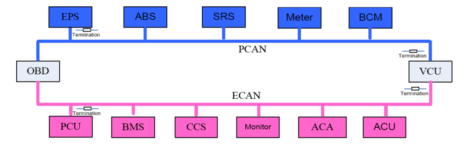
CAN protocol is a versatile bus used in automotive, robotics, industrial control. Broadcast/response, bus topology, high speed (1 Mbps, CAN FD up to 5+ Mbps), high immunity, real‑time. Excellent error detection – preferred for vehicle networks and distributed control.
Profibus
Common industrial protocol (Profibus DP for factory automation, Profibus PA for process). Supports bus and point‑to‑point, RS‑485 or fibre. Reliable, real‑time, flexible.
Ethernet (Industrial Ethernet)
Based on TCP/IP, high speed (100 Mbps to 10 Gbps), wide area connectivity. Real‑time extensions: PROFINET, EtherNet/IP, EtherCAT – become mainstream for high‑end automation.
3. Communication Modes
Point‑to‑Point
Direct connection between two nodes, each with unique address. Suitable for few devices, short distance. Examples: RS‑232, RS‑422. Simple but poor scalability.
Bus Communication
Multiple nodes share the same bus; any node can publish or receive data. Fast, reliable, supports many devices. Examples: CAN, Profibus, Ethernet (switched), RS‑485 multi‑drop. Dominant architecture in industrial control.
4. Communication Interfaces
Hardware Interfaces
Physical connectors: serial (RS‑232, RS‑485), Ethernet (RJ45, M12), USB, CAN transceivers. For communication protocols in embedded systems, hardware choice affects cost, noise immunity, and distance.
Software Interfaces
APIs for data exchange: Modbus TCP, Modbus RTU, OPC UA, etc. Define function calls and data structures, hiding lower‑layer hardware differences.
5. Advantages & Disadvantages
✅ Advantages
- Enable reliable, real‑time data exchange between different devices.
- Adapt to various scenarios via different modes and interfaces.
- Mature protocols (Modbus, CAN) are easy to use and implement.
- Industrial Ethernet supports high bandwidth, low latency – meets Industry 4.0 demands.
⚠️ Disadvantages
- Improper use may cause data loss or collisions – need error control (e.g. CAN arbitration).
- Poor interoperability between different protocols; gateways required.
- Requires technical knowledge to configure and optimise.
- Unsecure protocols (e.g. plain Modbus) pose cybersecurity risks – need firewalls, VPN, encryption.
6. Summary & Selection Recommendations
Controller communication protocols are essential for data exchange and interoperability in industrial automation and embedded systems. Choose based on your specific needs:
- ✔ Simple, low‑cost, low‑speed applications: Prefer Modbus RTU or CAN protocol.
- ✔ Vehicle, motion control, distributed control: CAN or CAN FD is best.
- ✔ Factory automation, PLC networking: Profibus DP or PROFINET.
- ✔ High bandwidth, big data, IT/OT convergence: Choose Industrial Ethernet (EtherCAT, EtherNet/IP).
- ✔ Embedded system internal communication: Based on resource constraints use SPI, I²C, UART; for board‑to‑board or device‑to‑device, CAN or Modbus are common. Communication protocols in embedded systems must balance power, speed, and real‑time performance.
As technology evolves (TSN, OPC UA), keep learning new trends to maintain system advancement and compatibility.
Frequently Asked Questions
❓ What is the difference between Modbus RTU and Modbus TCP?
Modbus RTU uses serial communication (RS‑232/485) with binary coding and CRC error checking. Modbus TCP encapsulates Modbus frames inside TCP/IP packets for Ethernet networks, allowing higher speed and multiple simultaneous connections.
❓ Why is CAN protocol so popular in automotive?
CAN offers high noise immunity, built‑error detection (CRC, ACK, bit monitoring), and deterministic arbitration (CSMA/CA). It is also lightweight and cost‑effective for real‑time distributed control, making it ideal for vehicle networks.
❓ Can I mix Profibus and Ethernet in the same system?
Yes, using gateways or proxies. Many PLCs support both; Profibus DP can be integrated into an Ethernet backbone via couplers or a controller that handles both protocols. However, native PROFINET is the modern migration path.
❓ Which protocol is best for real‑time motion control?
For hard real‑time (cycle times <1 ms), EtherCAT and PROFINET IRT are excellent. EtherCAT uses “on‑the‑fly” processing, achieving very low jitter. CANopen (based on CAN) also works for soft real‑time but with lower speed.
❓ Are there security risks with industrial protocols?
Yes. Many legacy protocols (Modbus, Profibus) lack encryption or authentication. Use network segmentation, firewalls, VPNs, and protocol‑aware security gateways. For new installations, consider OPC UA with security extensions or secure variants.

