

A street-legal EV conversion requires more than just bolting in a motor and battery. Every country has specific regulations covering high-voltage safety, battery crash protection, wiring standards, and documentation. Fail to comply, and your build will not pass inspection — or worse, it could be dangerous.
Here is what you need to know for a compliant, road-legal conversion in the US, UK, and other major markets — and how CMVTE components help you meet every requirement.

United States: FMVSS 305a
The US National Highway Traffic Safety Administration (NHTSA) has updated Federal Motor Vehicle Safety Standard No. 305a, which directly affects EV conversions. Key requirements include:
- Electrolyte leakage protection: Battery enclosures must prevent chemical exposure during a crash.
- Emergency response documentation: First responders must have clear instructions for battery disconnection.
- High-voltage safety: Orange-coloured cables with double insulation per ISO 6469-3.
- Mandatory compliance: Light-duty vehicles by September 2027; heavy-duty by September 2028.
State-level rules add another layer. California requires CARB emissions compliance (even for EVs, the conversion must be documented). Texas requires post-conversion safety inspections. CMVTE kits ship with component certificates and wiring schematics that support state-level inspection processes.
United Kingdom: DVSA & IVA
In the UK, the Driver and Vehicle Standards Agency (DVSA) requires:
- Battery mounting must withstand 15G crash forces per ISO 6469-1.
- Regenerative braking must integrate with the existing ABS system.
- Engine swaps require Individual Vehicle Approval (IVA) certification.
- MOT test must verify high-voltage system integrity.
CMVTE provides certified battery enclosures, pre-configured wiring harnesses, and detailed build documentation that your IVA engineer needs for approval. A US Parts Retailer Kit typically arrives without this documentation, forcing you to reverse-engineer the compliance paperwork yourself.
Core Safety Requirements for Any Build
| Requirement | Standard | CMVTE Solution |
| Battery enclosure crash resistance | UL 2580 / ISO 6469-1 | Certified enclosures, tested before shipment |
| High-voltage cable colour & insulation | ISO 6469-3 (orange, double insulation) | Pre-wired harness with OEM-spec orange cabling |
| Insulation resistance | > 500 Ω/V under wet conditions | Verified on every CMVTE motor and controller |
| Master disconnect (kill switch) | NFPA 70E — within 1m of driver | Included in kit with wiring instructions |
| Equipotential bonding | ≤ 100 mΩ between all exposed metal | Bonding points marked on every component |
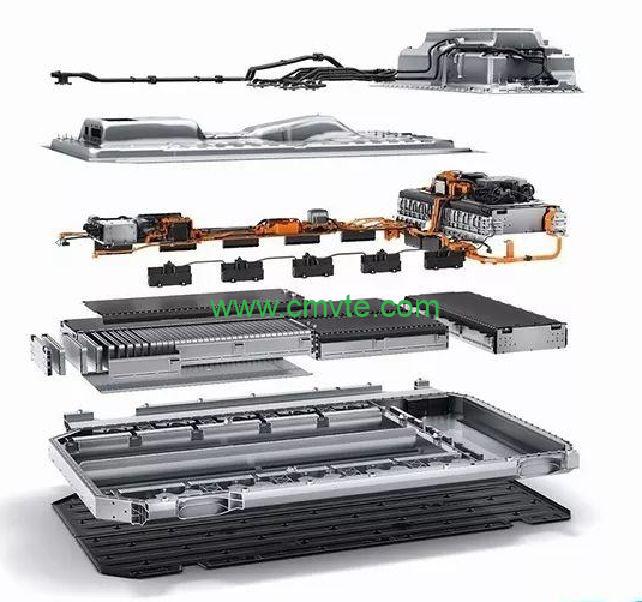
Battery Safety & Thermal Management
Battery safety is the single most scrutinised aspect of any EV conversion inspection. Requirements include:
- Liquid cooling for packs exceeding 40 kWh capacity
- BMS that monitors cell voltage, temperature, and state of charge
- Thermal runaway resistance testing per GB/T 18386 or equivalent
- Battery enclosure sealed against water ingress (IP67 minimum for under-vehicle mounting)
CMVTE battery packs include all of these features as standard. Our LFP cells are rated for 3,000+ cycles with active BMS balancing. Every pack is assembled in our Foshan factory and tested for insulation resistance, short circuit protection, and thermal performance before shipment.
Documentation: What You Need for Inspection
Regulators do not just inspect the hardware — they review the paperwork. A compliant conversion requires:
- Component certificates for motor, controller, battery, and BMS
- Wiring diagram showing all high-voltage and low-voltage circuits
- Emergency response guide for first responders
- Build photos documenting the installation process
- Engineer's certification (required in UK, EU, Australia, NZ)
CMVTE provides every document in this list with each kit. Our customers submit them directly to their local inspection authority or provide them to their certifying engineer. We have supported successful registrations in the US, UK, Canada, Australia, New Zealand, South Africa, and across Europe.
Common Compliance Mistakes
DIY builders often fail compliance inspections for predictable reasons: using non-certified battery cells, skipping the equipotential bonding connection between the motor housing and chassis, running high-voltage cables without proper orange jacketing or conduit, or failing to install a master disconnect switch that is accessible from the driver's seat. Each of these mistakes can be avoided by using a complete CMVTE kit that arrives with correct components and clear documentation.
A US Parts Retailer Kit often sources the motor from one supplier, the controller from another, and the battery from a third. When one component lacks certification, your entire build fails inspection. CMVTE's single-source approach guarantees that every component in your kit meets the required standards because they are designed, tested, and shipped together.
Build Compliant from Day One
Compliance is not something you add after the build — it must be designed in from the start. Choosing components that meet international safety standards, wiring to code, and documenting every step are what separate a road-legal EV from a garage project that never sees the street.
Get Components with Full Compliance Docs →
Tell us your vehicle and target market — we will recommend a CMVTE kit that meets your local regulations

