

Why the Miata's Braking System Changes After EV Conversion
The Mazda MX-5 Miata is one of the lightest platforms for an EV conversion at around 1000 kg curb weight. That lightness is why it handles so well — but after conversion, you add 200–300 kg of batteries. The stopping distance increases, and the brake system must compensate.
Three critical things change when you convert a Miata to electric:
- Engine vacuum disappears — the brake booster loses its power source
- Weight increases — more mass to stop, especially at the rear if batteries are mounted there
- Regenerative braking — the motor becomes a generator, slowing the car and recovering energy
A well-planned braking system preserves the Miata's responsive pedal feel while keeping you safe at higher weights.
Regenerative Braking: Your New Primary Brake
When you lift off the accelerator in an EV, the motor reverses into a generator. The resistance of generating electricity naturally slows the car. This is regenerative braking.
In a Miata conversion, regen can handle 70–80% of daily braking — stopping, slowing for corners, descending hills. Your physical brakes only engage for the last few mph or emergency stops.
| Benefit | Impact on Miata Conversion |
|---|---|
| Range recovery | Recovers 10–20% of energy in city driving |
| Pad/rotor life | Brake pads last 3–4× longer |
| One-pedal driving | Full stop without touching the brake pedal |
| Reduced brake fade | Physical brakes stay cooler, perform better on track |
Solving the Vacuum Problem in a Miata
The Miata's original brake booster relies on engine intake vacuum. Without an engine, you need an alternative. Two options:
Option 1: Electric Vacuum Pump (Recommended)
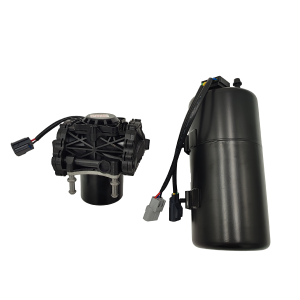
The GMT 12V Electronic Vacuum Pump is the simplest solution. The Miata's engine bay has limited space, but the pump is compact enough to mount on the firewall or inner fender. Key specs for Miata:
- 12V DC — powered by your auxiliary battery or DC-DC converter
- Maintains 18–22 inHg — matches the Miata's factory brake booster requirement
- Includes pressure sensor and relay for automatic cycling
- 1–1.5L reservoir provides 2–3 emergency stops if power fails
Mount the pump on rubber isolation bushings to reduce noise transmission into the cabin — especially important in a roadster with no engine noise to mask it.
Option 2: Electronic Brake Booster (iBooster)
Replaces the vacuum booster entirely. More expensive and requires CAN bus integration, but offers seamless regen blending. Best for high-budget track builds.
Hydraulic Brake Upgrades for the Heavier EV Miata
Your Miata will gain 200–300 kg after conversion. The stock brakes may still be adequate for street driving, but consider these upgrades:
| Upgrade | Why for EV Miata | Recommendation |
|---|---|---|
| Performance brake pads | Extra weight increases heat; better pads resist fade | Hawk HP+ or equivalent for street/track |
| Braided stainless lines | Firmer pedal feel; compensates for extra weight | Recommended for all EV conversions |
| Larger rotors (NB/NC swap) | More thermal capacity for repeated stops | Optional for street; recommended for track |
| Proportioning valve adjustment | Battery weight shifts balance; adjust bias | Must do after conversion |
Note: Because regen handles most slowing, your pads and rotors will wear much slower than in a gasoline Miata.
Brake System Layout for Miata EV Conversion
Brake Pedal → Master Cylinder → Proportioning Valve → Front Calipers
                                        ↓
              Vacuum Booster ← Electric Vacuum Pump ← Reservoir
                                        ↓
                              Pressure Sensor → ECU (pump ON/OFF)
The vacuum pump runs automatically when pressure drops below ~18 inHg. The system is independent of the motor controller — it only needs 12V power and a pressure signal.
FAQ
Can I keep my Miata's original brake booster?
Yes. The vacuum pump approach is designed to work with your factory Miata booster and master cylinder. No major modifications needed.
Where do I mount the vacuum pump in the Miata's tight engine bay?
Common locations: passenger-side firewall, inner fender well, or under the cowl panel. Use rubber isolation mounts to reduce noise.
Does regeneration work with all motor controllers?
Most PMSM and AC induction motor controllers support regen. Check your controller specifications — if it supports regen, you can adjust the regen strength to your preference.
Do I need bigger brakes for a track-day EV Miata?
Yes, if you plan track use. The added battery weight increases thermal load. Upgrade to NB Sport or NC rotors and use track-rated pads. The vacuum pump should remain the same — the booster only needs 18–22 inHg regardless of brake size.
Will the ABS still work after conversion?
If your Miata has ABS, it will still function as long as the wheel speed sensors are intact and the ECU receives power. The ABS module is independent of the engine vacuum system.
Build Your Miata Braking System
Browse CMVTE's Braking Systems collection for vacuum pumps and components for your Miata EV conversion.
Not sure which vacuum pump fits your Miata? Tell us your year, motor controller model, and battery pack weight — we will confirm compatibility.
View Braking Components Contact Support
Related Miata conversion guides:

