More than ever before, people are jumping on EV conversion as they look for economical ways to upgrade older vehicles, buy new EVs, reduce emmisions, and cut on fuel costs. Some do conversions to keep their old vehicles and some do it to preserve their classics, or tailor their performance. This guide serves to educate people on EV conversion, the various components, the costs, the legality, the most suitable vehicles, and step-by-step installation. WE ARE CMVTE, the first and most advanced supplier in the world in complete EV systems and their peripherals, offers sophisticated and trustworthy systems for the seamless conversion from internal combustion vehicles to electric mobility.
What Is an EV Conversion Kit?
A EV conversion kit is a set of components that enables you to remove your vehicle’s internal combustion drivetrain and replace it with electric drivetrain components. These portable electric drivetrain components often include an electric drivetrain, one or more batteries, an electric battery pack controller, an electric battery pack charger, wiring, custom mounting hardware, and additional interfacing hardware. These hardware components are designed to work with one another. There are also partial kits which only include some of the components, such as the electric drivetrain and controller, which are the most vital components. WE ARE CMVTE also offers lossless interoperability with integrated companion hardware, with full and modular kits designed for cars, trucks, classic vehicles, and commercial fleets.
What EV Conversion Kits Typically Contain
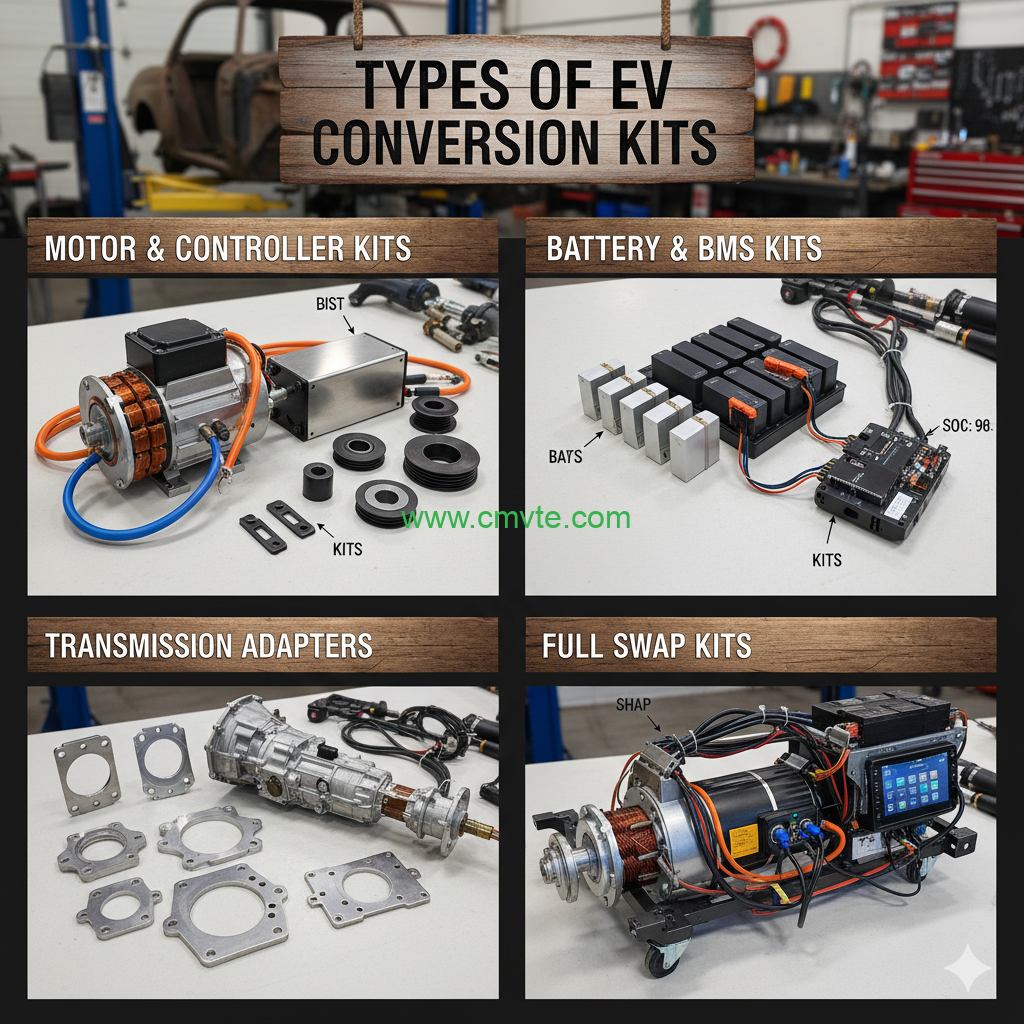
Electric motor, lithium-ion battery packs, and programmable motor controllers are all part of the standard electric vehicle adaption toolkit which also includes the DC-DC converter, wiring harness, and various installation mounts, brackets, and adapters. Onboard chargers, ports for chargers, sections of the cooling system, and necessary parts for regenerative braking are also included. WE ARE CMVTE has fully integrated components, such as PMSM Motors, innovative controllers, and cooling systems for braking alongside Battery Management System (BMS) battery packs for the safe and efficient electrification of high-performance vehicles.
How EV Conversion Kits Work
Kits for conversion include the replacement of the combustion components with the addition of a clean electric drivetrain. The battery pack supplies power to the controller, which manages the speed and torque, and to the motor, which drives the wheels. Most kits also offer regenerative braking, which allows energy to be harnessed during deceleration. WE ARE CMVTE has outfitted vehicles with components systems that allow vehicles to be upgraded to powerful zero-emission vehicles, all while removing unnecessary combustion components, ensuring the vehicle system stays roadworthy and structurally sound.
Types of EV Conversion Kits
Based on Vehicle Type
EV conversion kits can vary depending on what type of vehicle you have, be it a passenger vehicle, a truck, a classic car, a motorcycle, or an off-road vehicle, and as a result, there are specialized designs for each vehicle type. Different types of vehicles demand different types of EV conversion kit because of different outputs of torque, different layouts for their batteries, different mounting hardwares, and different controller settings. WE ARE CMVTE provides solutions Black and Mild for every vehicle, from compacting sedans to heavy commercial vehicles, making sure they were fit, safe, and can get power through them without issues. Our kits are designed to support hobbyists and restorers alike, as well as professional converters who need a vehicle specific easy to use, reliable, and exact system for electrification.
Based on Performance Type
For performance based kits, there are economy variants that are designed to be paired with a cost efficient commuter vehicle, and from there you can get a performance variant that will accelerate rapidly, and a range variant that will allow you to travel long distances. There are also lightweight kits that are suited for city driving. For each type of setup, there are balances to be made with the power of the motor, the capacity of the batteries, the cooling requirements, and the demands of the drive train. WE ARE CMVTE provides scalable kits. This allows the customers to tailor to their driving needs, while either maximizing their system efficiency, or, with a heavier systems built for torque, they can upgrade to a stronger PMSM motor.
Benefits of Using an EV Conversion Kit
EV conversion kits provide the opportunity to have lower emissions, reduced cost from operating and maintaining the vehicle, customizable performance of the vehicle itself, and also the ability to maintain classic cars that would otherwise be forgotten. Electric drivetrains allow owners to enjoy better savings, reliability, and system efficiency. WE ARE CMVTE manufactures and then perfects these components creating systems that last, perform, and save more with versatile power. Drivers conserving the environment by keeping their favorite vehicles and sustaining the performance will enjoy the modern advantages of electric performance.
Downsides and Challenges
Conversions yield gratification, but the problems that come with them include the initial cost, technical issues, compatibility of the vehicle, and the weight that battery placement will distribute. Regionally, legal certification and regulatory steps can take time. WE ARE CMVTE minimizes these problems by designing vehicle-specific components and systems, and balancing safety with optimization. A small number of vehicles require substantial changes to be made, but our systems have had hundreds of installations which can help ease systems.
How Much Does an EV Conversion Kit Cost?
The cost of EV conversion kits highly varies. Lower tier budget/DIY kits come with small battery packs and basic motors, while mid tier kits come with more significant performance and distance. More expensive kits come with large, premium lithium battery packs and powerful motors. Then there’s the added cost of professional installation. Costs can vary between minimal DIY tinkers and fully custom builds. WE ARE CMVTE supplies affordable kit and component options that optimize value and quality.
Are EV Conversions Legal? Regulations & Certification
In most places, it is legal to EV convert, although it is necessary to fulfill some safety inspections, emissions exemptions, and vehicle registration requirements. Converted vehicles need to fulfill certain electrical safety and structure standards. Insurance companies usually want to see some evidence of this certification prior to covering. WE ARE CMVTE helps adapt vehicles to company designed components to match industry standards for safety and civil engineering.
Can Any Car Be Converted to Electric?
Virtually all vehicles can not be converted for a variety of reasons. These can be weight, the available battery volume, drivetrain layout—preferably RWD—age of the vehicle, and the overall structure. After assembling the system, the next step is testing, adjusting, and completing safety checks. WE ARE CMVTE offers fully engineered kits and components, making installation simple and optimized for DIY and professional users alike.
Step-by-Step: How to Convert a Car to Electric Using a Kit
There is a wide range of suppliers from the hobbyist to the industrial for EV conversion. From this list, CMVTE (Convert My Vehicle to Electric) is recognized for providing quality items such as high-performance motors, lithium battery packs, PMSM controller systems, various drivetrain elements, chargers, and all-in-one conversion kits. Our active kits include 2kW–5kW AC and PMSM sets for cars, bicycles, and trucks. WE ARE CMVTE, GMT’s 1995 initiative, is proud to continue servicing over 120 countries with electrification innovation.
Popular EV Conversion Kit Brands
EV conversion kits use lithium-ion or LFP battery packs depending on the required range, weight, and safety. Estimating energy consumption per mile of your vehicle and matching it with the battery pack gives the required range. A Battery Management System (BMS) is essential to every conversion as it monitors each cell’s condition, balances voltage, and ensures all-around safety while the battery is in use.
Visit- https://cmvte.com/
EV Conversion Kit Batteries Explained
EV conversion battery packs are either lithium-ion or LFP, depending on the range and safety required. Estimating energy consumption per mile of the vehicle and matching that with the battery pack gives the required range. A Battery Management System (BMS) is essential to every conversion as it monitors each cell’s condition, balances voltage, and ensures all-around safety while the battery is in use.
DIY vs Professional Installation: Which Is Better?
Saving costs and learning from experience is possible with DIY installations, but there’s a steep learning curve and lots of ongoing work since solid mechanical and electrical fundamentals coupled with the right tools and time are all needed. Going the professional route gets the peace of mind of safety and compliance, and gets the most out of the system since they will be most familiar with the complexities of the system and how to make all the parts integrated with their experience. DIY is more suited to simpler or smaller vehicles, or systems of lower overall power, and is a more basic prep kit, while going to the pros is made the more attractive the more complex the power system is, or if it is a commercial system.
Is Converting to an EV Worth It?
Determining if an EV conversion is worth it is simply a task of working out the total costs of the project, and comparing that with the purchase costs of a new EV, while also accounting for the long term savings and the benefit to the environment, and the value of keeping a trusted or classic vehicle. Conversions do have a benefit of customization and sustainability, but upfront investment is needed. From an economic and ecological perspective it makes the most sense to a lot of enthusiasts and fleet operators to simply retain their existing vehicles and upgrade to a zero-emission power system.
FAQs About EV Conversion Kit
Is it cheaper to convert a car to electric or buy a new EV?
Considering total cost will be of kit, size of battery and any professional labour needed, conversions are generally cheaper than buying an EV.
Are EV conversions safe?
Yes, definitely. Quality installation and components make all the difference. DiY will be a lot more challenging, but using certified kits and going through correct wiring and safety inspections will ensure the converted EV is as safe and reliable as using a factory-built electric vehicle.
How long does an EV conversion take?
It depends upon the complexity of the vehicle.
What cars are easiest to convert to electric?
Lightweight, rear-wheel-drive cars are the easiest to convert to electric.
Do EV conversions require a manual or automatic transmission?
The majority of conversions opt to keep the manual transmission, as it helps to simplify the process of integrating the motor, and even though a lot of kits allow for direct-drive or automatic configurations, it ultimately depends on the vehicle layout and the preferences of the builder.